 Globe Quest
 Human Quest · LearningSign in
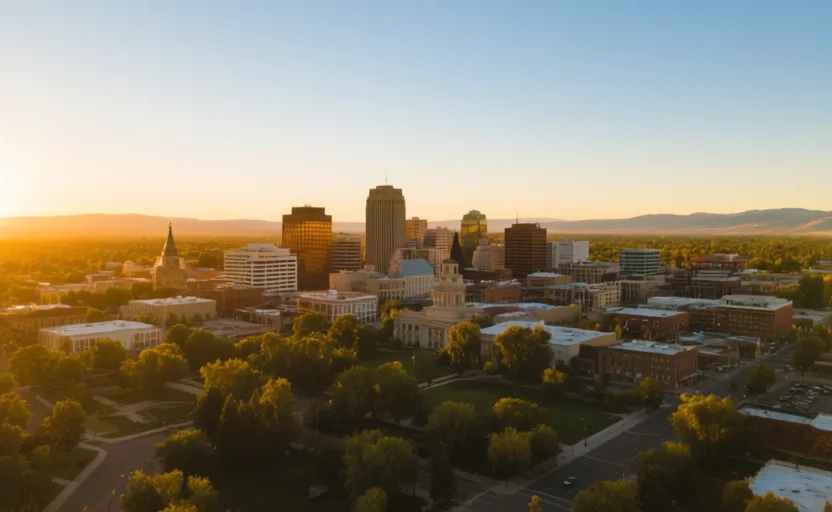 Boise · AI city illustration · Artistic impression
City · North America
Boise
Saved in this browser — no account needed. Sign in later and it comes with you.
Where it is
Boise is a river oasis in high desert. It stands on the Boise River in the Treasure Valley of south-western Idaho, 2,704 feet above sea level, about 41 miles east of the Oregon line and 110 miles north of Nevada. The surrounding country is semi-arid, with hot dry summers that reach 100 °F on about nine days in a typical year, but cottonwoods line the river and irrigation canals have turned the valley floor green. The metropolitan area spreads over a wide plain that slopes down to the west, with the Boise Foothills rising immediately north of downtown.
The land and water around it
The Boise Riverriver
A tree-lined stream through a dry plain. Its trees gave the place its name, whether from trappers calling it the wooded river or from a guide shouting “les bois” when an army party saw it. The river now feeds irrigation canals, a greenbelt trail and rafting.
The Treasure Valleyvalley
The broad basin of the lower Boise River, where Idaho's largest metropolitan area lies. Irrigation works turned it into an important farming region in the early 20th century.
The Boise Foothillsmountains
The hills just north of downtown carry the Hull's Gulch trails. Farther north the road to Bogus Basin, 16 miles away, climbs 3,400 feet through sagebrush and forest to a ski area that opened in 1942.
Its history, in short
The valley was a winter and trading ground for Northern Shoshone and Bannock people when fur trappers, French Canadians working for the Hudson's Bay Company among them, began setting traps along the river in the 1820s. The Oregon Trail passed through from the 1840s, and as settler traffic grew so did friction with the people whose game and land it crossed. Gold discoveries in the Boise Basin and at the Owyhee mines in the 1860s brought the army: Fort Boise was founded in 1863, at the junction of the trail and the road between the two mining districts, and Idaho Territory was created the same year. The town lived by supplying the mines and by irrigated farming, with three canal companies by 1864. In the early 20th century the federal Boise Project dammed the river; Arrowrock Dam, finished in 1915, was the tallest in the world when completed. The railway depot of 1925 served passengers until 1997, and today the state capital is a base for technology and manufacturing firms and food companies, with one of the largest Basque communities in the country.
Timeline
Dates are shown on a timeline rather than as changing shapes on the map. The globe draws modern boundaries only, and tinting a modern outline to stand for a historical one would state something we cannot source.
Industrial & imperial
1811
The Hunt expedition
An overland party of about 60 men led by Wilson Hunt for John Jacob Astor's fur company passes through the valley on the way to the Columbia, the first recorded entry of a white American into the region.
Well attestedWikipedia1840s
The Oregon Trail
Settlers on their way to Oregon cross Shoshone and Bannock territory in growing numbers after the Oregon Treaty and the California gold rush, increasing tension with the Indigenous bands along the trail.
Approximate dateWikipedia1863
Fort Boise and Idaho Territory
Gold discoveries around the valley and continuing fighting lead the army to build a new Fort Boise where the city now stands. The United States creates Idaho Territory the same year.
Well attestedWikipedia1864
A mining-supply town
A territorial count lists 1,658 people. Farming on irrigated land near the river is under way, and three canal companies have been incorporated.
Well attestedWikipedia1911–1915
Arrowrock Dam
The dam, the main storage structure of the federal Boise Project, is built and is the tallest in the world when completed.
Well attestedWikipedia
Contemporary
1955
The lavender scare
Police interrogate hundreds of residents and arrest sixteen men in a panic over an alleged “homosexual ring”, including prominent citizens.
Well attestedWikipedia2020
A city of 235,685
The census counts 235,685 people in the city, with a metropolitan area of about 846,000 in five counties.
Well attestedWikipedia
Places that carry meaning
The Basque Block20th century onward
A downtown section celebrating the Basque community, one of the largest in the United States. A festival called Jaialdi is held every five years, with the next in 2030.
Bonneville Point19th century
A viewpoint beside the Oregon Trail, east of town. By one account, an exploring party looking down on the green Boise River valley after weeks of dry country shouted a name that stuck.
Local tradition, which attributes the name to Captain Bonneville's French-speaking guide; the name may instead come from French Canadian trappers of the 1820s
Anne Frank Human Rights Memorialpresent
The only human rights memorial of its kind in the United States, next to the city's main library.
Languages here
Places are usually multilingual. This lists what is actually spoken, not one language per border.
EnglishGermanic family
The language of daily life and public business.
Nationally about 77 percent of people speak only English at home. The city's name comes from French, and locals pronounce it “BOY-see”, a pronunciation that works as a shibboleth against outsiders who say “BOY-zee”.
BasqueLanguage isolate family
The heritage language of one of the largest Basque communities in the United States.
Idaho's Basque community numbered nearly 7,000 in 2000, many of them in Boise, and keeps its identity alive through the Basque Block and the Jaialdi festival. Boise is a sister region of Basque communities.
SpanishRomance family
The most common language other than English.
Hispanic or Latino residents were 9.03 percent of the city in 2020, up from 7.1 percent in 2010.
Learn the language here
- 1Understand which languages are spoken hereBoise is multilingual. Start with which languages are used, by whom, and for what — the phrase list only covers one of them.Written by Globe Quest
- 2Learn 12 phrasesCurated everyday phrases for Boise, with audio and a written form.Written by Globe Quest
- 3Say them out loudSpeaking practice with pronunciation feedback, one phrase at a time.Globe Quest material, your own additions
- 4Come back to themSpaced review, so what you learned this week is still there next month.Written by Globe Quest
Check yourself
Why does Boise's name refer to trees?
A green river valley of cottonwoods stood out in dry high desert
Whichever story of the name is true, both describe the wooded Boise River as a landmark in dry country.
Why was Fort Boise built where the city now stands in 1863?
It lay near the junction of the Oregon Trail and a road linking two mining districts
The army chose the place near where the Oregon Trail met the road between the Boise Basin and Owyhee mining areas, both then booming.
Worth arguing about
- Boise began as a place to supply miners and was then rebuilt around irrigation and later semiconductors. What turned each boom into a lasting city rather than a ghost town?
- The Basque Block celebrates a minority community that built a presence in a small city far from its homeland. What keeps a heritage language alive across generations?
What we have not established
These are open questions, listed rather than filled in. We would rather show a gap than a plausible guess.
Where does the name Boise come from?
One account credits the exclamation of a French-speaking guide with an army party led by Captain Bonneville, while another credits French Canadian trappers who called the river “la rivière boisée” in the 1820s. No document settles which came first.
Sources
- Wikipedia · Boise, IdahoWikipedia · encyclopedia · checked 2026-11-24
- Wikipedia · Languages of the United StatesWikipedia · encyclopedia · checked 2026-11-24
Reviewed by Globe Quest editorial on 2026-11-24. Drafted with AI assistance and checked against the sources above before publication.