 Globe Quest
 Human Quest · LearningSign in
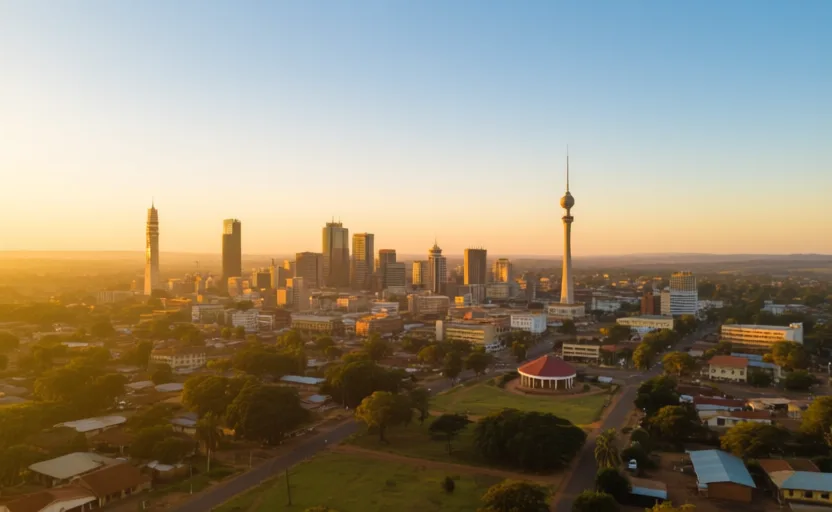 Chitungwiza · AI city illustration · Artistic impression
City · Africa
Chitungwiza
Saved in this browser — no account needed. Sign in later and it comes with you.
Where it is
Chitungwiza is a dormitory city on the southern edge of Harare, a few kilometres from the capital on the same high plateau. It has no old centre and no river or harbour that explains it. It exists because of Harare, and two main roads, Seke Road and Chitungwiza Road, tie the two together. It is one of the municipalities, with Epworth and Ruwa, that sit inside Harare Metropolitan Province but outside the city’s own boundary.
The land and water around it
The edge of Harareplain
The town lies on the outskirts of the capital, so it shares the land and climate of the Zimbabwean Highveld around Harare.
The Seke and Chitungwiza road corridorsplain
Two highways connect the town to Harare, and the daily journey along them is what defines its relationship with the capital.
Its history, in short
The records for this town are thin. What is documented is its growth and the forced removals that shaped it. After the civil war that ended in 1980, rural people poured into the area looking for work, and the squatted settlement of Chirambahuyo alone held about 30,000 people in 1979. The authorities demolished Chirambahuyo in 1982, and its inhabitants squatted elsewhere in the town, in areas such as Mayambara. A 1995 aquatic complex was built here for the All-Africa Games, though it has since stopped working as a pool and become a music and church venue. In May 2005 Operation Murambatsvina destroyed slum areas. By the mid-2010s the number of squatters in informal settlements was growing again, and in 2020 the local authorities dropped their demolition plans for four areas, Nyatsime, Seke, St Mary’s and Zengeza, once a judge was asked to rule. The 2022 census counted 371,244 people, making it the third biggest urban centre in Zimbabwe.
Timeline
Dates are shown on a timeline rather than as changing shapes on the map. The globe draws modern boundaries only, and tinting a modern outline to stand for a historical one would state something we cannot source.
Contemporary
1979
Chirambahuyo’s squatters
The squatted area of Chirambahuyo alone holds about 30,000 people, part of a wave of migration to the city edge after the civil war.
Approximate dateWikipedia1982
Chirambahuyo demolished
The authorities pull down the settlement, and its inhabitants squat in other parts of the town such as Mayambara.
Well attestedWikipedia1995
The aquatic complex
A swimming complex is built for the All-Africa Games, a sign of public investment in the town in that decade.
Well attestedWikipedia2005
Operation Murambatsvina
Slum areas in Chitungwiza are destroyed during the government’s nationwide clearance of informal housing and vending sites.
Well attestedWikipedia2020
Demolitions dropped
The councils give up their plans to pull down squatter houses in four areas, Nyatsime, Seke, St Mary’s and Zengeza, once a court order is sought.
Well attestedWikipedia
Places that carry meaning
Chirambahuyo1979–1982
A large squatter settlement that was demolished in 1982, whose people moved to other parts of the town. It marks how the town’s population grew faster than planned housing.
The former aquatic complex1995 onward
Built for the All-Africa Games and no longer used as a pool, it now serves as a venue for music and churches.
Languages here
Places are usually multilingual. This lists what is actually spoken, not one language per border.
ShonaBantu family
The main language of the Harare area, which includes Chitungwiza.
Shona is spoken by roughly three quarters of Zimbabweans and is the main indigenous language around the capital. It has dialects including Karanga, Korekore, Manyika, Zezuru and Ndau, and the standard form draws chiefly on Karanga and Zezuru.
NdebeleBantu family
The second main indigenous language of Zimbabwe, whose home is Matabeleland.
Northern Ndebele is an Nguni language closely related to Zulu, which developed in Zimbabwe after Zulu-speaking migrants arrived in the 19th century.
EnglishGermanic family
The lingua franca, used in government, business and schools.
Most white Zimbabweans grew up speaking English, and most black Zimbabweans learn it as a second language. It was the sole official language through the colonial and Rhodesian periods.
Other official languages
Fourteen more languages share official status.
The 2013 Constitution lists 16 official languages, including Chewa, Kalanga, Nambya, Ndau, Shangani, Tonga, Tswana, Venda and Xhosa, as well as sign language. Zimbabwe has never run a census that counted people by language, so the shares in any one town are unknown.
Learn the language here
- 1Understand which languages are spoken hereChitungwiza is multilingual. Start with which languages are used, by whom, and for what — the phrase list only covers one of them.Written by Globe Quest
- 2Learn 12 phrasesCurated everyday phrases for Chitungwiza, with audio and a written form.Written by Globe Quest
- 3Say them out loudSpeaking practice with pronunciation feedback, one phrase at a time.Globe Quest material, your own additions
- 4Come back to themSpaced review, so what you learned this week is still there next month.Written by Globe Quest
Check yourself
How many people did the 2022 census count in Chitungwiza?
About 371,000
The 2022 census counted 371,244 people, which makes the town the third biggest urban centre in Zimbabwe after Harare and Bulawayo.
What happened to Chirambahuyo in 1982?
The authorities demolished it, and residents squatted elsewhere in town
Demolition of the squatted settlement, which held about 30,000 people three years earlier, pushed its people into other areas of the town.
Worth arguing about
- Chitungwiza is a town that grew because of a neighbouring capital. What does a city owe the people who live in its dormitory suburbs?
- Informal settlements here have been demolished and later spared by court order. Who gets to decide whether a settlement stays?
What we have not established
These are open questions, listed rather than filled in. We would rather show a gap than a plausible guess.
When and how was Chitungwiza founded as a town?
Neither the available sources nor the national histories give a founding date or the origin of the name, so the entry starts from the post-war migration that is documented.
Sources
- Wikipedia · ChitungwizaWikipedia · encyclopedia · checked 2026-11-24
- Wikipedia · ZimbabweWikipedia · encyclopedia · checked 2026-11-24
- Wikipedia · Languages of ZimbabweWikipedia · encyclopedia · checked 2026-11-24
Reviewed by Globe Quest editorial on 2026-11-24. Drafted with AI assistance and checked against the sources above before publication.