 Globe Quest
 Human Quest · LearningSign in
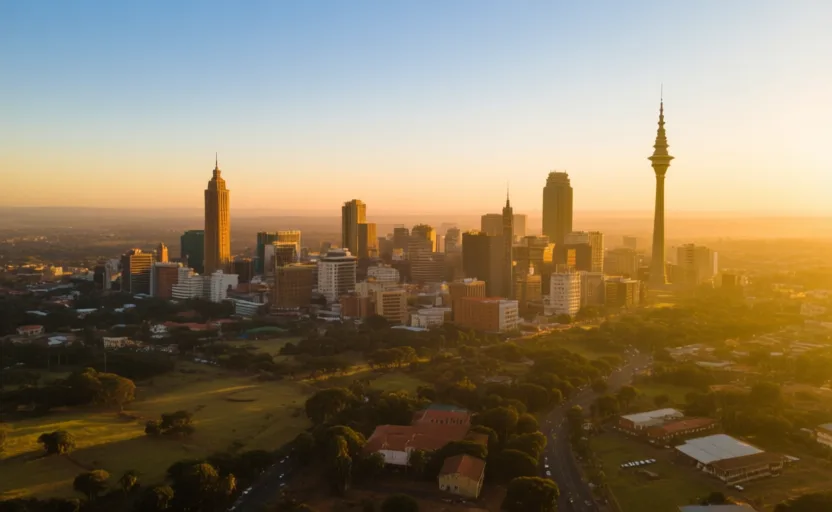 Johannesburg · AI city illustration · Artistic impression
City · Africa
Johannesburg
Also known as Egoli, Joburg
Saved in this browser — no account needed. Sign in later and it comes with you.
Where it is
Johannesburg has no river, lake or harbour to explain it. It stands at about 1,753 m on the Highveld, along the Witwatersrand, a ridge whose name means “white waters”, and the ridge itself is a major watershed: streams to the north run toward the Limpopo, those to the south toward the Vaal and so the Orange. The old springs behind many early farm names, such as Braamfontein and Doornfontein, have been canalised or built over. Summer brings hot days and afternoon thunderstorms, winter dry sun and cold nights with frost, and snow is rare enough that each fall is recorded. The reason for the city is underground.
The land and water around it
The Witwatersrand ridgeridge
The old central business district lies on the southern side of a prominent ridge, and the ground falls away to the north and south. The ridge is the watershed between the Limpopo and Vaal river systems, and the gold-bearing reef the city was built on runs along it.
The Highveldplateau
The city occupies the eastern part of the high interior plateau of South Africa. The altitude keeps the climate mild, with a subtropical highland climate: January highs average around 25.6 °C and June highs about 16 °C, and the UV index is extreme in summer.
The buried springsriver
Johannesburg stands at the head of two great river systems without lying on either. Small streams, the Jukskei to the north and the Klip to the south, begin from springs that have mostly been paved over, which is why so many early farm names end in “fontein”, the Afrikaans word for spring.
Its history, in short
The ground here was home to San hunter-gatherers and then to Sotho–Tswana communities, who left stone-walled towns and iron-smelting furnaces across the region. The modern city began after Jan Bantjes found the main Witwatersrand reef in June 1884 and George Harrison an outcrop at Langlaagte in 1886. The settlement was laid out on a wedge of ground left over between surveyed farms, and within ten years it held about 100,000 people. Tensions between the Transvaal government in Pretoria and the foreign miners, the Uitlanders, led to the failed Jameson Raid of 1896, and British forces occupied the city on 30 May 1900. Johannesburg stayed segregated by class and race from the start. Under apartheid the government built the vast township of Soweto in the 1950s and 1960s, mine workers were brought from across southern Africa and the white suburbs spread northward along new freeways. Since 1994 the apartheid-era city and its surrounding townships have been joined under one municipality, but the pattern of settlement is hard to undo, and recent years have brought failing infrastructure and building fires such as the one in Hillbrow in 2023.
Timeline
Dates are shown on a timeline rather than as changing shapes on the map. The globe draws modern boundaries only, and tinting a modern outline to stand for a historical one would state something we cannot source.
Industrial & imperial
June 1884
Gold on the Witwatersrand
Jan Gerritse Bantjes finds the main reef on the farm Vogelstruisfontein. The Struben brothers find the Confidence Reef near today’s Roodepoort a few months later, and the rush begins.
Well attestedWikipedia1886
A town is founded
Gold is found at Langlaagte, the government declares nearby farms public diggings, and the town is laid out as 600 stands on a triangle of ground between farms. Stands are first auctioned on 8 December 1886.
January 1896
The Jameson Raid
Rising tension between the Boer-led Transvaal government and British interests, over the control of land and the mining industry, ends in the failed raid at Doornkop.
Well attestedWikipedia30 May 1900
British occupation
During the Second Boer War, forces under Lord Roberts take the city after battles to its south-west.
Well attestedWikipedia1917
Anglo American
The Anglo American Corporation, founded by Ernest Oppenheimer, makes Johannesburg its headquarters. It grows into a company dominating South African gold and diamond mining.
Well attestedWikipedia
Contemporary
1976
The Soweto Uprising
Peaceful student protests in Soweto are met with brutal force, making the township the centre of the uprising against apartheid.
Well attestedWikipediac. 2000
One metropolitan municipality
The end of apartheid brings the administrative unification of the former white city with surrounding townships and settlements. The date is recorded as 2000 in one account and 2002 in another.
31 August 2023
The Hillbrow fire
A hijacked building burns in the inner city and at least 76 people die. In March 2025 President Cyril Ramaphosa launches a rescue plan for what he calls the city’s rapidly declining infrastructure.
Well attestedWikipedia
Places that carry meaning
Sowetofrom the 1950s
Short for South-Western Townships, built by the apartheid government and designated for black residents only until 1994. It was home to leaders such as Nelson Mandela and Desmond Tutu and the centre of the 1976 uprising.
Hillbrowfrom the late 1940s
A district that went high-rise in the late 1940s and early 1950s. In recent years abandoned buildings there have been taken over by gangs.
Melville Koppies13th century onward
A site inside the city containing an iron-smelting furnace, evidence that Sotho–Tswana communities were already exploiting the area’s minerals before Europeans came or gold was found.
Sandton20th century
A formerly white-only suburb called “Africa’s richest square-mile”, standing against the townships that apartheid placed far from the centre.
Languages here
Places are usually multilingual. This lists what is actually spoken, not one language per border.
Nguni languagesBantu family
The home languages of about a third of residents.
About 32% of residents speak Nguni languages at home, chiefly Zulu and Xhosa, the two most common first languages in South Africa as a whole.
Sotho languagesBantu family
The home languages of about a quarter of residents.
Around 24% speak Sotho languages such as Southern Sotho, Pedi and Tswana, which are native to the Highveld, and a further 6% speak Tshivenda.
EnglishGermanic family
Spoken at home by about 18% and widely used in business.
English is the home language of the Indo-South Africans who make up much of Lenasia, and the language of business in a city that also hosts the continent’s largest stock exchange.
AfrikaansGermanic family
Spoken at home by about 7% of residents.
The language of the Boer republic’s officials and of the many impoverished Afrikaners who were part of the early rush.
Learn the language here
- 1Understand which languages are spoken hereJohannesburg is multilingual. Start with which languages are used, by whom, and for what — the phrase list only covers one of them.Written by Globe Quest
- 2Learn 11 phrasesCurated everyday phrases for Johannesburg, with audio and a written form.Written by Globe Quest
- 3Say them out loudSpeaking practice with pronunciation feedback, one phrase at a time.Globe Quest material, your own additions
- 4Come back to themSpaced review, so what you learned this week is still there next month.Written by Globe Quest
Check yourself
What is unusual about the site of Johannesburg?
It stands on a ridge that divides two river systems, with no major river of its own
The Witwatersrand is a watershed between the Limpopo and Vaal basins. The city has no big river or harbour, and its streams begin as springs that have been built over.
What caused the founding of Johannesburg in 1886?
The discovery of gold on the Witwatersrand
The gold rush that followed the finds of 1884 and 1886 turned farmland into a city of about 100,000 people within ten years.
Worth arguing about
- A city founded entirely for gold that now lives mainly on finance and services. What does Johannesburg owe to the mines, and what is left once they are gone?
- The spatial legacy of apartheid has proved hard to undo, and it is still counted among the most unequal cities anywhere. Can a city be redesigned, or only governed better?
What we have not established
These are open questions, listed rather than filled in. We would rather show a gap than a plausible guess.
How did Johannesburg get its name?
No record of the choice survives. Candidates include the officials Christiaan Johannes Joubert and Johannes Rissik, the first government official in the area, Johannes Meyer, and President Paul Kruger, so the origin remains disputed.
How many people live in Johannesburg?
The 2022 census counted about 4.8 million in the municipality, while the wider urban area is put between about 7.9 million and 15 million, depending on who defines the boundary.
Sources
- Wikipedia · JohannesburgWikipedia · encyclopedia · checked 2026-11-24
- Wikipedia · History of JohannesburgWikipedia · encyclopedia · checked 2026-11-24
- Wikipedia · South AfricaWikipedia · encyclopedia · checked 2026-11-24
Reviewed by Globe Quest editorial on 2026-11-24. Drafted with AI assistance and checked against the sources above before publication.