 Globe Quest
 Human Quest · LearningSign in
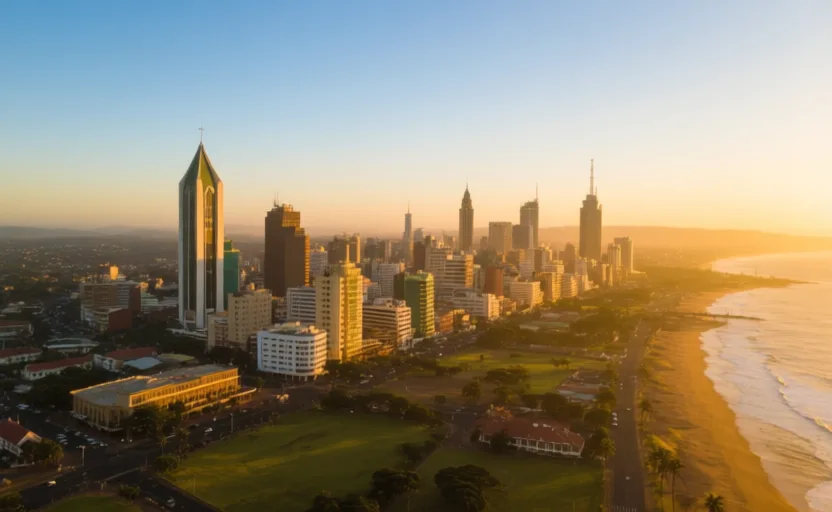 Durban · AI city illustration · Artistic impression
City · Africa
Durban
Saved in this browser — no account needed. Sign in later and it comes with you.
Where it is
Durban is built around a natural bay on South Africa’s Indian Ocean coast, which is what made it a port before it was a city. The flat centre lies beside the water, the ground climbs west to the hills of the Berea, the Bluff runs along the coast to the south, and the Umgeni River reaches the sea to the north. The climate is humid subtropical, with hot, wet summers, mild frost-free winters and about 1,009 mm of rain a year. The Zulu name, itheku, means a bay or lagoon.
The land and water around it
The Bay of Natalbay
A sheltered natural harbour, entered across a sandbar that crews in 1823 chose to risk while running from a storm. It became the busiest port in sub-Saharan Africa, and the shipping, sugar and industry around it explain why the city sits where it does.
The Umgeni Riverriver
The river reaches the sea north of the harbour and the city centre and marks part of the northern city limit, while other stretches run through the built-up area.
The Berea and the Bluffplain
The flat centre is boxed in by the Berea hills to the west and the Bluff along the southern coast. Beyond them the city has spread over hills and valleys into more than 120 former towns and suburbs.
Its history, in short
The harbour has been the reason for almost everything here. Hunter-gatherers lived in the region long before farming peoples moved in from the north, and the Zulu nation holds its own oral history of the land. Written records begin with Portuguese sailors who passed the coast at Christmas in 1497 and called it Natal. A Dutch ship was wrecked nearby in 1686, and in 1689 the Dutch Cape Colony bought the bay from the local Abambo people. The town itself dates from 1824, when British traders at Port Natal received land from the Zulu king Shaka, and it took the name D’Urban in 1835. Voortrekker and British rivalry led to a siege in 1842 and British annexation in 1843. From 1860 indentured labourers arrived from British India, and their descendants are now a large part of the city. Natal became a province of the new Union in 1910, and Durban gained city status in 1935. After apartheid ended it was merged into the much larger eThekwini municipality.
Timeline
Dates are shown on a timeline rather than as changing shapes on the map. The globe draws modern boundaries only, and tinting a modern outline to stand for a historical one would state something we cannot source.
Early modern & oceanic
Christmas 1497
Vasco da Gama names Natal
Sailing along the coast in search of a route to India, the Portuguese explorer calls the land Natal, the Portuguese word for Christmas. It is the first written account of the area.
Well attestedWikipedia1689
The Dutch buy the bay
After survivors of a wrecked Dutch ship were sheltered by the Abambo people, the Dutch Cape Colony bought the Bay of Natal from them for £1,650, with the shipwreck survivors translating the contract.
Well attestedWikipedia
Industrial & imperial
7 August 1824
Shaka grants land at Port Natal
Traders led by Francis Farewell and Henry Fynn set up a trading station, and Shaka grants Farewell’s company the harbour and a large tract of land. The modern city dates its founding from this settlement.
Well attestedWikipedia1835
Named for Benjamin D’Urban
At a meeting on 23 June 1835, 35 European residents agree to found a capital town and call it D’Urban, honouring the governor of the Cape Colony.
Well attestedWikipedia1842–1843
The siege and annexation
British troops establish a fortified camp in 1842 and are besieged by Voortrekkers after a failed attack. The trader Dick King and his servant Ndongeni ride to Grahamstown for help, and in 1843 Britain annexes the Republic of Natalia.
Well attestedWikipediaFrom 1860
Indentured labourers arrive from India
Labourers from British India begin to arrive, followed by later passenger migrants. Their descendants remain one of the city’s largest communities and have shaped its food, religion and trade.
Well attestedWikipedia1935
City status
Durban, a borough since 1854, is granted city status, twenty-five years after the colony of Natal joined the Union.
Well attestedWikipedia
Contemporary
1999
The eThekwini municipality
After the end of apartheid, the city is reorganised first as a unicity in 1996 and then as the eThekwini Metropolitan Municipality, which absorbs more than 120 formerly independent towns and suburbs.
Well attestedWikipedia
Places that carry meaning
Farewell Square and the old settlement1824 onward
The first trading station stood on the northern shore of the bay near today’s Farewell Square. The Old Fort was built nearby in 1842, when the British arrived to hold the harbour.
The port19th century to today
The Port of Durban handles more cargo than any other in South Africa and ranks fourth in the Southern Hemisphere. Sugar refining and manufacturing grew up around it.
Moses Mabhida Stadium and the Golden Mile20th and 21st centuries
The stadium was built for the 2010 FIFA World Cup, for which Durban was a host city. The beachfront promenade known as the Golden Mile draws mostly domestic visitors, a reminder that the warm climate is part of the city’s economy.
Languages here
Places are usually multilingual. This lists what is actually spoken, not one language per border.
ZuluBantu family
The language of the largest single ethnic group in the city.
Zulus are the biggest ethnic group in Durban, and Zulu is the most spoken first language in South Africa as a whole, at 24.4 per cent in the 2022 census. The Zulu name for the place, itheku, refers to the bay.
EnglishGermanic family
The language of the colonial port town and still a common shared language.
English came with the British traders and settlers from 1824 and became the language of administration and trade. People of British and Indian descent make up a large share of the population, and it is one of South Africa’s twelve official languages.
Learn the language here
- 1Understand which languages are spoken hereDurban is multilingual. Start with which languages are used, by whom, and for what — the phrase list only covers one of them.Written by Globe Quest
- 2Learn 11 phrasesCurated everyday phrases for Durban, with audio and a written form.Written by Globe Quest
- 3Say them out loudSpeaking practice with pronunciation feedback, one phrase at a time.Globe Quest material, your own additions
- 4Come back to themSpaced review, so what you learned this week is still there next month.Written by Globe Quest
Check yourself
After whom was Durban named in 1835?
Sir Benjamin D’Urban, governor of the Cape Colony
The 35 European residents who met in 1835 chose to honour the governor of the Cape Colony. Natal, the region’s name, comes from the Portuguese word for Christmas, which is how da Gama named the coast in 1497.
Why does Durban have a large population of Indian descent?
Indentured labourers were brought from British India from 1860
Labour migration under the British Empire moved people from India to Natal from the 1860s. The influence of that community on the city’s cuisine, culture and religion is still very visible.
Worth arguing about
- The Dutch bought the bay in 1689 and Shaka granted land in 1824. Did the people on each side understand the same transaction?
- Durban’s official limits were redrawn in 1999 to take in more than 120 towns. Is the city the old centre or the whole metropolitan area?
What we have not established
These are open questions, listed rather than filled in. We would rather show a gap than a plausible guess.
How many people live in Durban?
The city proper had 595,061 residents in 2011, while the eThekwini municipality, which absorbs more than 120 former towns, had about 4.2 million in 2022. The two figures count different areas, so they cannot be compared directly.
Sources
- Wikipedia · DurbanWikipedia · encyclopedia · checked 2026-11-24
- Wikipedia · South AfricaWikipedia · encyclopedia · checked 2026-11-24
Reviewed by Globe Quest editorial on 2026-11-24. Drafted with AI assistance and checked against the sources above before publication.