 Globe Quest
 Human Quest · LearningSign in
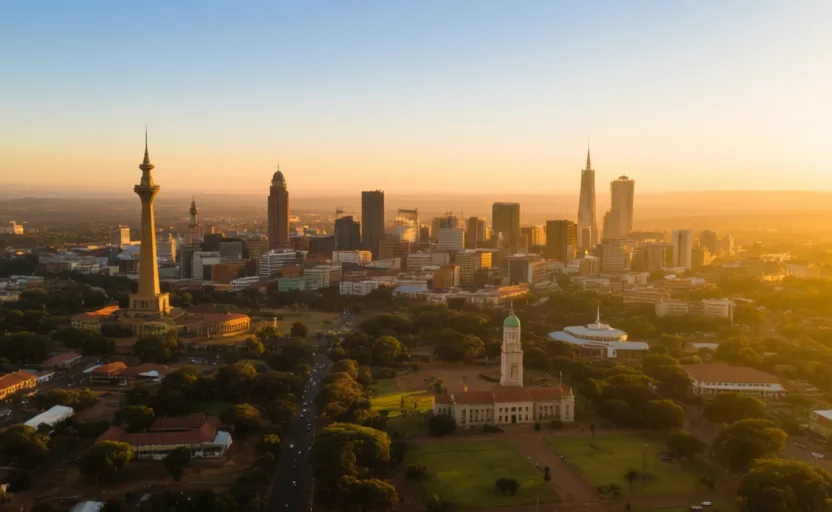 Pretoria · AI city illustration · Artistic impression
City · Africa
Pretoria
Saved in this browser — no account needed. Sign in later and it comes with you.
Where it is
A warm, sheltered valley at about 1,339 m holds Pretoria, some 56 km north-northeast of Johannesburg, on the border between the high Highveld plateau and the lower-lying Bushveld. The city straddles the small Apies River, and its western suburbs climb into the foothills of the Magaliesberg. The hills close the valley off from cool southerly air, so it is warmer than its altitude would suggest, averaging 18.7 °C a year. Rain falls mostly in the long, hot summers, winters are dry and clear with sharp frosts, and snow has never settled, only flurries in 1959, 1968 and 2012.
The land and water around it
The Apies Riverriver
A small stream whose name is Afrikaans for “monkeys river”. It was the reason for the choice of site, and the city now spreads across it and beyond.
The Magaliesbergmountains
A range of hills to the west and around the valley that shelters the city. It cuts Pretoria off from cool southern and south-eastern air for much of the year, so the city runs warm for its height, and it extends the city’s suburbs into the foothills.
The Highveld–Bushveld transitionplateau
The city lies in a transitional belt, with the elevated Highveld to the south and the Bushveld, which lies lower, to the north. Its climate is humid subtropical, with monsoon influence.
Its history, in short
Pretoria was a political creation. Marthinus Pretorius founded it in 1855 on the Apies as a capital for the Voortrekker republic, naming it after his father Andries Pretorius, the hero of the Battle of Blood River, and from 1860 it served as the republic’s capital in place of Potchefstroom. The foundation of the town is often seen as the end of the Great Trek. The Boers besieged the British garrison in 1880–81, and the Pretoria Convention of August 1881 ended the First Boer War. In the Second Boer War the city surrendered to Lord Roberts on 5 June 1900, and the Peace of Vereeniging was signed at Melrose House on 31 May 1902. When the Union formed in 1910, Pretoria became the administrative capital of the whole country, and it also served as capital of the Transvaal province until 1994. It has remained a major Afrikaner centre, with roughly a million Afrikaners living in or near it. Its townships, among them Mamelodi, Soshanguve and Atteridgeville, are almost entirely black, and today the city hosts national government departments and 134 embassies, more than any city but Washington. A proposal to rename the city Tshwane remains controversial.
Timeline
Dates are shown on a timeline rather than as changing shapes on the map. The globe draws modern boundaries only, and tinting a modern outline to stand for a historical one would state something we cannot source.
Industrial & imperial
1855
Founded on the Apies
Marthinus Pretorius, a Voortrekker leader, chooses the site as the new capital of the South African Republic and names it for his father Andries Pretorius, victor of Blood River in 1838.
Well attestedWikipedia1 May 1860
Capital of the republic
Pretoria becomes the official capital of the South African Republic, replacing Potchefstroom.
Well attestedWikipedia3 August 1881
The Pretoria Convention
The city is besieged by Republican forces in December 1880 and again in March 1881, and a treaty signed here ends the First Boer War.
Well attestedWikipedia1888
The first jacarandas
The gardener J. D. Cilliers plants two jacaranda trees at Myrtle Lodge in Sunnyside, from seedlings that came by way of a Cape Town nurseryman who had collected them in Rio de Janeiro. They are the origin of the Jacaranda City.
Well attestedWikipedia5 June 1900
Surrender to Lord Roberts
The city surrenders to British forces during the Second Boer War, ending the Transvaal Republic and beginning British dominance in South Africa.
Well attestedWikipedia31 May 1902
Peace of Vereeniging
The war is formally ended with the signing of the peace at Melrose House.
Well attestedWikipedia1910
Administrative capital of the Union
The former Boer republics join the Cape and Natal colonies. Pretoria becomes the administrative capital, with Cape Town the legislative capital and Bloemfontein the judicial one, and stays capital of the Transvaal province until 1994.
Well attestedWikipedia
Contemporary
6 June 1958
Indian residents ordered to Laudium
Pretoria’s Indian community is ordered to move out of the city to Laudium under the racial segregation of apartheid.
Well attestedWikipedia
Places that carry meaning
Melrose House1902
The house where the Peace of Vereeniging was signed on 31 May 1902, ending the Second Boer War.
The Pretoria Fortsbuilt shortly before 1899
Defences built just before the Second Boer War. Some are now ruins and several are kept as national monuments.
Laudiumfrom 1958
The township to which Pretoria’s Indian residents were ordered to move on 6 June 1958.
The Sunnyside jacarandasfrom 1888
Two trees still stand in the grounds of Sunnyside Primary School, the first of some 60,000 to 70,000 that now colour the streets purple each October.
Languages here
Places are usually multilingual. This lists what is actually spoken, not one language per border.
AfrikaansGermanic family
The language of the large Afrikaner population that has lived here since the city’s founding.
Pretoria has been a major Afrikaner centre since it was founded by Voortrekker leaders, and roughly a million Afrikaners live in or around it, so Afrikaans is among the city’s main languages.
SepediBantu family
The language of the largest black ethnic group, the Bapedi.
Pedi is one of the main languages of the city and of its townships such as Mamelodi, Soshanguve and Atteridgeville, where black people make up nearly the whole population.
Setswana, Xitsonga and TshivendaBantu family
Other widely spoken Bantu languages of the region.
All three are among the main languages of Pretoria and are official languages of South Africa, spoken by the peoples of the Highveld and the northeast.
EnglishGermanic family
A major language of government, diplomacy and the university.
As host to national departments, 134 embassies and several universities, Pretoria has English as one of the languages of the city, alongside the other 11 official languages.
Learn the language here
- 1Understand which languages are spoken herePretoria is multilingual. Start with which languages are used, by whom, and for what — the phrase list only covers one of them.Written by Globe Quest
- 2Learn 11 phrasesCurated everyday phrases for Pretoria, with audio and a written form.Written by Globe Quest
- 3Say them out loudSpeaking practice with pronunciation feedback, one phrase at a time.Globe Quest material, your own additions
- 4Come back to themSpaced review, so what you learned this week is still there next month.Written by Globe Quest
Check yourself
Which of South Africa’s capital functions does Pretoria hold?
The administrative capital, seat of the executive and embassies
Pretoria is the executive capital, hosting government departments and foreign missions. Cape Town is the legislative capital and Bloemfontein the judicial one.
Who founded Pretoria in 1855, and for whom is it named?
Marthinus Pretorius, after his father Andries
Marthinus Pretorius named the new capital for his father Andries Pretorius, the Voortrekker hero of the Battle of Blood River in 1838.
Worth arguing about
- Pretoria was built as the capital of a Boer republic and now hosts the national government of a multiracial democracy. What should a city do with the buildings and names of a very different founding project?
- Some have proposed changing the city’s official name to Tshwane, which has caused public controversy. Who should decide what a city is called?
What we have not established
These are open questions, listed rather than filled in. We would rather show a gap than a plausible guess.
How many people live in Pretoria, and is it a white-majority city?
Depending on whether the figure covers only the former white-designated areas or also the separate townships, the population ranges from about 700,000 to 2.95 million, and the racial majority changes with it.
Sources
- Wikipedia · PretoriaWikipedia · encyclopedia · checked 2026-11-24
- Wikipedia · South AfricaWikipedia · encyclopedia · checked 2026-11-24
Reviewed by Globe Quest editorial on 2026-11-24. Drafted with AI assistance and checked against the sources above before publication.