 Globe Quest
 Human Quest · LearningSign in
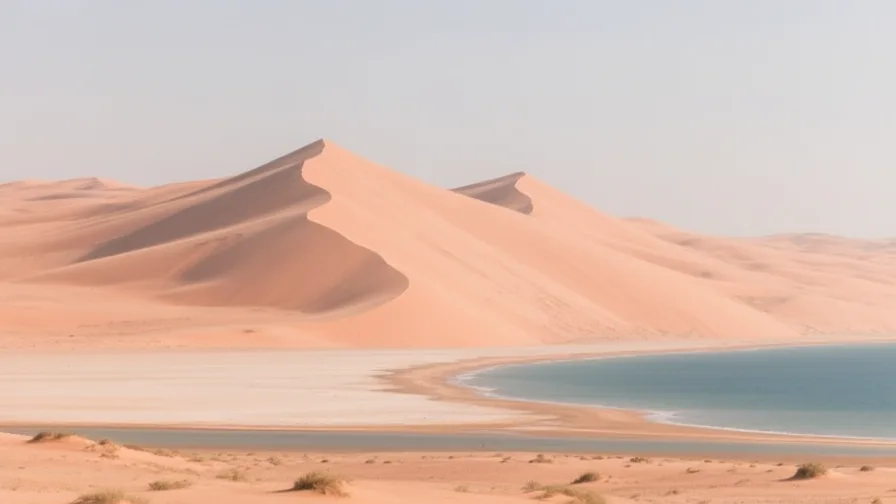 United Arab Emirates · AI landscape illustration · Artistic impression
Country · Middle East
United Arab Emirates
Also known as UAE
Saved in this browser — no account needed. Sign in later and it comes with you.
Where it is
The United Arab Emirates occupies the eastern end of the Arabian Peninsula, on the southern shore of the Persian Gulf and a short stretch of the Gulf of Oman. Its coast runs for nearly 650 kilometres, a little south of the Strait of Hormuz, through which a large share of the world’s crude oil passes. Behind the shore lies desert, with a belt of oases, and in the north-east the Hajar Mountains rise and bring cooler air and more rain. Coastal summers pass 45 °C and annual rain on the coast is under 120 millimetres, so fresh water has always set limits here. Abu Dhabi alone takes up about 87 per cent of the country’s land.
The land and water around it
The Gulf coastcoast
The country’s coast stretches for nearly 650 kilometres along the southern shore of the Persian Gulf, interrupted briefly by an outcrop of Omani territory. Ports such as Julfar, Dibba and Khor Fakkan were the links between Arabian trade and the wider Indian Ocean world.
The Hajar Mountainsmountains
A rugged range in the north and east that is cooler and wetter than the coast. Its copper fed trade with Mesopotamia from about 3000 BCE, and in 2004 snow was recorded on Jebel Jais, in Ras Al Khaimah, for the first time.
Desert and oasesdesert
Most of the country is sparse desert of grasses and thorn bushes. Oases growing date palms and acacia break up the desert. Nomadic groups moved seasonally and set up semi-permanent settlements, and the tribal names of Abu Dhabi, Al Ain and Liwa are still carried by Emiratis today.
Its history, in short
Human presence here goes back some 125,000 years, and by the third millennium BCE the coast and the Hajar foothills were linked by trade to Mesopotamia and the Indus Valley, with copper from the mountains as one draw. Islam arrived in the seventh century. From about 1500 the Portuguese took the Gulf’s ports to choke the Arab trade towards India, and were eventually pushed out by local forces, Persians and the English. In the nineteenth century, as pearling grew and raiding at sea became a problem for British shipping, local rulers signed treaties with Britain, producing the Trucial States. Pearling collapsed in the late 1920s and 1930s, and hardship followed until oil revenue arrived. Britain announced in 1968 that it would end its protection, and seven emirates formed a federation in 1971 under Zayed bin Sultan Al Nahyan of Abu Dhabi, the first president. Oil money then went into health, education and infrastructure, and the country is now a hub for trade, finance and tourism, dependent on a workforce that is mostly foreign.
Timeline
Dates are shown on a timeline rather than as changing shapes on the map. The globe draws modern boundaries only, and tinting a modern outline to stand for a historical one would state something we cannot source.
Early human world
About 125,000 years ago
Early modern humans at Jebel Faya
Stone tools at Jebel Faya, dated by thermoluminescence to around 125,000 years ago, are among the earliest evidence of modern humans outside Africa and suggest people left Africa earlier than once thought.
Approximate dateWikipedia
First cities & states
3200–2600 BCE
The Hafit period
Beehive-shaped tombs, over 300 on Jebel Hafit near Al Ain alone, mark the start of the Bronze Age here, with pottery that shows links to Mesopotamia.
Approximate dateWikipedia
Post-classical world
630 CE
Islam reaches the coast
A letter from the Prophet Muhammad to the rulers of Oman is thought to have led to conversion in the region and an uprising against the Sasanians who held the coast.
Approximate dateWikipedia
Early modern & oceanic
1506–1507
Portuguese capture Khor Fakkan and Hormuz
Afonso de Albuquerque sacks Khor Fakkan and takes Hormuz, beginning a century of Portuguese forts along the coast. The aim was to throttle Arab trade with India.
Well attestedWikipedia
Industrial & imperial
1820
General Maritime Treaty
After a British campaign against the Qawasim of Ras Al Khaimah, local sheikhs sign a treaty with Britain. It leads to the Trucial States, whose rulers keep control of internal affairs.
Well attestedWikipediaMarch 1892
Exclusive Agreement
The Trucial rulers agree not to deal with any power other than Britain without British consent.
Well attestedWikipedia
Contemporary
January 1968
Britain announces its withdrawal
Prime Minister Harold Wilson says Britain will end its treaty relationships with the sheikhdoms. Zayed of Abu Dhabi offers to pay the full cost of keeping British forces and is refused.
Well attestedWikipedia1971
Independence as the United Arab Emirates
The Trucial States become independent as a federation of seven emirates. Zayed of Abu Dhabi is the first president, and the rulers of all seven emirates, among them Rashid of Dubai, are counted as founding fathers.
Well attestedWikipedia
Places that carry meaning
Jebel Faya and MleihaAbout 125,000 years ago onward
Jebel Faya is where hand-axes and scrapers resembling early East African tools were found. Finds from later cultures, from the Bronze Age through Hellenistic and Islamic times, are displayed at the Mleiha Archaeological Centre.
Jebel Hafit tombs3200–2600 BCE
More than 300 beehive tombs in the mountains of the Al Ain region gave their name to the earliest Bronze Age phase in the UAE and Oman.
Sheikh Zayed Grand MosqueModern
The largest mosque in the country, in Abu Dhabi, named for the first president.
Languages here
Places are usually multilingual. This lists what is actually spoken, not one language per border.
ArabicSemitic family
The official and national language, in two registers.
Modern Standard Arabic is the national language and the main medium of instruction in government schools. Emiratis speak a Gulf variety, Emirati Arabic, as their first language.
EnglishGermanic family
The most commonly spoken language, and the language of business.
It follows British conventions, is taught as a second language in government schools, and is the common tongue between the many nationalities who live here. Private schools may teach in other languages and curricula.
South Asian languages
Spoken by the largest groups of foreign residents.
Indians, Pakistanis and Bangladeshis are the biggest non-Emirati groups. Hindi became a third official court language in Abu Dhabi in 2019, and driving licence lectures and tests are offered in Urdu, Hindi, Malayalam, Tamil and Bengali as well as Arabic and English.
Learn the language here
- 1Understand which languages are spoken hereUnited Arab Emirates is multilingual. Start with which languages are used, by whom, and for what — the phrase list only covers one of them.Written by Globe Quest
- 2Practise with people: Arabic practice · DohaAn in-person practice circle. It is a prepared plan and needs a host before it runs.Run by members
Check yourself
Which year did the seven emirates form the federation?
1971
Britain announced in 1968 that it would end its protection of the Trucial States, and the country became independent as the UAE in 1971, when Zayed of Abu Dhabi became president.
What collapsed in the late 1920s and 1930s and caused hardship in the Trucial States?
Pearling
Pearling was the main income and employment of the Gulf in the nineteenth century. The world depression and the invention of the cultured pearl wiped it out, and oil revenue came later.
Worth arguing about
- Only about 11 per cent of residents are Emirati citizens, and citizenship is very hard to obtain. How does a country run when nearly nine in ten people are temporary residents?
- The UAE grew from treaties with a foreign power to a federation within a lifetime. What did the older tribal and coastal ties contribute to that, and what did oil replace?
What we have not established
These are open questions, listed rather than filled in. We would rather show a gap than a plausible guess.
How big is the country?
Reference works give about 83,600 square kilometres in one place and a larger figure elsewhere, and Abu Dhabi’s own area is given as both 67,340 and 72,732. Several land borders are undemarcated and island claims are disputed, so no exact total exists.
Who holds the disputed islands and border sections?
The UAE claims Abu Musa and the Greater and Lesser Tunbs, which Iran occupies, and the status of a roughly 19 kilometre border with Qatar at Khor Al Adaid is also disputed. These disputes are unresolved, and this entry takes no side.
Sources
- Wikipedia · United Arab EmiratesWikipedia · encyclopedia · checked 2026-11-24
- Wikipedia · History of the United Arab EmiratesWikipedia · encyclopedia · checked 2026-11-24
- Wikipedia · Geography of the United Arab EmiratesWikipedia · encyclopedia · checked 2026-11-24
- Wikipedia · Demographics of the United Arab EmiratesWikipedia · encyclopedia · checked 2026-11-24
Reviewed by Globe Quest editorial on 2026-11-24. Drafted with AI assistance and checked against the sources above before publication.