 Globe Quest
 Human Quest · LearningSign in
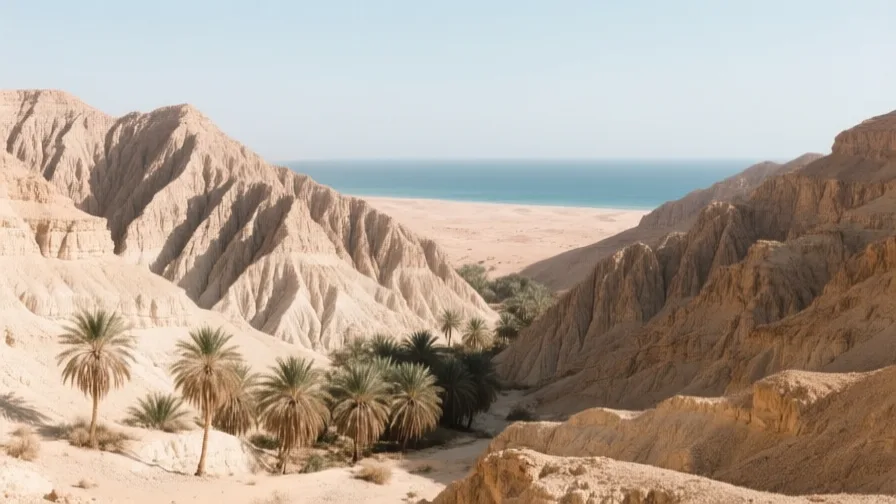 Oman · AI landscape illustration · Artistic impression
Country · Middle East
Oman
Saved in this browser — no account needed. Sign in later and it comes with you.
Where it is
Oman occupies the south-eastern corner of the Arabian Peninsula, facing the Gulf of Oman and the Arabian Sea. Most of its 315,000 square kilometres is valley floor and gravel desert, about 82 per cent, with mountains making up 15 per cent and the coastal plain only 3. The Hajar range curves between the northern coast and the interior, and the Rub’ al Khali, the Empty Quarter, lies to the west. These barriers pushed Omanis toward the sea. Two pieces of the country lie detached: the Musandam peninsula on the Strait of Hormuz, and the small exclave of Madha, both surrounded by the United Arab Emirates on land.
The land and water around it
The Hajar Mountainsmountains
A belt between the sea and the desert from Musandam to Sur, the highest ground in eastern Arabia. It forms a distinct ecoregion, home to the Arabian tahr, and receives enough rain on the higher parts of Jabal Akhdar to exceed 400 millimetres a year. The Wadi Samail cuts through it and is the traditional route from Muscat to the interior.
The gravel plain and the Empty Quarterdesert
Central Oman is a tableland of gravel desert with sparse vegetation, and beyond it lies the Rub’ al Khali, which is hard to cross even with modern vehicles. The desert cut the country off from the rest of Arabia for much of history, so that its contacts ran by sea rather than by land.
Dhofar and the monsoonclimate
In the south the Dhofar mountains catch monsoon winds from the Indian Ocean from late June to late September, and the summer air fills with cool moisture and fog. Coconut palms line the coastal plain and frankincense is produced in the hills, a sharp contrast with the hot desert that covers most of the country.
Its history, in short
Sumerian tablets knew the region as Magan, a name tied to its copper. Waves of Semitic-speaking tribes, the Azd foremost among them, moved east from central and western Arabia in the later first millennium BCE and settled as farmers, herders and fishers. Islam came in the seventh century, and Omanis later built a tradition of elected imams, most of them following the Ibadi school today. Portugal seized the coast in 1507 and held it for 143 years, until the Yaruba imams drove it out in the 1650s. Under the Al Bu Said dynasty, which has ruled since 1744, Oman became a maritime power whose influence reached across the strait to the Iranian and Pakistani coasts and south to Zanzibar. In the twentieth century Britain held effective influence while Oman remained formally sovereign. In 1970 Qaboos bin Said replaced his father, Said bin Taimur, ended the war in Dhofar and began a programme of rapid modernisation that the country calls its Renaissance. He ruled until 2020, when Haitham bin Tariq succeeded him.
Timeline
Dates are shown on a timeline rather than as changing shapes on the map. The globe draws modern boundaries only, and tinting a modern outline to stand for a historical one would state something we cannot source.
Early human world
About 106,000 years ago
Stone-tool makers in Dhofar
Scatters of stone tools found at Al Aybut Al Awal in 2011 resemble an industry known earlier from Sudan, and luminescence dating puts them at roughly 106,000 years old. They bear on the question of how early humans spread out of Africa.
Classical world
About 220 BCE
The name Oman is first written
The oldest known inscription of the name is carved on a tomb at Mleiha, now in the UAE, in Ancient South Arabian and in Aramaic. The name is believed to be older still.
Approximate dateWikipedia
Post-classical world
7th century, consolidated in 632
Oman accepts Islam
Omanis come into contact with Islam in the seventh century, and the community is consolidated in the Ridda Wars of 632. Later, Omani Azd settle in a quarter of Basra to trade.
Approximate dateWikipedia1154
Nabhani dynasty
The Seljuks, whose influence had reached the Omani coast in the eleventh and twelfth centuries, are expelled. The Nabhani rule as kings while the imams are reduced to a largely symbolic role.
Well attestedWikipedia
Early modern & oceanic
1507–1650
The Portuguese coast
Afonso de Albuquerque takes Hormuz, and Portugal governs the Omani coast for 143 years. Imam Nasir bin Murshid, elected at Rustaq in 1624, and his successor expel the Portuguese in the 1650s.
Well attestedWikipedia20 November 1744
Ahmad bin Said becomes imam
After a civil war that began in 1718 and the expulsion of the Persians, Ahmad bin Said is elected imam, with Rustaq as his capital. His Al Bu Said dynasty still rules.
Well attestedWikipedia
Contemporary
1970
Qaboos takes power
With British support, Qaboos bin Said ends his father’s rule in a bloodless coup. He abolishes slavery, offers amnesty to opponents and defeats the insurgency that began in Dhofar in the 1960s, which was confined to a small area near the Yemeni border by early 1975.
1996
The Basic Statute
Sultan Qaboos issues Oman’s first written constitution, which also sets rules for the succession.
Well attestedWikipedia
Places that carry meaning
Rustaq17th–18th century
An interior town where the first Yaruba imam was elected in 1624 and where Ahmad bin Said made his capital in 1744. It shows that the political centre of Oman was long inland, not on the coast.
Al Aybut Al AwalMiddle Stone Age
A site in Dhofar with more than a hundred surface scatters of tools. It linked southern Arabia to an industry previously known only from north-east Africa.
Masirah IslandSecond World War
A barren island about 70 kilometres long, 15 kilometres off the coast near the approach to the Gulf of Oman. The Royal Air Force opened stations there in 1943 to guard British trade routes with anti-submarine patrols.
Languages here
Places are usually multilingual. This lists what is actually spoken, not one language per border.
ArabicSemitic family
Official language and the one most widely spoken.
Omani Arabic is the speech of central Oman, and it differs from the Gulf Arabic of the east of the peninsula and Bahrain. Gulf Arabic is heard in the areas along the UAE border. Around a fifth of Omanis are of Baloch descent, descendants of settlers who arrived centuries ago and are now counted as native.
Dhofari ArabicSemitic family
The local variety of Salalah and the Dhofar coast.
Dhofar sits apart from the north by distance and by climate, and its Arabic has its own name and character. The region was also the cradle of the Dhofar Rebellion and the birthplace of Sultan Qaboos.
Learn the language here
- 1Understand which languages are spoken hereOman is multilingual. Start with which languages are used, by whom, and for what — the phrase list only covers one of them.Written by Globe Quest
- 2Practise with people: Arabic practice · DohaAn in-person practice circle. It is a prepared plan and needs a host before it runs.Run by members
Check yourself
How long did Portugal govern the Omani coast?
143 years, from 1507 to 1650
Portugal took Hormuz and the coast in 1507, and the Yaruba imams expelled it in the 1650s. The Yaruba then built the maritime state that the Al Bu Said inherited.
Which landform covers most of Oman?
Valleys and desert, about 82 per cent
Only 3 per cent of Oman is coastal plain and 15 per cent is mountain. The rest is valley and desert.
Worth arguing about
- Oman’s deserts and mountains kept invaders out of the interior while the sea carried its empire to Zanzibar. How does a country shaped by both orientations decide where it belongs?
- The sultan’s word has the force of law, and the country is called one of the more peaceful in the region. How should that stability be weighed against limits on political participation?
What we have not established
These are open questions, listed rather than filled in. We would rather show a gap than a plausible guess.
How many Omanis follow each school of Islam?
The government keeps no statistics on religious affiliation. Estimates come from outside bodies, and the divisions between Ibadi, Sunni and Shia communities are not formally counted.
Sources
- Wikipedia · OmanWikipedia · encyclopedia · checked 2026-11-24
- Wikipedia · History of OmanWikipedia · encyclopedia · checked 2026-11-24
- Wikipedia · Geography of OmanWikipedia · encyclopedia · checked 2026-11-24
Reviewed by Globe Quest editorial on 2026-11-24. Drafted with AI assistance and checked against the sources above before publication.