 Globe Quest
 Human Quest · LearningSign in
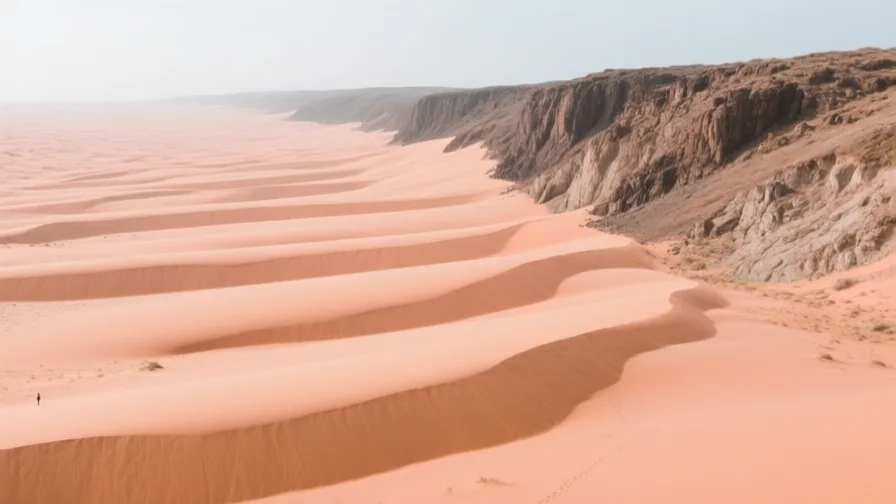 Saudi Arabia · AI landscape illustration · Artistic impression
Country · Middle East
Saudi Arabia
Saved in this browser — no account needed. Sign in later and it comes with you.
Where it is
Saudi Arabia fills about four fifths of the Arabian Peninsula, between the Red Sea on one side and the Persian Gulf on the other. It is the largest country in the world with no permanent river: water comes from wadis that run only after rain, and the fertile ground is found in their alluvial beds, in basins and at oases. A great plateau rises sharply from the Red Sea and slopes down eastward across the central Najd to the Gulf. Three deserts cut it off on the other sides, the largest being the Rub’ al Khali. Less than 7 per cent of the land can be cultivated.
The land and water around it
The Rub’ al Khalidesert
The Empty Quarter covers some 647,500 square kilometres in the south-east and is the largest unbroken sand desert in the world. Together with the An Nafud in the north and the sand belts of the east, it isolates the central plateau from its neighbours.
The Red Sea escarpment and the Tihamahcoast
On the west, a rugged wall drops from the highlands to a coastal plain called the Tihamah, on average 65 kilometres wide. Both Mecca and Jeddah lie in its northern part. Almost no natural harbours exist along this coast, and the mountains in the south-west, in Aseer, reach 3,015 metres at Jabal Soudah.
The Najd plateauplateau
A rocky tableland with small sandy deserts and isolated mountain clumps, sloping from about 1,360 metres in the west to 750 metres in the east. Riyadh and the original Saudi heartland lie on it, and it was also the home ground of their rivals, the Rashidis of Ha’il.
Its history, in short
Arabia holds some of the oldest traces of human activity outside Africa, and in historic times its north-western oases, Lihyan, the Nabataeans and the Thamud, sat on caravan routes carrying incense from the south. Islam emerged in the Hejaz in the seventh century. Muhammad united the tribes of the peninsula, and after his death in 632 his followers carried Muslim rule far beyond it, so that Arabia soon became politically peripheral even as Mecca and Medina remained holy. For centuries the Hejaz was ruled by the Sharifs of Mecca under the suzerainty of larger empires, and the Ottomans added the Red Sea coast and Al-Ahsa in the sixteenth century. The Saudi dynasty began at Diriyah, near Riyadh, in 1727, and in 1744 its ruler joined forces with the preacher Muhammad ibn Abd al-Wahhab, an alliance that still underpins the state. After two earlier Saudi states fell, Abdulaziz began a series of campaigns in 1902 that ended with the proclamation of the kingdom in 1932, joining Hejaz, Najd and the east. Oil, found in 1938 in Al-Hasa, replaced pilgrimage revenue as the economy’s base and brought a large foreign workforce.
Timeline
Dates are shown on a timeline rather than as changing shapes on the map. The globe draws modern boundaries only, and tinting a modern outline to stand for a historical one would state something we cannot source.
First cities & states
7th millennium BCE
A monument at Dumat al-Jandal
A triangular stone structure 35 metres long, published in 2020, is dated to this period and thought to be tied to ritual. It points to a herding society in prehistoric northern Arabia.
Approximate dateWikipedia
Classical world
6th–2nd centuries BCE
The kingdom of Lihyan
Centred on Dedan, now al-Ula, it leaves many inscriptions and monumental tombs. The Nabataeans later take over the north-western Hejaz and the oasis of Hegra.
Approximate dateWikipedia106 CE
Rome annexes the Nabataean kingdom
The Nabataeans’ control of caravan routes and of Hegra ends with Roman annexation.
Well attestedWikipedia
Post-classical world
Early 7th century to 632
A single Islamic polity
Muhammad, born in Mecca about 570, unites the tribes of the peninsula. After his death in 632 his followers conquer lands from Iberia to Central Asia within decades.
Well attestedWikipedia
Early modern & oceanic
1517
Ottoman control of Mecca and Medina
Selim I takes the holy cities, and the Ottomans go on to add the Red Sea and Gulf coasts. They claim the interior, but only nominally.
Well attestedWikipedia1744
The Saudi–Wahhabi alliance
Muhammad bin Saud, who became emir of Diriyah in 1727, joins forces with Muhammad ibn Abd al-Wahhab. The emirate expands, captures Mecca in 1803 and is destroyed by the Ottoman viceroy of Egypt in 1818.
Industrial & imperial
1932
The Kingdom of Saudi Arabia
Abdulaziz, who began his campaigns in 1902, unites Hejaz, Najd, parts of Eastern Arabia and the south into one state. The name is announced from Mecca on 23 September 1932.
Well attestedWikipedia1938
Oil discovered
Large reserves are found in Al-Hasa. Full development begins in 1941 under the US-controlled Aramco and changes the kingdom’s fortunes and its standing abroad.
Well attestedWikipedia
Places that carry meaning
Mecca and MedinaPre-Islamic to present
The two holiest cities of Islam, in the Hejaz. The Kaaba in Mecca was already a sanctuary for several tribal cults and a place of pilgrimage before Islam, while Medina, then Yathrib, was an oasis with Jewish communities.
Hegra (Mada’in Salih)Nabataean, until 106 CE
An oasis in the north-west that the Nabataeans controlled as a caravan stop, until the Roman annexation of 106 CE.
DiriyahFrom 1727
The town in central Arabia where the Al Saud rose to power. Its emirate was the first Saudi state, and the heartland of the dynasty around Riyadh grew from it.
Tarout IslandEarly 3rd millennium BCE
A site on the Gulf coast that was likely the main port and capital of Dilmun, whose settlements of the Eastern Province are linked in Mesopotamian records with copper.
Languages here
Places are usually multilingual. This lists what is actually spoken, not one language per border.
ArabicSemitic family
Official language, spoken in four main regional dialect groups.
Najdi, with about 14.6 million speakers, and Hejazi, with about 10.3 million, are the two largest. Gulf Arabic and the southern Hejaz-Tihama dialects are smaller groups.
South Asian languagesIndo-European family
Languages of the large migrant workforce.
Bengali is the most numerous of the expatriate languages, followed by Punjabi and Urdu, and Malayalam is also spoken. Indians and Pakistanis are among the largest foreign communities, roughly 1.5 million and 1.3 million.
TagalogAustronesian family
Spoken by the Filipino community.
One of the major languages of the foreign workforce, which makes up roughly 40 per cent of the resident population by some estimates.
MehriSemitic family
A minority language of Saudi citizens.
Spoken by a community of Mehri citizens, alongside Faifi. Deaf Saudis mainly use their own sign language.
Learn the language here
- 1Understand which languages are spoken hereSaudi Arabia is multilingual. Start with which languages are used, by whom, and for what — the phrase list only covers one of them.Written by Globe Quest
- 2Practise with people: Arabic practice · DohaAn in-person practice circle. It is a prepared plan and needs a host before it runs.Run by members
Check yourself
What is unusual about Saudi Arabia’s water?
It is the largest country with no permanent rivers
Only wadis, which flow after rain, drain the land, and farming depends on their alluvial beds, on basins and on oases. That scarcity shaped where towns grew.
Which regions did Abdulaziz unite into the kingdom of 1932?
Hejaz, Najd, parts of Eastern Arabia and the south
The state was assembled by a series of campaigns that began in 1902. Its earlier titles, such as the Emirate of Nejd and the Kingdom of Hejaz and Nejd, show how it was built up stage by stage.
Worth arguing about
- The 1744 alliance between a ruling family and a religious movement still underlies the state. How does a country change course when its founding bargain is both political and religious?
- Around two fifths of residents are foreign-born by some estimates. How should we think about a society whose economy depends on workers who cannot settle?
What we have not established
These are open questions, listed rather than filled in. We would rather show a gap than a plausible guess.
What share of residents are foreign nationals?
Estimates range from about 21 per cent to about 42 per cent depending on the year and the body counting, and none can be reconciled with the others.
How large is the country?
Its south-eastern and southern borders with the UAE and Oman are not precisely marked, so estimates run from about 2.15 to 2.24 million square kilometres.
Sources
- Wikipedia · Saudi ArabiaWikipedia · encyclopedia · checked 2026-11-24
- Wikipedia · History of Saudi ArabiaWikipedia · encyclopedia · checked 2026-11-24
- Wikipedia · Geography of Saudi ArabiaWikipedia · encyclopedia · checked 2026-11-24
Reviewed by Globe Quest editorial on 2026-11-24. Drafted with AI assistance and checked against the sources above before publication.