 Globe Quest
 Human Quest · LearningSign in
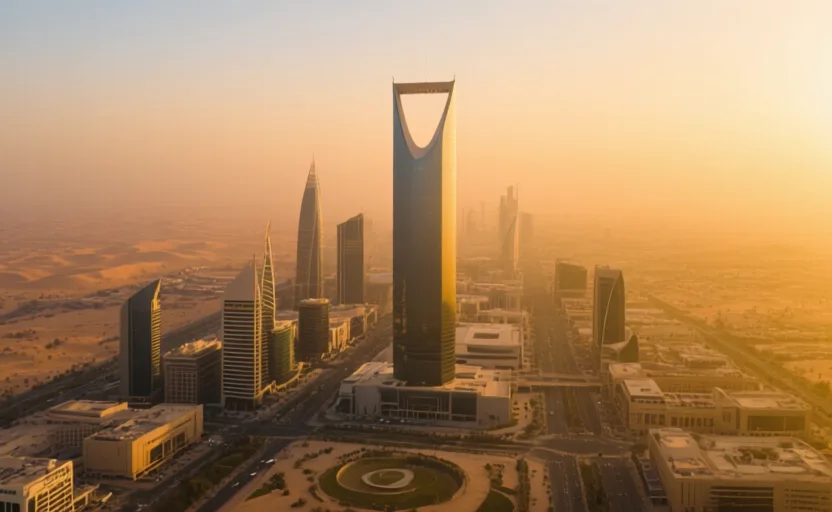 Riyadh · AI city illustration · Artistic impression
City · Middle East
Riyadh
Saved in this browser — no account needed. Sign in later and it comes with you.
Where it is
Far from any sea, Riyadh stands in the middle of the Najd, the rocky central plateau of Arabia. Its name means gardens, and it was an oasis town first: date orchards grew outside the walls on the strength of local water and fertile ground. The climate is hot desert with a cold edge, so that August highs average 43.6 degrees and January nights fall to about 7. Rain is scarce except in March and April, and dust storms can cut visibility to under ten metres. A storm on 1 and 2 April 2015 grounded hundreds of flights.
The land and water around it
The Najd plateauplateau
A broad tableland of rock broken by small sandy deserts and isolated mountains, sloping eastward toward the Gulf. The Saudi state grew out of this interior rather than from a port, which sets Riyadh apart from most of the peninsula’s capitals.
The Riyadh oasisoasis
Water and fertile ground made the site good for dates and other crops, and wheat was long grown there until insects and mites ruined the harvests. The oasis, and the neighbouring Diriyah oasis to the north-west, is why a city exists in this dry plateau at all.
Desert weatherclimate
Cold air from Siberia reaches Riyadh in winter, giving short, cold winters between very long, hot summers. The dust storms of spring are the city’s signature hazard and have closed schools and airports.
Its history, in short
Before Islam the site was called Hajr, said to have been founded by the Banu Hanifa tribe, and it served as the seat of Al-Yamama, a province whose governors answered to the Umayyad and Abbasid caliphs for much of central and eastern Arabia. In 866 Al-Yamama broke from the Abbasids, the new rulers moved their capital to Al-Kharj, and Hajr entered a long decline. The modern city grew out of the walled town of the eighteenth century. Riyadh resisted the Saudi emirate of nearby Diriyah for years and capitulated in 1774. In 1824 it became the seat of the Second Saudi State and has been the capital since, though the Rashidis of Ha’il held it for a time and the Al Saud returned in 1902. A town of about 40,000 in 1935 and 83,000 in 1949, it was transformed by oil from the 1940s: ministries moved from Jeddah, a grid of broad roads was laid out from 1953, and population growth averaged 8.2 per cent a year between 1974 and 1992. No city on the peninsula is larger now, with more than seven million people.
Timeline
Dates are shown on a timeline rather than as changing shapes on the map. The globe draws modern boundaries only, and tinting a modern outline to stand for a historical one would state something we cannot source.
Post-classical world
866
Al-Yamama leaves the Abbasids
The province breaks away, and the Banu Ukhaidhir who take over move the capital from Hajr to Al-Kharj. The old city on the Riyadh site begins a long decline.
Well attestedWikipedia
Early modern & oceanic
1744
Diriyah begins to expand
Muhammad bin Saud of Diriyah allies with Muhammad ibn Abd al-Wahhab and sets out to bring the neighbouring region under a single state. Ibn Dawwas of Riyadh leads the main resistance.
Well attestedWikipedia1774
Riyadh capitulates
Ibn Dawwas flees, ending years of war, and the First Saudi State is declared with Diriyah as its capital.
Well attestedWikipedia
Industrial & imperial
1824
Seat of the Second Saudi State
After the Ottoman viceroy of Egypt destroys Diriyah in 1818, the smaller Emirate of Nejd is set up with Riyadh as its capital, and the city has been the Saudi capital since.
About 1865
The Masmak fortress
The House of Rashid, rulers of Ha’il, who had taken the city from the Al Saud, build the fortress now known as Al-Masmak.
Approximate dateWikipedia1902
The Al Saud return
After exile in Kuwait, the family comes back and Riyadh becomes the base of an Emirate of Riyadh, the first of the titles that lead to the kingdom of 1932.
Contemporary
1953
The grid is introduced
New neighbourhoods are laid out on American-style grid plans linked by high-capacity roads. The Doxiadis masterplan of 1972 later fixed the 2 by 2 kilometre block as the city’s basic unit.
Well attestedWikipedia31 July 2010
At-Turaif on the World Heritage List
The citadel district at Diriyah, now enclosed by the metropolis, is inscribed by UNESCO.
Places that carry meaning
At-Turaif District, Diriyah15th century onward
The first capital of the Saudi dynasty, built of adobe in the Najdi style on the edge of an oasis. Its palaces and street plan are largely intact, though many buildings are ruined. It is a World Heritage property.
Al-MasmakAbout 1865
A fortress of the Rashidi period in the old centre. It is one of the few survivors of a walled town that covered less than a square kilometre.
Al-Deerah and Al-Bat’haOld centre
The oldest part of the city, where a square and market stood among mosques and adobe courtyard houses within the walls. Five old gates from the wall survive as archaeological sites.
Al-OlayaLate 20th century onward
The commercial heart of the modern city, with the Kingdom Centre and Al-Faisaliah towers. It shows how far the city has moved from its walled core.
Languages here
Places are usually multilingual. This lists what is actually spoken, not one language per border.
ArabicSemitic family
Official language, spoken in the Najdi dialect of the region.
Najdi is the largest of the four main dialect groups of Saudi Arabic, with about 14.6 million speakers across the country. Egyptian and Levantine Arabic also arrive with expatriate workers.
Urdu and PunjabiIndo-European family
Languages of the Pakistani community, 12.4 per cent of residents in 2017.
Pakistanis are the second largest group of non-Saudis in Riyadh after Indians, who made up 13.7 per cent. Bengali, Malayalam and other South Asian languages are spoken across the foreign workforce.
TagalogAustronesian family
The language of the Filipino community.
Among the more numerous languages of the large immigrant workforce, which accounts for over a third of the city’s residents.
Learn the language here
- 1Understand which languages are spoken hereRiyadh is multilingual. Start with which languages are used, by whom, and for what — the phrase list only covers one of them.Written by Globe Quest
- 2Learn 12 phrasesCurated everyday phrases for Riyadh, with audio and a written form.Written by Globe Quest
- 3Say them out loudSpeaking practice with pronunciation feedback, one phrase at a time.Globe Quest material, your own additions
- 4Come back to themSpaced review, so what you learned this week is still there next month.Written by Globe Quest
- 5Practise with people: Arabic practice · DohaAn in-person practice circle. It is a prepared plan and needs a host before it runs.Run by members
Check yourself
What does the name Riyadh refer to?
Gardens
Date orchards stood outside the old walls, and the name means gardens. The oasis is the reason a large city grew in a desert plateau.
When did Riyadh become the Saudi capital?
1824, as seat of the Second Saudi State
Diriyah was the first capital until its destruction in 1818, and after that the smaller Emirate of Nejd made Riyadh its seat in 1824. The title has stayed there through the 1932 kingdom and the oil era.
Worth arguing about
- Riyadh grew from tens of thousands to over seven million within a lifetime, on a grid of wide roads. What kind of city does that pattern produce, and who does it serve?
- The ruins of Diriyah are restored as a heritage district while the old centre of Riyadh has few survivors. Whose history is the city choosing to keep?
What we have not established
These are open questions, listed rather than filled in. We would rather show a gap than a plausible guess.
How many people live in Riyadh, and how many are foreign nationals?
The total of over seven million refers to 2022, while the split of 64.19 per cent Saudi to 35.81 per cent non-Saudi dates from 2017. No single recent figure covers both.
Sources
- Wikipedia · RiyadhWikipedia · encyclopedia · checked 2026-11-24
- Wikipedia · Saudi ArabiaWikipedia · encyclopedia · checked 2026-11-24
- Wikipedia · History of Saudi ArabiaWikipedia · encyclopedia · checked 2026-11-24
- UNESCO · At-Turaif District in ad-Dir'iyahUNESCO World Heritage Centre · intergovernmental · checked 2026-11-24
Reviewed by Globe Quest editorial on 2026-11-24. Drafted with AI assistance and checked against the sources above before publication.