 Globe Quest
 Human Quest · LearningSign in
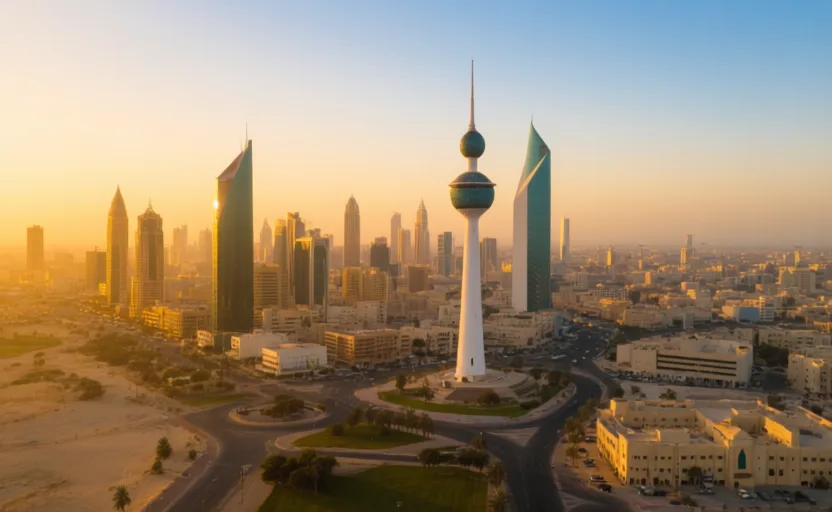 Kuwait City · AI city illustration · Artistic impression
City · Middle East
Kuwait City
Saved in this browser — no account needed. Sign in later and it comes with you.
Where it is
The old town faces north over Kuwait Bay on the Persian Gulf, a natural deep-water harbour that is the reason the settlement exists here. The land is flat desert, only about 16 metres above the sea, with sparse vegetation and no river. Summer highs stay above 45 °C for three months, sometimes pass 50 °C, and nights often stay above 30 °C. Winds from the north-west bring sandstorms in summer, and winters are mild, with nights that can fall below 8 °C. The built-up area has spread far beyond the old centre and now crosses all six of the country’s governorates.
The land and water around it
Kuwait Baybay
A natural harbour on the south shore of which the city stands. Ninety per cent of Kuwait’s people live on the bay’s coast, and the old port, the modern harbours at Shuwaikh and Ahmadi, and the airport all serve this one stretch of shore.
The desert climateclimate
A hot desert climate with very long summers. The shamal wind from the north-west carries sandstorms, mostly in summer. In the 1960s and 1970s, new buildings tried passive cooling alongside local decoration.
Its history, in short
In the early and mid-eighteenth century this was a small fishing village. The Bani Utbah settled in the mid-1700s, and the town soon turned into a port for goods moving between India, Persia, Baghdad, Muscat and Arabia. Merchants who fled Persia’s siege of Basra in the 1770s helped expand its boat building, and in the late 1700s the East India Company diverted its trade here. Kuwaiti-built ships carried much of the cargo between India, East Africa and the Red Sea. Under Mubarak Al-Sabah the town was nicknamed the Marseille of the Gulf. The pearl trade declined in the 1930s, when the travel writer Freya Stark found poverty, and oil then changed the city: exports began in 1946, a new master plan was approved in 1952, and independence came in 1961. The 1960s and 1970s are remembered as a golden era of theatre, magazines and a freer press. Iraqi occupation in 1990 and the oil fires that followed damaged the land, and the city rebuilt afterwards.
Timeline
Dates are shown on a timeline rather than as changing shapes on the map. The globe draws modern boundaries only, and tinting a modern outline to stand for a historical one would state something we cannot source.
Early modern & oceanic
Mid-1700s
A fishing village and the Bani Utbah
Kuwait City is a small fishing village when the Bani Utbah settle. In the later eighteenth century it becomes a commercial centre for goods between India, Muscat, Baghdad, Persia and Arabia.
Approximate dateWikipedia1775–1779
Refuge from the siege of Basra
Persia besieges Basra, and Iraqi merchants take refuge in Kuwait. They help expand its boat building and trading, and trade routes from India to Baghdad, Aleppo and Constantinople are diverted through the town.
Well attestedWikipedia1792
The East India Company
The company’s trade is diverted to Kuwait, which secures sea routes to India and the east coast of Africa. Kuwaiti sailors gain a reputation as the best in the Gulf.
Approximate dateWikipedia
Contemporary
1952
The first master plan
A British planning firm, Minoprio, Spenceley and Macfarlane, designs the first master plan for Kuwait, as oil income rises and foreign workers arrive from Jordan, Egypt and India. By this year the country is the Gulf’s largest oil exporter.
1963
A parliament in the capital
Two years after independence Kuwait holds its first parliamentary elections under a new constitution. It was the first Gulf state to have a constitution and parliament.
Well attestedWikipedia1982
The National Assembly Building
A parliament building designed by Jørn Utzon, with elements of Islamic architecture, is completed by his son Jan Utzon. In the same period the city suffers a stock-market crash and a drop in oil prices.
Well attestedWikipedia1990–1991
Occupation
Iraqi forces invade and annex Kuwait in August 1990, and the occupation ends in February 1991. Burning oil wells and the oil spills damage the land and sea, leaving more than 500 oil lakes over about 36 square kilometres in one estimate, which made parts of the east and south-east uninhabitable.
Places that carry meaning
The National Assembly BuildingCompleted 1982
Parliament’s seat, designed from the work of Jørn Utzon, a landmark of modern Gulf architecture that draws on Islamic forms.
Kuwait National Cultural District21st century
A group of cultural buildings including the Sheikh Abdullah Al Salem and Sheikh Jaber Al Ahmad cultural centres, Al Shaheed Park and Al Salam Palace. The city’s other museums include the National Museum, Museum of Modern Art, Maritime Museum and Sadu House.
Shuwaikh PortModern
One of the ports, with Ahmadi, that handle the city’s trade, alongside Kuwait International Airport.
Languages here
Places are usually multilingual. This lists what is actually spoken, not one language per border.
ArabicSemitic family
The everyday language, in its Kuwaiti form.
Kuwaiti Arabic is a Gulf variety, and Kuwait City is its home. Soap operas made here in the local dialect are among the most watched in the Arab world, and the city has had a theatre tradition since the 1920s.
EnglishGermanic family
A common business language.
English is widely understood and used in business in a country where foreign nationals are about two thirds of residents.
Learn the language here
- 1Understand which languages are spoken hereKuwait City is multilingual. Start with which languages are used, by whom, and for what — the phrase list only covers one of them.Written by Globe Quest
- 2Learn 11 phrasesCurated everyday phrases for Kuwait City, with audio and a written form.Written by Globe Quest
- 3Say them out loudSpeaking practice with pronunciation feedback, one phrase at a time.Globe Quest material, your own additions
- 4Come back to themSpaced review, so what you learned this week is still there next month.Written by Globe Quest
- 5Practise with people: Arabic practice · DohaAn in-person practice circle. It is a prepared plan and needs a host before it runs.Run by members
Check yourself
How did the Persian siege of Basra (1775–1779) affect Kuwait?
Iraqi merchants took refuge there, boosting boat building and trade
Merchants who fled Basra settled in Kuwait and helped expand its ship building and commerce. Trade routes from India to Baghdad and Aleppo were diverted here.
How many of Kuwait’s governorates does the urban area of Kuwait City reach into?
All six
Kuwait City has no administrative status of its own. The urban area crosses all six governorates, and the historic core lies in the Capital Governorate.
Worth arguing about
- A port town that made its living from sailing and pearls was rebuilt around oil in a few decades. What does a city keep of its maritime past when its economy leaves the sea?
- A capital with no administrative boundary of its own, spread across six governorates. What does that do to planning and to local identity?
What we have not established
These are open questions, listed rather than filled in. We would rather show a gap than a plausible guess.
How many people live in Kuwait City?
The city itself has no administrative status, so a figure depends on the boundary: the historic core in the Capital Governorate, or the whole urban agglomeration of about three million in 2018, which is described as over 70 per cent of the country’s population even though the national total of 4.82 million would make it less.
Sources
- Wikipedia · Kuwait CityWikipedia · encyclopedia · checked 2026-11-24
- Wikipedia · KuwaitWikipedia · encyclopedia · checked 2026-11-24
Reviewed by Globe Quest editorial on 2026-11-24. Drafted with AI assistance and checked against the sources above before publication.