 Globe Quest
 Human Quest · LearningSign in
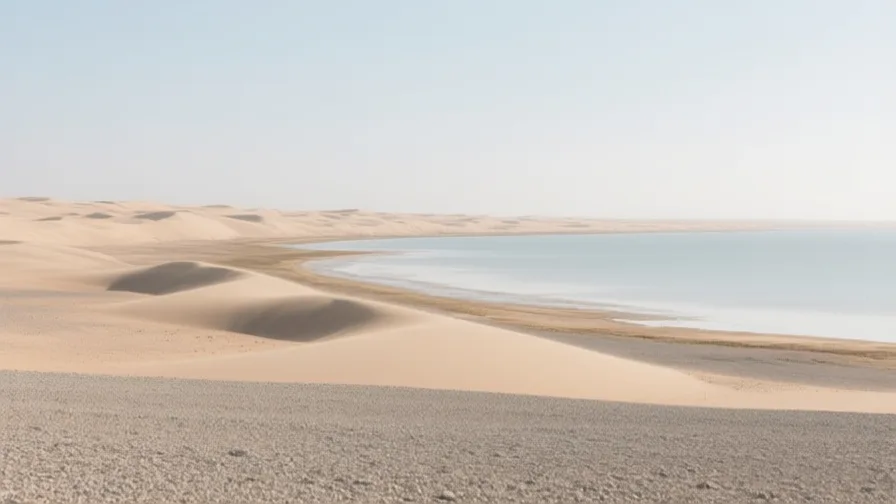 Kuwait · AI landscape illustration · Artistic impression
Country · Middle East
Kuwait
Saved in this browser — no account needed. Sign in later and it comes with you.
Where it is
Kuwait fills the corner where the Persian Gulf meets the Arabian desert, between Iraq to the north and Saudi Arabia to the south. It is small and low: the highest ground, Mutla Ridge, is only 306 metres, and most of the land is desert with a thin coastal strip of vegetation. Much of the ground was built up by silt from the Tigris and Euphrates. Kuwait has no permanent river, so fresh water comes from a small aquifer found in 1960 and, mostly, from distilling seawater. Summers are among the hottest on earth, with dust storms driven by the shamal wind, and winters are colder than elsewhere on the Gulf.
The land and water around it
Kuwait Baybay
A natural deep-water harbour that cuts about 40 km into the shoreline and shelters the port. It accounts for nearly a third of the shoreline, and the capital, Kuwait City, and most of the population sit on its coast.
Bubiyan Island and the delta marshesisland
Bubiyan, at 860 square kilometres the largest of Kuwait’s ten islands, lies in the delta of the Shatt al-Arab and is joined to the mainland by a bridge of 2,380 metres. Its Mubarak al-Kabeer reserve is a wetland of international importance and holds the world’s largest breeding colony of crab-plovers. Kuwait is on migration routes used by two to three million birds a year.
The desert and Wadi al-Batindesert
The dry valley of Wadi al-Batin forms Kuwait’s western edge with Iraq. Beneath the south lies a limestone dome that holds the main oil fields, and a thick layer of sand, gravel and clay covers the north and west.
Its history, in short
The coast was part of ancient Mesopotamia, and from about 2000 BCE traders from Ur settled on Failaka Island. After Greek, Parthian and Sasanian rule, Muslim armies fought a first battle here in 636. The modern state grew from a fishing village that the Bani Utbah settled in the mid-1700s. It became a port and boat-building centre for trade between India, Basra, Baghdad and Arabia, ruled by the Al Sabah, and accepted a British protectorate in 1899. Oil, found in the late 1930s and exported from 1946, made it the Gulf’s largest exporter by 1952 and drew workers from Palestine, Iran, India and Egypt. Kuwait became independent in 1961 and held its first parliamentary elections in 1963. Iraq invaded and annexed it on 2 August 1990 and was expelled in February 1991 by a US-led coalition authorised by the UN. The country’s politics since then have been marked by recurrent deadlock between the emir and the elected assembly, and since 2024 by the suspension of the assembly and the withdrawal of citizenship from tens of thousands of people. Citizens are now about a third of the population.
Timeline
Dates are shown on a timeline rather than as changing shapes on the map. The globe draws modern boundaries only, and tinting a modern outline to stand for a historical one would state something we cannot source.
First cities & states
c. 2000 BCE
Mesopotamians on Failaka
Traders from the Sumerian city of Ur settle on Failaka Island and build Mesopotamian-style buildings there. Failaka later becomes part of the Dilmun trading world.
Early modern & oceanic
1752
A sheikhdom
The territory becomes known as the Sheikhdom of Kuwait. In the later eighteenth century it becomes a major port for trade from Baghdad, India, Persia, Muscat and Arabia, helped by merchants who fled Persia’s siege of Basra.
Approximate dateWikipedia
Industrial & imperial
1899
British protectorate
A protectorate agreement gives the United Kingdom responsibility for Kuwait’s foreign affairs. In 1922 Britain draws the Kuwait–Iraq border, which leaves Iraq with little coastline.
Contemporary
1946
First oil exports
Crude oil is exported for the first time. A public-works programme begins in 1950, and by 1952 Kuwait is the largest oil exporter on the Gulf.
Well attestedWikipedia1961
Independence
The British protectorate ends in June. Iraq at first refuses to recognise the new state, and an international crisis the same year is defused by an Arab League force. Iraq accepted the 1932 border in 1963, and in 1994 accepted the border demarcated by the UN.
1990–1991
Iraqi invasion and the Gulf War
Iraq invades on 2 August 1990 and annexes Kuwait on 8 August. A coalition of 34 nations, authorised by the UN Security Council, fights the war that ends the occupation on 26 February 1991. About half the population leaves during the occupation, and a local armed resistance forms.
Iraq, which argued that Kuwait was historically part of the Ottoman province of Basra and so rightfully Iraqi, accused Kuwait of overproducing oil and slant-drilling into the Rumaila field, and said the invasion supported a Kuwaiti rebellion against the Al Sabah. Kuwait and the UN Security Council, which condemned the invasion and demanded withdrawal, rejected these claims.
1991
The oil fires
Retreating Iraqi troops set about 700 oil wells alight, and the fires burn for about ten months, with the last put out by November 1991. Pooled oil forms about 300 oil lakes and a hard crust covering nearly 5 per cent of Kuwait’s land.
Well attestedWikipedia2024 onward
Assembly suspended, citizenship withdrawn
The National Assembly is suspended from 10 May 2024, and since April 2024 the emir has been withdrawing Kuwaiti citizenship from large numbers of people. Reports counted 42,000 in six months to March 2025, and estimates by December 2025 reached as many as 200,000. The Carnegie Endowment for International Peace has called this a weaponising of citizenship revocation.
Approximate dateWikipedia
Places that carry meaning
Failaka Islandc. 2000 BCE to the 20th century
An island with Mesopotamian, Dilmun, Hellenistic and later remains. The Greeks, who built a fort and temples, called it Ikaros.
KazmaEarly Islamic
A port and caravan stop in the early Islamic period, near where the Rashidun army fought the Sasanians at the Battle of Chains in 636. It was a rest stop for pilgrims travelling from Iraq to Hejaz.
Kuwait City18th century onward
The capital, on Kuwait Bay, which started as a fishing village and grew into a trading and boat-building port, and the centre of the urban area where most of the population lives.
Languages here
Places are usually multilingual. This lists what is actually spoken, not one language per border.
ArabicSemitic family
The official language, in a standard and a spoken form.
Modern Standard Arabic is used in journalism and education, while Kuwaiti Arabic, a variety of Gulf Arabic, is used in daily life. It has borrowed from Persian, Indian languages, Balochi, Turkish, English and Italian because of trade and migration.
EnglishGermanic family
The business language.
Widely understood and often used in business. French is taught for two years to students of the humanities.
PersianIndo-European family
Spoken by Kuwaitis of Iranian descent.
Kuwaiti Persian is used among the Ajam, Kuwaitis of Iranian ancestry, who include most Shia Kuwaiti citizens. Iranian dialects such as Larestani, Khonji, Bastaki and Gerashi have influenced Kuwaiti Arabic vocabulary.
Expatriate languages
The languages of the workers who form most of the population.
Foreign nationals from more than 100 countries are around two thirds of the population. Indians and Egyptians are the largest groups, and among Indian Christians there are Malankara Orthodox, Mar Thoma and Catholic congregations from Kerala.
Learn the language here
- 1Understand which languages are spoken hereKuwait is multilingual. Start with which languages are used, by whom, and for what — the phrase list only covers one of them.Written by Globe Quest
- 2Practise with people: Arabic practice · DohaAn in-person practice circle. It is a prepared plan and needs a host before it runs.Run by members
Check yourself
What gives Kuwait City its natural deep-water harbour?
Kuwait Bay
Kuwait Bay indents the coast for about 40 km and shelters the port. The bay accounts for nearly a third of the whole shoreline.
Roughly what share of Kuwait’s population are Kuwaiti citizens?
About one third
In 2023 the country had 4.82 million people, of whom 1.53 million were citizens and 3.29 million foreign nationals. Citizenship withdrawals since 2024 have reduced the citizen figure further.
Worth arguing about
- A country with no permanent river and almost no farmland has built a high-income state on oil and desalination. What does it do when either one fails?
- After the 1991 liberation, Palestinians, Iraqis, Yemenis and stateless Bedoon left Kuwait in large numbers, many of them deported, and critics have called the deportations collective punishment. What does a state owe to residents whose leaders sided with an occupier?
What we have not established
These are open questions, listed rather than filled in. We would rather show a gap than a plausible guess.
How long is Kuwait’s coastline, and how many islands does it have?
Sources give the coast as about 500 km in some accounts and 195 km in another, and the number of islands as ten and as nine. The figures have not been reconciled.
How many people have lost Kuwaiti citizenship since 2024?
Reports give 42,000 in six months to March 2025, and estimates of as many as 200,000 by December 2025, while another description refers to hundreds of thousands. No official total is available, so the citizen share of the population is also uncertain.
Sources
- Wikipedia · KuwaitWikipedia · encyclopedia · checked 2026-11-24
- Wikipedia · History of KuwaitWikipedia · encyclopedia · checked 2026-11-24
- Wikipedia · Geography of KuwaitWikipedia · encyclopedia · checked 2026-11-24
Reviewed by Globe Quest editorial on 2026-11-24. Drafted with AI assistance and checked against the sources above before publication.