 Globe Quest
 Human Quest · LearningSign in
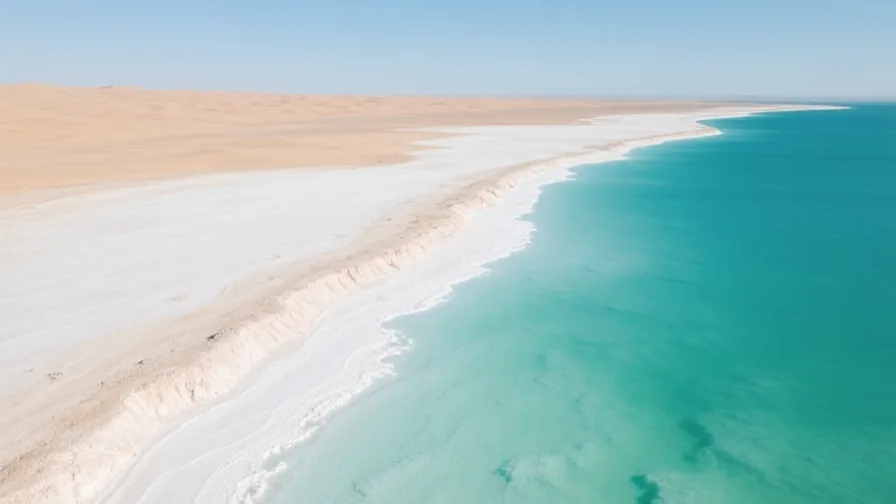 Qatar · AI landscape illustration · Artistic impression
Country · Middle East
Qatar
Saved in this browser — no account needed. Sign in later and it comes with you.
Where it is
Qatar is a low limestone peninsula pushed about 160 kilometres north into the Gulf, with a single land border, in the south, with Saudi Arabia. An inlet of the Gulf separates it from Bahrain. Most of the surface is a barren sandy plain: the highest point, Qurayn Abu al Bawl in the Jebel Dukhan, is only 103 metres, and the lowest, in the Dukhan sabkha, lies about 6 metres below sea level. Rain averages somewhere between 70 and 100 millimetres a year, summers pass 40 °C, and most groundwater is too mineral-rich to drink or irrigate with, so seawater desalination now supplies most of the water. Settlement followed fresh water, in rawdas and wadis, and today over 80% of the people live in Doha.
The land and water around it
The Qatar Archpeninsula
The peninsula is the surface expression of an anticline, the Qatar Arch, wrapped in loose sand and pebbles broken from the outcropping limestone. It covers 11,571 square kilometres. Salt flats called sabkhas form wherever seawater reaches the low ground, especially near Mesaieed and Khor Al Adaid.
Jebel Dukhanridge
A north-south belt of low limestone outcrops on the west flank, from Zekreet to the southern border. It holds the country’s main onshore oil and, in the Dukhan sabkha, the largest inland salt flat in the Gulf. The natural gas fields lie offshore to the north-west.
Khor Al Adaid and the southern desertdesert
In the south-east, rolling dunes surround a sea inlet known as the Inland Sea. The southern desert as a whole, dunes and rocky plains south of Doha’s latitude, takes up about 35% of the country’s area.
Its history, in short
Qatar entered the written record as a coast that others used. Mesopotamian pottery of the Ubaid period, Kassite dye-making on the Al Khor islands and a Sasanian taste for its pearls and purple dye tie it to Gulf trade from early on. Christian communities knew the region as Beth Qatraye, and by the 9th century Murwab had stone houses, two mosques and a fort. Ormus, the Portuguese, the Bani Khalid, the Al Khalifa of Bahrain and Wahhabi forces from Najd followed one another, and the Ottomans arrived in 1871 and withdrew in 1915. The Al Thani rose among the peninsula’s clans in the 1850s, and Britain’s recognition in 1868 marks the start of their rule. Britain made Qatar a protectorate in 1916, and independence followed in 1971. Oil came ashore at Jebel Dukhan, and the gas fields lie offshore to the north-west. Today foreigners are an overwhelming majority: the 2020 census counted about 2.85 million people, of whom around 340,000 were citizens. Scholars and observers widely describe the state as authoritarian, since the emir wields almost all executive, legislative and judicial power, and the Shura Council is fully appointed.
Timeline
Dates are shown on a timeline rather than as changing shapes on the map. The globe draws modern boundaries only, and tinting a modern outline to stand for a historical one would state something we cannot source.
First cities & states
c. 6500–3800 BCE
Ubaid-period visitors
Mesopotamian pottery of the Ubaid period turns up in abandoned coastal settlements. At Al Da’asa, on the west coast, a seasonal camp left nearly sixty fire pits, apparently used to dry fish.
Classical world
From AD 224
A Sasanian coast
The Sasanian Empire takes control of the Gulf’s shores, and Qatar supplies it with pearls and purple dye. Christianity spreads along the coast, and the region is known in Syriac as Beth Qatraye.
Well attestedWikipedia
Post-classical world
9th century
Murwab
Under the Abbasids, Murwab grows to more than a hundred stone houses, two mosques and a fort. Chinese porcelain and coins from West Africa found in Qatar show how far ships calling here had travelled.
Approximate dateWikipedia
Early modern & oceanic
1521
The Portuguese arrive
Portugal seizes much of eastern Arabia after making the Kingdom of Ormus its vassal. A Portuguese map of 1563 shows the “city of Qatar” as a fortress, possibly the fort at Ruwayda.
Well attestedWikipedia
Industrial & imperial
1868
British recognition of the Al Thani
Mohammed bin Thani signs an agreement with Britain that officially recognises Qatar’s separate status and the Al Thani’s rule over the peninsula.
Well attestedWikipedia1916
British protectorate
Abdullah Al Thani signs a treaty by which he can cede territory only to Britain, in return for protection against attack by sea and support in the event of a land attack.
Contemporary
1971
Independence
Qatar declares itself independent, ending the protectorate that began in 1916.
2021–2024
An elected council, then not
Two-thirds of the Shura Council’s seats are filled by a vote in 2021. By 2024 the state has moved to scrap those elections, and the council is again appointed entirely by the emir.
Well attestedWikipedia
Places that carry meaning
Al Da’asaUbaid period
The most extensive Ubaid site in the country, on the west coast. Its fire pits, flint tools, painted pottery and a carnelian bead point to repeated visits by a hunting-fishing group with overseas connections.
Ras AbrouqHellenistic and Parthian periods
A coastal site north of Dukhan with a fishing station that foreign vessels used to dry fish in 140 BCE. A cairnfield of 100 burial mounds nearby, with Seleucid-style pottery, suggests a sizeable seafaring community.
MurwabEarly Islamic or Abbasid
About a hundred small stone houses and the fortified palace of a tribal leader, which may have been the seat of the governor Munzir ibn Sawa. Its date is not settled.
Historian Habibur Rahman, who places it in the early Islamic period, versus accounts that date the town to the Abbasid 9th century
Zubarah18th century onward
A settlement where members of the Al Khalifa moved from Kuwait in 1766 before taking Bahrain in 1783. Its fort was set alight in 1811 during raids on the Wahhabi garrisons.
Languages here
Places are usually multilingual. This lists what is actually spoken, not one language per border.
ArabicSemitic family
The official language, spoken locally as Qatari Arabic.
Qatari Arabic is the local dialect, and Qatari Sign Language serves the native deaf community. Citizens are only about 12% of the population, and there are moves to protect Arabic from the encroachment of English.
EnglishGermanic family
The second language and the common language of business and healthcare.
English is a rising lingua franca, particularly in commerce and in medicine, where it is the working language for training nurses and for dealing with the expatriate community.
South Asian languages
The languages of the largest expatriate communities.
South Asians make up about 60% of residents by a 2017 report, the largest community being Indians, at some 650,000, followed by Nepalese, Bangladeshis, Sri Lankans and Pakistanis. Malayalam, Hindi, Urdu, Tamil, Telugu, Kannada, Nepali, Sinhalese, Bengali and Tulu are all spoken, with Persian, Baluchi, Brahui and Pashto.
Tagalog
The language of the Filipino community, the largest non-South Asian group.
Around 260,000 Filipinos lived in Qatar in 2017, ahead of some 200,000 Egyptians. Indonesian is also spoken.
Learn the language here
- 1Understand which languages are spoken hereQatar is multilingual. Start with which languages are used, by whom, and for what — the phrase list only covers one of them.Written by Globe Quest
- 2Practise with people: Arabic practice · DohaAn in-person practice circle. It is a prepared plan and needs a host before it runs.Run by members
Check yourself
Where did people settle in the interior of Qatar, where groundwater was scarce?
In rawdas, depressions with shallow groundwater
Fresh groundwater decided where people lived. Rawdas held shallow water, and in the far south settlement was largely limited to wadis fed by run-off and to rawdas.
What did the agreement of 1868 between Mohammed bin Thani and Britain recognise?
Qatar’s separate status and Al Thani rule
The Al Thani had risen among Qatar’s clans in the 1850s and accepted Ottoman suzerainty to strengthen their position. British recognition in 1868 is the point from which the family has ruled the peninsula.
Worth arguing about
- A country whose settlement pattern was set by where fresh water could be found now runs on desalinated seawater. What does that change about how far a state can grow, and about what it depends on?
- Citizens are about one in eight of the population, and the council that advises the emir has gone back to being fully appointed. What does citizenship mean in a country where citizens are a small minority?
What we have not established
These are open questions, listed rather than filled in. We would rather show a gap than a plausible guess.
How many people live in Qatar?
The number swings with the season because the country relies on migrant labour. The 2020 census counted 2,846,118 people, a mid-2026 estimate is 3.18 million, and the count depends on who is in the country on the day.
When was Murwab built and by whom?
One historian links the stone houses and palace to the seat of the governor Munzir ibn Sawa in the early Islamic period, while the archaeology elsewhere is read as Abbasid, 9th century. Excavated finds do not decide between them.
Sources
- Wikipedia · QatarWikipedia · encyclopedia · checked 2026-11-24
- Wikipedia · History of QatarWikipedia · encyclopedia · checked 2026-11-24
- Wikipedia · Geography of QatarWikipedia · encyclopedia · checked 2026-11-24
Reviewed by Globe Quest editorial on 2026-11-24. Drafted with AI assistance and checked against the sources above before publication.