 Globe Quest
 Human Quest · LearningSign in
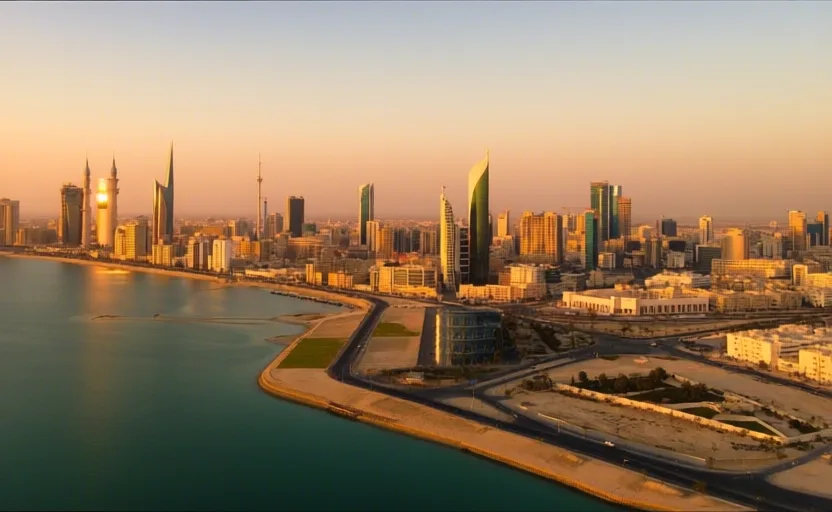 Manama · AI city illustration · Artistic impression
City · Middle East
Manama
Saved in this browser — no account needed. Sign in later and it comes with you.
Where it is
Manama occupies a small peninsula at the north-eastern corner of Bahrain Island, facing the Persian Gulf across low, shallow water. The island is flat or gently rolling and arid, and the city has pushed its edge outward with reclaimed land and artificial islands as much as into the desert behind it. Summer temperatures reach 45 °C, winters can fall to 7 °C, and rain is scarce. The fertile belt is further west, along the island’s northern coast, where springs and date palms have fed farms since antiquity. A harbour on a sheltered coast, rather than any resource of its own, has been what Manama is for.
The land and water around it
The Manama peninsulapeninsula
The city sits on a small peninsula in the north-east of the island. Reclamation has added land along the coast, and development has spread from the old souq and fort onto the reclaimed ground and offshore islands.
The northern palm beltoasis
The north of Bahrain Island is its farming land, with date palms and orchards. Aqueducts built in antiquity watered the fields, and the same area holds roughly 100,000 Dilmun burial mounds.
The pearl oyster bedssea
Offshore beds in the shallow Gulf supported pearling for millennia. Three of them, together with a shore at the southern tip of Muharraq Island from which the boats set out, now form part of a World Heritage property.
Its history, in short
Bahrain was a trading land long before Manama appeared in the record. The Dilmun civilisation here linked Mesopotamia, Magan and the Indus Valley from about 3000 BCE, and later the island was called Tylos by the Greeks. Manama is first named in the fourteenth century, when Bahrain paid tribute to Hormuz, and remained a small port until the Portuguese arrived in the early 1500s. The Safavids expelled them in 1602 and made the nearby town of Bilad Al Qadeem the provincial capital, so Manama grew as a trade and pearling port instead of a seat of government. In 1783 the Bani Utbah invaded, the Al Khalifa began their rule, and ties with Persia were cut. Nineteenth-century invasions and a civil war closed the port. The twin town of Muharraq was capital until 1923 while Manama became the merchants’ city. British reforms, a municipality in 1919, the collapse of pearling around 1927, and oil from 1932 remade it. Bahrain became independent in 1971 and Manama is its capital, now a financial centre whose population is roughly half foreign.
Timeline
Dates are shown on a timeline rather than as changing shapes on the map. The globe draws modern boundaries only, and tinting a modern outline to stand for a historical one would state something we cannot source.
First cities & states
From about 3000 BCE
Dilmun
A trading civilisation based on Bahrain links Mesopotamia, Magan and the Indus Valley. Most of its people lived in rural areas rather than in cities.
Approximate dateWikipedia
Post-classical world
c. 1330
The name Manama is first recorded
The name appears at the time of a visit by Turan Shah of Hormuz, when Bahrain is a tributary of the kingdom of Hormuz. A manuscript of 1345 mentions the town by name.
Approximate dateWikipedia
Early modern & oceanic
1602
Safavids expel the Portuguese
Persian forces end Portuguese control. Manama becomes a regional centre for commerce and pearling, while the neighbouring Bilad Al Qadeem is made the provincial capital.
Well attestedWikipedia1783
The Al Khalifa take Bahrain
The Bani Utbah invade and expel the resident Persian governor. Ahmed ibn Muhammad ibn Khalifa becomes the first ruler of the dynasty, which is still in power today.
Well attestedWikipedia
Industrial & imperial
1919
Municipal government and British control
Manama gets a municipal government, and Bahrain is formally integrated into the British Empire. Civil courts and a land registry follow in the early 1920s.
Well attestedWikipedia1927 onward
The pearl market collapses
Japanese cultured pearls reach the world market. Pearling entrepreneurs lose more than two thirds of their income between 1929 and 1931, and the Depression deepens the debt.
1932
Oil
Oil is discovered in 1932 and exported from 1934, which raises Bahrain’s importance for Britain as the Second World War approaches.
Well attestedWikipedia
Contemporary
1971
Independence
Bahrain ends British protection and becomes independent, with Manama as its capital.
Well attestedWikipedia
Places that carry meaning
Qal’at al-BahrainAbout 2300 BCE to the present
A tell more than 16 hectares large on the north coast, 5.5 kilometres west of Manama, with a sea tower, probably an ancient lighthouse, and a channel cut through the reef. It was the capital of Dilmun, and layers of the Tylos and Islamic periods lie above.
Manama Souq and Bab Al BahrainHistoric core
The old town was once only the souq and the fort to its south, now the Ministry of Interior. The souq and Bab Al Bahrain are still the centre of Muharram processions, which draw hundreds of thousands of people from across the Gulf.
The Muharraq pearling quarterLate 19th and early 20th centuries
Seventeen merchant buildings in the city of Muharraq, with fine timber and plaster work, survive from the peak of the pearl trade and are part of the World Heritage property.
Languages here
Places are usually multilingual. This lists what is actually spoken, not one language per border.
ArabicSemitic family
The language of the native Arab population.
Both main Muslim communities have Arab roots: the Shia Baharna and the Sunni Bedouin tribes who migrated in the eighteenth century with the Bani Utbah.
PersianIndo-Iranian family
The language of the Ajam community and a long influence on the island.
A Persian-descended Shia community, the Ajam, is part of Manama’s population. Persian rule under the Safavids and earlier, and the possible Persian roots of the name Manama, reflect a long connection.
Languages of the migrant community
Spoken by the foreign half of the population.
About half of Bahrain’s residents come from abroad. Manama was already cosmopolitan in 1904, when half its roughly 25,000 people were thought to be foreign, drawn from Basra, Najd, al-Hasa, Iran, India and Europe.
Learn the language here
- 1Understand which languages are spoken hereManama is multilingual. Start with which languages are used, by whom, and for what — the phrase list only covers one of them.Written by Globe Quest
- 2Learn 11 phrasesCurated everyday phrases for Manama, with audio and a written form.Written by Globe Quest
- 3Say them out loudSpeaking practice with pronunciation feedback, one phrase at a time.Globe Quest material, your own additions
- 4Come back to themSpaced review, so what you learned this week is still there next month.Written by Globe Quest
- 5Practise with people: Arabic practice · DohaAn in-person practice circle. It is a prepared plan and needs a host before it runs.Run by members
Check yourself
What was Dilmun?
A trading civilisation linking Mesopotamia and the Indus Valley
The Dilmun civilisation was inhabited from about 3000 BCE and lasted nearly 2,000 years as a trade hub. Qal’at al-Bahrain, close to Manama, was its capital.
What ended Bahrain’s pearl economy?
Cultured pearls from Japan
Japanese cultured pearls, together with the Depression, wiped out pearling income in the late 1920s and early 1930s. Oil came afterwards.
Worth arguing about
- Manama was a merchants’ city while the rulers and scholars sat in nearby towns. What does a city that has never been a seat of power look like, and last, differently?
- Half the population has always come from elsewhere, from 1904 to today. At what point does a cosmopolitan port become a place of its own?
What we have not established
These are open questions, listed rather than filled in. We would rather show a gap than a plausible guess.
When did Manama become the capital?
One account says Muharraq was capital until 1923, and another that Manama was declared capital in 1971 on independence. Which date counts depends on what is meant by capital, since Manama was the commercial centre earlier.
How many people live in Manama?
A 2025 estimate gives about 743,000, while an earlier figure for 2012 is under 300,000. The difference reflects both growth and a wider urban boundary.
Sources
- Wikipedia · ManamaWikipedia · encyclopedia · checked 2026-11-24
- UNESCO · Qal’at al-Bahrain – Ancient Harbour and Capital of DilmunUNESCO World Heritage Centre · intergovernmental · checked 2026-11-24
- UNESCO · Pearling, Testimony of an Island EconomyUNESCO World Heritage Centre · intergovernmental · checked 2026-11-24
Reviewed by Globe Quest editorial on 2026-11-24. Drafted with AI assistance and checked against the sources above before publication.