 Globe Quest
 Human Quest · LearningSign in
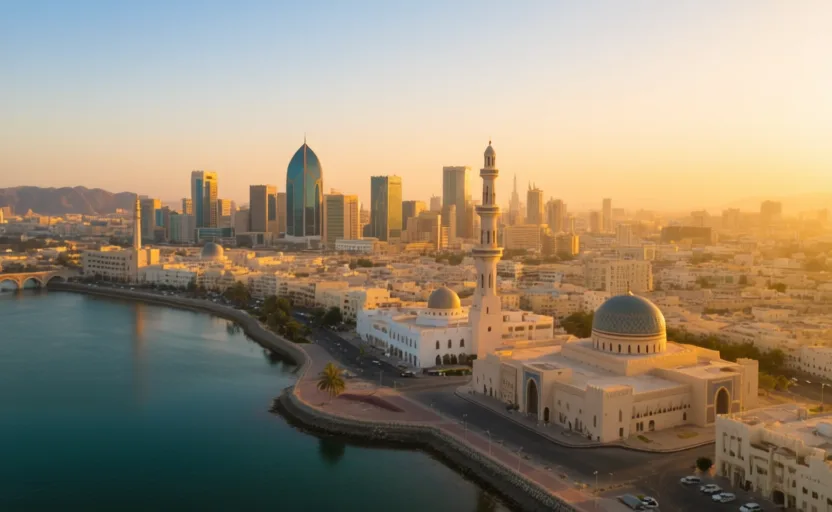 Muscat · AI city illustration · Artistic impression
City · Middle East
Muscat
Saved in this browser — no account needed. Sign in later and it comes with you.
Read its story
Where it is
Between the Hajar Mountains and the Gulf of Oman, Muscat is a coastal city stretched along a narrow shelf. Dark, mostly bare hills of volcanic and plutonic rock close in behind it, and the water off the shore is deep enough to have formed two natural harbours, one at Muttrah and one at Muscat itself. The climate is hot and arid, with about 100 millimetres of rain a year and summer temperatures that sometimes reach 45 degrees. Rain is so rare that single storms from the Arabian Sea, such as Cyclone Gonu in 2007, become landmarks in the city’s recent memory.
The land and water around it
The Central Hajarmountains
The range runs along the northern coast of the city and closes the view inland. The rock is serpentinite, greenstone and basalt, typical of south-eastern Arabia, and the hills are mostly bare, though rich in iron.
The harbours of Muttrah and Muscatharbour
Deep water runs close to the shore here, which gave the coast two sheltered anchorages when much of the rest of the coastline had few. Muttrah, at the north-eastern edge, is where the corniche, the souk and the modern port, Mina Qaboos, stand.
Sabkha and reefscoast
Salt-tolerant plants grow on the salt flats, and the Qurum Nature Reserve holds a freshwater estuary with glassfish. In sheltered bays at Jussah and Khairan there are coral reefs, which survive in water that is otherwise hot and salty.
Its history, in short
Fishermen were burying their dead at Ras al-Hamra in the sixth millennium BCE, and the harbour was already known to Greek geographers in the first century CE as the hidden port. Its value was always as a stop on the sea routes between the Gulf, India and East Africa, so it was fought over by outsiders more than by the interior. The Portuguese admiral Afonso de Albuquerque burned much of it in 1507, and Portugal held it, apart from two Ottoman captures, until the Imam’s forces took it back in January 1650. The Al Bu Said dynasty then built Muscat into a naval power whose reach extended to Zanzibar, and in 1793 the capital was moved to the coast from Rustaq. Merchants from Sindh and Gujarat, Balochs and Persians settled here, and by the nineteenth century Hindu merchants dominated trade. The interior and the coast were often at odds, and tribes from inland attacked Muscat and Muttrah in 1895 and 1915. After 1970 the city was rebuilt almost from scratch, with a new port, an airport at Seeb and ministries for health and education.
Timeline
Dates are shown on a timeline rather than as changing shapes on the map. The globe draws modern boundaries only, and tinting a modern outline to stand for a historical one would state something we cannot source.
First cities & states
6th millennium BCE
Fishermen’s graves at Ras al-Hamra
Neatly formed burials of fishing people indicate settled communities with burial ritual. Harappan pottery found to the south suggests early contact with the Indus Valley.
Approximate dateWikipedia
Classical world
1st century CE
A named port
Ptolemy refers to a place he calls Cryptus Portus, the Hidden Port, and Pliny the Elder to Amithoscuta. Scholars are divided on which ancient names refer to Muscat, so these identifications are not certain.
DisputedWikipediaScholars disagree over which of the classical names refers to Muscat.
Early modern & oceanic
1507
Albuquerque conquers Muscat
His ships are fired on as they approach the harbour, and he decides to take the town. Most of it burns during and after the fighting.
Well attestedWikipedia23 January 1650
Portuguese surrender
A small force of the Imam’s troops attacks the port at night and the Portuguese capitulate. The Al Jalali and Al-Mirani forts are the best-known buildings that they left behind.
Well attestedWikipedia1793
Capital moves to Muscat
The seat of government is transferred from Rustaq in the interior to the port.
Well attestedWikipedia
Industrial & imperial
21 September 1833
Treaty with the United States
Said bin Sultan signs a treaty with Edmund Roberts, the representative of President Andrew Jackson, at a time when Muscat’s naval strength is at a peak.
Well attestedWikipedia
Contemporary
1970
Qaboos and the new city
Qaboos bin Said takes power in a coup at the Salalah palace, where his father had been living. Muscat then grows rapidly under a series of five-year plans, the first in 1976.
Well attestedWikipedia6 June 2007
Cyclone Gonu
The cyclone damages property and infrastructure across the city. Cyclone Phet in 2010 brought more than 100 millimetres of rain in a single day.
Well attestedWikipedia
Places that carry meaning
MuttrahPort district
The north-eastern waterfront district with the harbour, corniche and souks, where dates, mother of pearl and fish were the traditional goods. It also had the highest number of expatriate residents in the governorate at the 2003 census.
Al Jalali and Al-Mirani forts16th century onward
Portuguese-built forts that guard the harbour and are the city’s most prominent surviving buildings from the period of Portuguese rule.
RuwiFrom the 1970s
A village in Muttrah that became a commercial district when offices, warehouses, shops and homes were built there. It is one of the clearest products of the post-1970 rebuilding.
Qurum Nature ReservePresent
A reserve of salt-marsh vegetation and freshwater estuary on the coast, rare green ground in a city of bare hills.
Languages here
Places are usually multilingual. This lists what is actually spoken, not one language per border.
ArabicSemitic family
The predominant language of the city, as across Oman.
Arabic is spoken by Omanis and shared by many residents who arrive from elsewhere. Oman’s varieties differ from the Gulf Arabic of the east of the peninsula.
EnglishGermanic family
Common language between Omanis and the many immigrant communities.
Expatriates made up more than 60 per cent of the labour force at the 2003 census, most of them men, and many work in engineering and construction.
BalochiIndo-European family
Language of the Baloch community, one of the long-settled immigrant groups.
Balochs settled in the port alongside Persians and Sindhis because of its trade. Around a fifth of Omanis are of Baloch descent.
Gujarati and SindhiIndo-European family
Languages of the merchant families from western India.
Hindu merchants from Sindh and Kutch dominated trade in the nineteenth century, and four Hindu temples are recorded around 1760. Today Hindi, Urdu, Malayalam, Tamil, Bengali and many other South Asian languages are heard too, along with Swahili.
Learn the language here
- 1Understand which languages are spoken hereMuscat is multilingual. Start with which languages are used, by whom, and for what — the phrase list only covers one of them.Written by Globe Quest
- 2Learn 11 phrasesCurated everyday phrases for Muscat, with audio and a written form.Written by Globe Quest
- 3Say them out loudSpeaking practice with pronunciation feedback, one phrase at a time.Globe Quest material, your own additions
- 4Come back to themSpaced review, so what you learned this week is still there next month.Written by Globe Quest
- 5Practise with people: Arabic practice · DohaAn in-person practice circle. It is a prepared plan and needs a host before it runs.Run by members
- 6Read why the language is what it isThe quest for this place covers how its languages got here and who speaks them.Written by Globe Quest
Check yourself
When was Oman’s capital moved from Rustaq to Muscat?
1793
In 1793 the seat of power shifted from the interior to the port. The move underlined the dynasty’s maritime orientation, though the interior and coast kept quarrelling until the 1970s.
Why did Muscat develop two natural harbours?
Deep water lies close to the shore, forming sheltered anchorages at Muttrah and Muscat
The shore drops away into deep water beside the hills, so ships could anchor in the shelter of headlands. That is the physical basis of the city’s long role as a trading port.
Worth arguing about
- For centuries Muscat looked to India and East Africa more than to inland Arabia. How much does that maritime outlook still shape the capital?
- Expatriates made up over 60 per cent of the labour force at the last census the city recorded. What does a city owe the people who build it but cannot become citizens?
What we have not established
These are open questions, listed rather than filled in. We would rather show a gap than a plausible guess.
How many people live in Muscat?
The governorate had about 1.72 million residents in 2022, but earlier counts and the city proper give far lower figures, and the metropolitan area covers six provinces. The total depends on where the boundary is drawn.
Where does the name Muscat come from?
Derivations proposed include an Arabic word for an inflated hide, a word for anchorage, an Old Persian word for strong-scented, and an Arabic word for hidden. None is established.
Sources
- Wikipedia · MuscatWikipedia · encyclopedia · checked 2026-11-24
- Wikipedia · OmanWikipedia · encyclopedia · checked 2026-11-24
Reviewed by Globe Quest editorial on 2026-11-24. Drafted with AI assistance and checked against the sources above before publication.