 Globe Quest
 Human Quest · LearningSign in
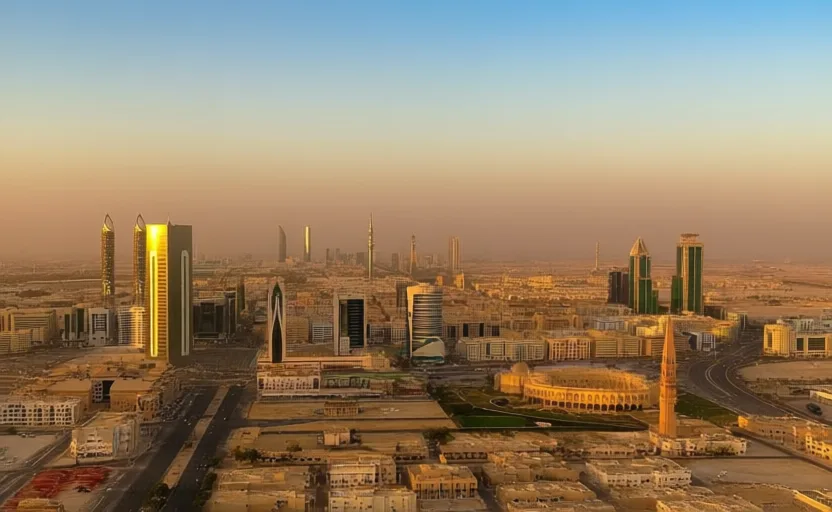 Al Khobar · AI city illustration · Artistic impression
City · Middle East
Al Khobar
Saved in this browser — no account needed. Sign in later and it comes with you.
Where it is
Al Khobar faces the Persian Gulf from the Eastern Province of Saudi Arabia, on a flat coast with a desert climate. Summers last about five months, from May to September, and are very hot and dry, while winters are mild to warm with occasional rain, thunderstorms and small spells of hail. Like Dammam next door, the city traps heat after dark, an urban heat island effect. A sixteen-kilometre corniche follows the eastern shore, and to the south the coast curves into Half Moon Bay, which makes Khobar the Gulf-facing resort of a region otherwise given over to oil.
The land and water around it
The Gulf shore and cornichecoast
The eastern edge of the city is a continuous waterfront, divided into a north and a south corniche. The northern shore has been turned into a promenade, and the Khobar Water Tower stands on an artificial peninsula there.
Half Moon Baybay
South of the city centre the coast bends into a sheltered bay with beaches, which have become the site of resorts. This stretch gave the town a leisure role that its first fishing community could not have imagined.
A hot desert coastclimate
Temperatures average 33 degrees by day and 22 by night through the year, and the changes between seasons are quick, with only April and October as brief transitions. Large swings are rare, especially in summer.
Its history, in short
Khobar began in the early twentieth century as a fishing hamlet. In 1923 members of the Dawasir tribe settled there, with the permission of King Abdulaziz, because they feared British persecution and wanted to be close to Bahrain, to which they hoped to return. Oil changed it. After the discovery in the 1930s, a port was built at the southern end of the town to ship petroleum out to Bahrain, and Khobar briefly became a commercial and industrial harbour as well as a residential centre. Then commercial operations moved to King Abdulaziz Port in Dammam and oil exports to Ras Tanura. Khobar kept its function as the residential core of the area, and its streets filled with markets and shops. In 1986 the King Fahd Causeway linked it to Bahrain.
Timeline
Dates are shown on a timeline rather than as changing shapes on the map. The globe draws modern boundaries only, and tinting a modern outline to stand for a historical one would state something we cannot source.
Industrial & imperial
1923
The Dawasir settle
A group of the Dawasir tribe moves to the coast, with the permission of King Abdulaziz, fearing British persecution. Khobar and Dammam are founded in this period.
Well attestedWikipedia1938
Oil is found nearby
Large oil reserves are discovered along the Gulf coast in Al-Hasa, and full development begins in 1941 under Aramco. Khobar becomes the port for the company’s early exports.
1942
Governorate incorporated
Khobar is formally constituted as a governorate, with a port in the south of the city to serve the oil trade with Bahrain.
Well attestedWikipedia
Contemporary
25 November 1986
King Fahd Causeway opens
A chain of causeways and bridges, about 25 kilometres between the toll plazas, joins Saudi Arabia to Bahrain from the edge of Khobar.
Well attestedWikipedia1996 and 2004
Militant attacks
Islamist militants carry out attacks in the city in 1996 and again in 2004, part of a wider run of violence in Saudi cities in the early 2000s.
Places that carry meaning
Khobar CornicheModern
A 16-kilometre strip of parks and promenade along the Gulf, split into northern and southern parts.
King Fahd Causeway1986
The 25-kilometre road link to Bahrain, 23.2 metres wide, with capacity for 28,000 cars and 1,000 trucks.
Suwaiket StreetOld town
Officially named Prince Bandar ibn Abdulaziz Street, it holds some of the oldest markets in the city and reflects Khobar’s tradition as a town of shopkeepers and merchants.
Khobar Water TowerModern
A 90-metre, eight-storey tower with a revolving restaurant at the top, on a man-made peninsula at the north end of the corniche. It hosts fireworks at Ramadan and the two Eids.
Languages here
Places are usually multilingual. This lists what is actually spoken, not one language per border.
ArabicSemitic family
Official and everyday language of citizens.
The Gulf dialect group is one of four regional varieties of Arabic spoken by Saudis, with just under a million speakers across the kingdom. Egyptian and Levantine Arabic are also carried by expatriate residents.
South Asian languagesIndo-European family
Languages of the expatriate majority.
Expatriates make up most of the city’s population, and the 2019 Sharqiah Season included a Bollywood festival aimed at them. Across the kingdom, Bengali, Punjabi, Urdu and Malayalam are among the most widely spoken foreign languages.
Learn the language here
- 1Understand which languages are spoken hereAl Khobar is multilingual. Start with which languages are used, by whom, and for what — the phrase list only covers one of them.Written by Globe Quest
- 2Learn 11 phrasesCurated everyday phrases for Al Khobar, with audio and a written form.Written by Globe Quest
- 3Say them out loudSpeaking practice with pronunciation feedback, one phrase at a time.Globe Quest material, your own additions
- 4Come back to themSpaced review, so what you learned this week is still there next month.Written by Globe Quest
- 5Practise with people: Arabic practice · DohaAn in-person practice circle. It is a prepared plan and needs a host before it runs.Run by members
Check yourself
Who settled Khobar in 1923?
Members of the Dawasir tribe, with King Abdulaziz’s permission
The Dawasir moved to the coast fearing British persecution, and they chose the spot for its closeness to Bahrain, where they hoped eventually to return. Khobar was then a fishing hamlet.
Why did Khobar stop being the main oil and trade port?
Commercial operations moved to Dammam and oil exports to Ras Tanura
King Abdulaziz Port at Dammam took over trade, and Ras Tanura took over petroleum. That left Khobar as the area’s residential and shopping core instead of an industrial harbour.
Worth arguing about
- Khobar began as a refuge for a tribe that hoped to go home, then became an oil town, then a shopping and residential city. Which of these identities is the real one?
- The causeway joins two countries but expatriates are the majority of residents. Who is the city really built for?
What we have not established
These are open questions, listed rather than filled in. We would rather show a gap than a plausible guess.
How many people live in Al Khobar?
About 410,000 people live in the city core and about 659,000 in the governorate as of 2022, so the answer depends on the boundary. Khobar also merges into the wider Dammam metropolitan area.
Sources
- Wikipedia · KhobarWikipedia · encyclopedia · checked 2026-11-24
- Wikipedia · Saudi ArabiaWikipedia · encyclopedia · checked 2026-11-24
Reviewed by Globe Quest editorial on 2026-11-24. Drafted with AI assistance and checked against the sources above before publication.