 Globe Quest
 Human Quest · LearningSign in
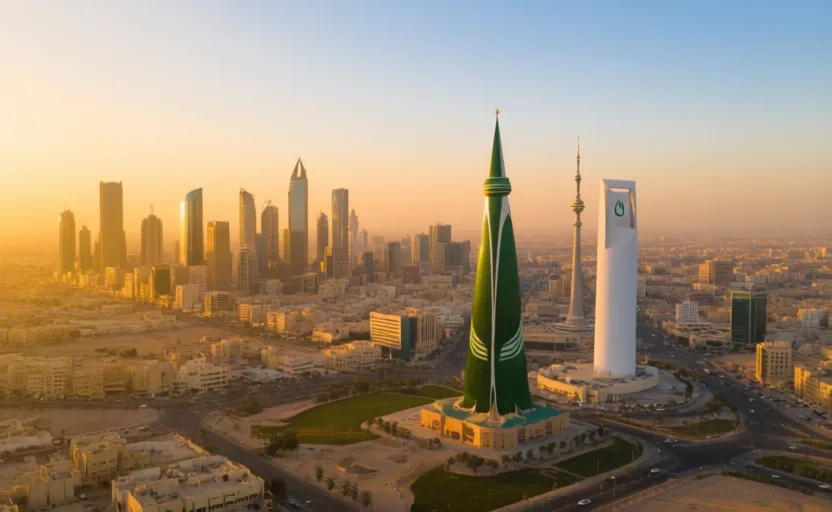 Dammam · AI city illustration · Artistic impression
City · Middle East
Dammam
Saved in this browser — no account needed. Sign in later and it comes with you.
Where it is
Dammam is built on the shallow waters of the Persian Gulf, and much of the ground under it is reclaimed seabed. It has the hot desert climate of the whole Eastern Province: temperatures above 40 degrees by day from May to September, nights sometimes above 35, and extreme humidity. A record of 51 degrees was set on 13 August 2021, and January 2008 saw 0.8. Dust storms called shamals arrive from the north in summer. There is no river and little rain, so the city lives on seawater: desalination plants supply its drinking water and, in effect, its whole expansion.
The land and water around it
The shallow Gulfgulf
Wide stretches of the shallow Persian Gulf off Dammam have been filled in to make new land. The coast is therefore partly artificial, and its beaches remain a destination for local fishermen and families.
Shamals and heatclimate
Winters are mild with rain in November, December and January, sometimes in heavy storms with hail, while summers combine extreme heat and humidity intensified by the urban heat island. The shamal, a dust-bearing wind from the north, is the characteristic summer hazard.
Its history, in short
For most of its history Dammam was a small coastal place, with a fort that the Second Saudi State held and that repelled a British attack in 1866. Its modern life starts with oil. A concession was signed in 1933 with Standard Oil of California, geologists were sent in 1934, and drilling began in 1935. The first wells disappointed, but Dammam No. 7, started in December 1936, reached productive oil by March 1938 and proved that the kingdom sat on very large reserves. The settlement then grew from about 22,000 people in 1950 to 759,000 in 2000, among the fastest-growing cities of the world in that period. The state planned it deliberately, with broad straight roads, residential areas apart from commercial ones, a railway linking it to Riyadh, an airport in 1961 and two industrial cities. It is now the seat of the Eastern Province, the fifth-largest city in Saudi Arabia, and the core of a metropolitan area with Khobar and Qatif.
Timeline
Dates are shown on a timeline rather than as changing shapes on the map. The globe draws modern boundaries only, and tinting a modern outline to stand for a historical one would state something we cannot source.
Industrial & imperial
1866
A British attack is repelled
British forces attack the fort at Dammam, then under the Second Saudi State, and are defeated.
Well attestedWikipedia1933
The oil concession
King Abdulaziz’s government and Standard Oil of California sign an agreement in Jeddah. A team of geologists is sent to Dammam, and they finalise drilling plans in June 1934.
Well attestedWikipedia1935–1936
The first wells
Drilling of Dammam No. 1 begins on 30 April 1935. The results are poor and work stops on 4 January 1936, and the next wells in the area are also disappointing.
Well attestedWikipedia4 March 1938
Dammam No. 7 strikes oil
The seventh well, started in December 1936, begins producing a promising quantity. Later named the Prosperity Well, it shows that the kingdom has huge hydrocarbon reserves.
Well attestedWikipedia
Contemporary
1950–2000
A boom town
The population rises from about 22,000 to 759,000, making Dammam the tenth-fastest-growing city in the world over those fifty years.
Well attestedWikipedia1961
Dhahran International Airport
The airport opens to tie the oil region to the rest of the kingdom and the world. By then a railway already ran inland through Kharj to Riyadh.
Well attestedWikipedia1999
King Fahd International Airport
All commercial flights move to this larger airport, about 20 kilometres north-west of the city.
Well attestedWikipedia
Places that carry meaning
Dammam No. 71936–1938
The well that proved the scale of the kingdom’s oil, known as the Prosperity Well. Saudi Aramco dug it.
The first Industrial CityLate 20th century
Built in open ground between Dammam, Khobar and Dhahran to foster industry beyond oil, it holds 124 factories and was soon surrounded by the growing urban area. A second, larger one was founded farther out along Highway 615.
King Abdulaziz Center for World Culture (Ithra)21st century
A cultural complex with a museum, children’s museum, library, cinema and theatre, designed by the firm Snøhetta of Norway. It drew a million visitors in 2019.
Languages here
Places are usually multilingual. This lists what is actually spoken, not one language per border.
ArabicSemitic family
Official language of the kingdom and of daily life for citizens.
Saudi Arabic falls into four main dialect groups: Najdi, Hejazi, Gulf and the southern Hejaz-Tihama varieties. A visitor to the Eastern Province may hear any of them, since citizens and foreign workers alike use the city.
Urdu and BengaliIndo-European family
Languages of South Asian workers, a large share of the foreign population.
Indian and Pakistani communities are the largest foreign groups in Saudi Arabia, and Bengali, Punjabi and Urdu are among the main expatriate languages. Foreign-born residents make up roughly 40 per cent of the country’s population.
Learn the language here
- 1Understand which languages are spoken hereDammam is multilingual. Start with which languages are used, by whom, and for what — the phrase list only covers one of them.Written by Globe Quest
- 2Learn 11 phrasesCurated everyday phrases for Dammam, with audio and a written form.Written by Globe Quest
- 3Say them out loudSpeaking practice with pronunciation feedback, one phrase at a time.Globe Quest material, your own additions
- 4Come back to themSpaced review, so what you learned this week is still there next month.Written by Globe Quest
- 5Practise with people: Arabic practice · DohaAn in-person practice circle. It is a prepared plan and needs a host before it runs.Run by members
Check yourself
What made Dammam No. 7 important?
It produced oil in 1938 and proved the kingdom’s huge reserves
Most of the earlier wells gave poor results, and work on the seventh began in December 1936. By March 1938 it was producing a promising amount of oil.
How does Dammam get most of its water supply?
From desalination plants on the Gulf
There are no permanent rivers in Saudi Arabia, so the city draws on seawater treated in desalination plants. The expansion of those plants sets the pace of urban and industrial growth.
Worth arguing about
- Dammam was laid out on the principles of modern planning from the outset, with separate zones and wide roads. What does it gain and lose by being a planned city rather than an old one?
- A rising water table is damaging the city’s foundations, and leaking pipes are the main cause. What does that tell us about the hidden costs of fast growth in a desert?
What we have not established
These are open questions, listed rather than filled in. We would rather show a gap than a plausible guess.
How many people live in Dammam?
The city had 1.39 million residents in 2022 and the metropolitan area 2.74 million, including Khobar and Qatif. Which figure counts depends on the boundary, and older counts such as 903,000 in 2010 are not directly comparable.
Sources
- Wikipedia · DammamWikipedia · encyclopedia · checked 2026-11-24
- Wikipedia · Saudi ArabiaWikipedia · encyclopedia · checked 2026-11-24
Reviewed by Globe Quest editorial on 2026-11-24. Drafted with AI assistance and checked against the sources above before publication.