 Globe Quest
 Human Quest · LearningSign in
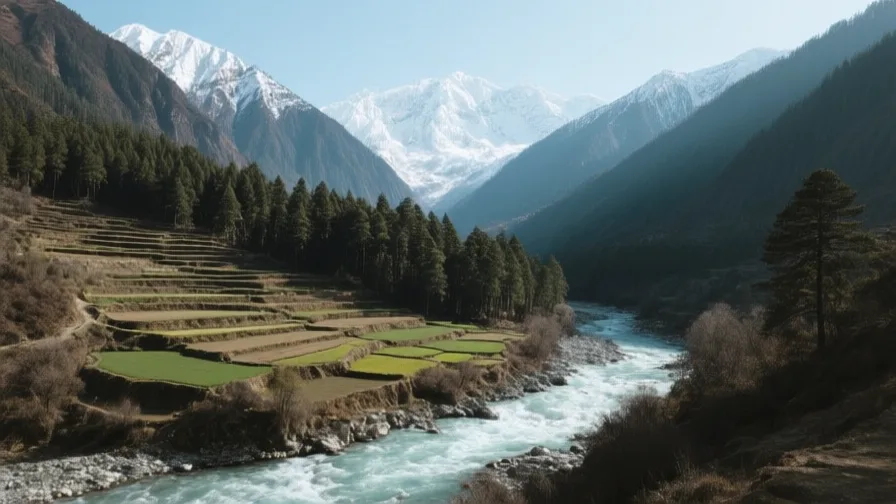 Bhutan · AI landscape illustration · Artistic impression
Country · South Asia
Bhutan
Saved in this browser — no account needed. Sign in later and it comes with you.
Where it is
Bhutan is a landlocked country of about 38,000 square kilometres on the southern slopes of the eastern Himalayas, with Tibet along its northern edge and Indian states on the other three sides. Almost all of it is steep ground cut by fast rivers that run south into India and the Brahmaputra. Most people live in isolated valleys between the high peaks of the north, which pass 7,000 metres, and a narrow strip of subtropical plain along the Indian border. Climate follows altitude, and the monsoon falls hardest in the west.
The land and water around it
The Himalayan wall and the Gangkhar Puensum massifmountains
The north of the country is rock, ice and wind-scoured alpine meadow. Gangkhar Puensum, at 7,570 metres, is the highest point and is described as the highest unclimbed mountain in the world. Passes between the valleys, such as the Dochu La and the Chele La, are what make a road network possible at all.
The valleys of the highlandsvalley
Rivers fall steeply from the glaciers, carve deep gorges and drain toward the Brahmaputra. Between the ridges lie separate valleys that hold most of the population, which is a large part of why Bhutan was historically a patchwork of local rulers and why each valley still has its own dzong and its own language.
The southern foothills and plainplain
In the far south the forest thins into the tropical plain of the Duars, the flat land at the foot of the mountains. It holds most of the country’s small arable share, mainly rice, and it is the strip that Britain pushed against in the nineteenth century, taking much of it from Bhutan.
Its history, in short
Bhutan’s early centuries are known mainly through Buddhist chronicles. Tibetan influence brought temples in the seventh century, and the traditional date for Buddhism taking firm hold is 746, tied to an exiled Indian king in Bumthang. For long afterwards there was no central government, only valley rulers and competing monastic schools, until the Drukpa lineage rose to dominance. In the early seventeenth century the lama Ngawang Namgyal, the Zhabdrung, fled Tibet, repelled Tibetan invasions, built a chain of fortress-monasteries called dzongs and issued a law code that bound local lords to the centre. Civil strife followed his death. Ugyen Wangchuck gained control in the 1880s and was enthroned as the first hereditary king in 1907. Britain pressed on the southern borderlands, and the 1910 Treaty of Punakha made Bhutan a de facto protectorate without colonising it. A treaty with India followed in 1949. Bhutan joined the United Nations in 1971, lifted its television ban in 1999 and became a parliamentary constitutional monarchy in 2008.
Timeline
Dates are shown on a timeline rather than as changing shapes on the map. The globe draws modern boundaries only, and tinting a modern outline to stand for a historical one would state something we cannot source.
Post-classical world
627–649
Tibetan temples in the valleys
The Tibetan king Songtsen Gampo, a Buddhist convert, extends his empire toward Sikkim and Bhutan and is credited with two temples, Jambay Lhakhang in Bumthang and Kyichu Lhakhang in the Paro valley.
Approximate dateWikipedia746
Buddhism takes root in Bumthang
Buddhism is spread in earnest under King Sindhu Raja, an exiled Indian ruler with a base at Bumthang. A later tradition places the saint Padmasambhava, known locally as Guru Rinpoche, in the country in 746 and others give 810, so the exact year is held loosely.
Early modern & oceanic
1616
The Zhabdrung unifies the valleys
Ngawang Namgyal, a lama from Tibet, defeats three Tibetan invasions, subdues rival religious schools, and issues the Tsa Yig legal code. The network of dzongs he builds remains the seat of both monasteries and district administration.
1627
First Europeans arrive
The Portuguese Jesuits Estêvão Cacella and João Cabral, on their way to Tibet, meet the Zhabdrung and stay nearly eight months. Cacella’s letter is one of the few surviving first-hand accounts of him.
Well attestedWikipedia
Industrial & imperial
1907
A hereditary monarchy
After consolidating power from 1885, Ugyen Wangchuck is enthroned as the first king. In 1910 the Treaty of Punakha makes Bhutan effectively a British protectorate, though never formally a colony.
Contemporary
1949
Treaty with India
A treaty signed at Darjeeling has each side recognise the other’s sovereignty. India keeps a consultative role in Bhutan’s foreign relations until a revised version took effect on 1 January 2011.
Well attestedWikipedia1971
United Nations membership and Dzongkha
Bhutan joins the UN, and Dzongkha is declared the national language in the same year.
2008
A parliamentary constitutional monarchy
After the 1999 lifting of the television ban, a new constitution, and elections in 2007 and 2008, the fifth king, Jigme Khesar Namgyel Wangchuck, is crowned on 6 November 2008 in the new system.
Well attestedWikipedia
Places that carry meaning
The dzongsFrom the 17th century
Fortress-monasteries built to hold the valleys against Tibetan raids and to hold local lords to the centre. Many are still active religious centres and district offices. Trongsa’s is described as the largest and most magnificent.
Bumthang7th–8th century onward
A central valley where Jambay Lhakhang stands and where Buddhism is said to have entered. It was the base of the exiled king Sindhu Raja and the most prominent of the early small kingdoms.
Paro7th century onward
A valley with Kyichu Lhakhang, one of the early temples, and the site of the international airport.
Languages here
Places are usually multilingual. This lists what is actually spoken, not one language per border.
DzongkhaSino-Tibetan family
The national language, dominant in the west and in government.
Declared the national language in 1971 and compulsory in schools, though only about 160,000 people spoke it as a first language in 2006. Most Bhutanese learn it as a second language. It is written in a local variant of the Tibetan script.
TshanglaSino-Tibetan family
The main language of the east.
About 138,000 speakers, the mother tongue of the Sharchops, and formerly a lingua franca of the eastern region.
NepaliIndo-European family
The language of the southern Lhotshampa communities.
The one Indo-Aryan language native to Bhutan, with about 265,000 speakers in 2006, mostly in the south. The government taught it in southern schools until the 1980s and then dropped it from the curriculum as Dzongkha was promoted.
EnglishGermanic family
The medium of instruction in schools.
Not an official language, but in practice the second language of educated Bhutanese and the language of much administration, education and media.
Learn the language here
Check yourself
What did Ngawang Namgyal, the Zhabdrung, do in the early seventeenth century?
He unified the valleys, built dzongs and issued a legal code
The Zhabdrung defeated Tibetan invasions, subdued rival schools and set out the Tsa Yig code, giving a patchwork of valley rulers a common law and a chain of fortresses.
Which language is the mother tongue of the Sharchops and dominant in eastern Bhutan?
Tshangla
Tshangla has about 138,000 speakers, close behind Dzongkha’s 160,000 native speakers, and it was once a lingua franca of the east, which shows how the national language is mostly a second language.
Worth arguing about
- Bhutan’s heartland was never successfully invaded and it was never colonised, yet it lived under a British protectorate and an Indian treaty. What does independence mean for a small state between two large ones?
- Dzongkha is the national language and Nepali was dropped from southern classrooms in the 1980s. When does promoting a national language protect a culture, and when does it push a minority out?
What we have not established
These are open questions, listed rather than filled in. We would rather show a gap than a plausible guess.
What happened to the Lhotshampa in the 1980s and 1990s?
The Nepali-speaking minority in the south saw its language dropped from schools in the 1980s, and some outside accounts describe the 1990s treatment of the community as ethnic cleansing. Accounts differ on scale and cause, and no agreed figures for those who left are given here.
Which year did Buddhism firmly take root?
Accounts give 746 for the arrival of the Indian king Sindhu Raja and the spread of the faith, and 810 for Padmasambhava’s visit, and an earlier introduction as early as the 2nd century is also suggested. The chronicles are the evidence and they do not agree.
Sources
- Wikipedia · BhutanWikipedia · encyclopedia · checked 2026-11-24
- Wikipedia · History of BhutanWikipedia · encyclopedia · checked 2026-11-24
- Wikipedia · Geography of BhutanWikipedia · encyclopedia · checked 2026-11-24
- Wikipedia · Languages of BhutanWikipedia · encyclopedia · checked 2026-11-24
Reviewed by Globe Quest editorial on 2026-11-24. Drafted with AI assistance and checked against the sources above before publication.