 Globe Quest
 Human Quest · LearningSign in
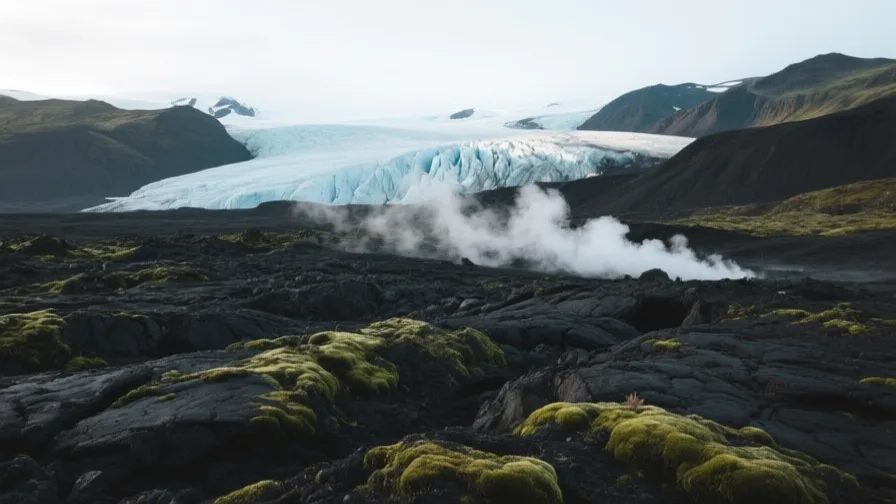 Iceland · AI landscape illustration · Artistic impression
Country · Europe
Iceland
Saved in this browser — no account needed. Sign in later and it comes with you.
Where it is
Iceland is an island of about 103,000 square kilometres lying across the Mid-Atlantic Ridge, just south of the Arctic Circle, where the Eurasian and North American plates pull apart. The interior is a volcanic plateau of lava fields, sand, mountains and glaciers, with half the land lying in the uninhabitable Highlands, so people live on the coast, above all in the southwest. The North Atlantic Current keeps the coasts ice-free through winter and the climate far milder than the latitude suggests, but summers stay cool and the weather is windy. It is Europe’s most sparsely populated country, with roughly 395,000 residents.
The land and water around it
The Mid-Atlantic Ridgevolcano
Iceland is the only large landmass that lies on a mid-ocean ridge above sea level. The rift crosses it from the southwest to the northeast, and volcanoes, geysers and hot springs follow the line, from Hekla, Eldgjá and Katla in the south to the Reykjanes peninsula in the southwest.
The Highlandsplateau
About half of Iceland is a recently formed mountainous lava desert reaching 2,110 metres. It is almost empty of people, so the inhabited country is a rim of coast, deeply indented by bays and fjords.
Glaciersglacier
Around 10.2% of the land is under ice, which is retreating faster each year. Vatnajökull, at 7,764 square kilometres, is by far the largest, and the volcanoes of the south sit beside Mýrdalsjökull and Eyjafjallajökull.
Its history, in short
Irish monks may have reached the island before the Norse, and a cabin on the Reykjanes peninsula was abandoned between 770 and 880, but the conventional date for permanent settlement is 874, when the Norwegian chieftain Ingólfur Arnarson settled where Reykjavík now stands. Settlers were mainly Norwegian, together with Irish and Scottish people, some of them slaves or servants. By 930 the chieftains had set up the Althing, one of the world’s oldest parliaments, and the island was run as a commonwealth without a king until feuding in the Sturlung age ended in submission to Norway in 1262–1264. Rule passed to Denmark; Lutheranism was imposed in 1550, and trade monopolies and natural disasters shrank the population. A colder nineteenth century drove about 15,000 of 70,000 people to emigrate. Independence came in stages: a constitution in 1874, home rule in 1904, sovereignty in union with Denmark in 1918 and the republic in 1944. Fishing, American-built infrastructure and later banking reshaped a poor farming society, and a 2008 financial crisis forced a hard reset.
Timeline
Dates are shown on a timeline rather than as changing shapes on the map. The globe draws modern boundaries only, and tinting a modern outline to stand for a historical one would state something we cannot source.
Post-classical world
874
Settlement by Ingólfur Arnarson
The Landnámabók dates the first permanent settlement to 874. It was compiled some three centuries later, and archaeology suggests people may have arrived earlier, since a longhouse found at Stöðvarfjörður may date to about 800.
930
The Althing
Chieftains set up a national assembly and govern the island without a king, in the period known as the Commonwealth. The Althing was suspended from 1799 to 1845, but Iceland still claims one of the longest-running parliaments.
1262–1264
Submission to Norway
After the violent Age of the Sturlungs, the Old Covenant brings Iceland under the Norwegian crown. Norway was later united with Sweden and then Denmark.
Early modern & oceanic
1550
Lutheranism imposed
Under Danish rule, Jón Arason, the last Catholic bishop, and two of his sons are beheaded, and Iceland becomes officially Lutheran.
Well attestedWikipedia
Industrial & imperial
1874
A constitution
Iceland receives its own constitution, and the Althing gains limited legislative power.
Well attestedWikipedia1 December 1918
Sovereign kingdom in union with Denmark
The Danish–Icelandic Act of Union recognises Iceland as a fully sovereign state sharing a monarch with Denmark. The treaty runs for 25 years.
Well attestedWikipedia17 June 1944
The republic
After a four-day plebiscite in which 97% voted to end the union, Iceland becomes a republic with Sveinn Björnsson as its first president.
Well attestedWikipedia
Contemporary
2009
After the financial crisis
A privatised banking sector had made Iceland one of the richest countries in the world by 2007, until a financial crisis hit it hard. Net emigration reached 5,000 people in 2009, the largest outflow since 1887.
Well attestedWikipedia
Places that carry meaning
Reykjavík874 onward; chartered 1786
The capital and the only city for most of Icelandic history. It holds about 35% of the country’s population.
Þingvellir10th century onward
The site where the Althing was located until it was suspended, and now one of Iceland’s three national parks, alongside Vatnajökull and Snæfellsjökull.
The Reykjanes peninsulaOngoing
A south-western peninsula of lava fields, hot springs and sulphur springs with very little vegetation, close to where an abandoned cabin dated to 770–880 was found.
Languages here
Places are usually multilingual. This lists what is actually spoken, not one language per border.
IcelandicGermanic family
The official written and spoken language.
A North Germanic language that has changed less from Old Norse than its Nordic relatives and keeps more verb and noun inflection. Planned coining of words from native roots, rather than borrowing, and long isolation explain this. It is the only living language to keep the runic letter Þ in Latin script, and its closest relative is Faroese.
Icelandic Sign Language
Officially recognised as a minority language in 2011.
Used by Iceland’s deaf community, with its use in education regulated by the national curriculum guide.
English and DanishGermanic family
Compulsory school subjects.
Both are taught to every pupil. Denmark was the ruling kingdom in practice from 1523 until 1918.
Learn the language here
Check yourself
What makes Iceland unusual among large islands?
It is the only large landmass sitting on a mid-ocean ridge above sea level
The Mid-Atlantic Ridge runs through it, where the Eurasian and North American plates move apart, which is why it has so many volcanoes and hot springs.
How did Iceland become a republic?
By a plebiscite in 1944, after the union treaty with Denmark ran out
The 1918 union treaty lasted 25 years. A four-day vote in May 1944 ended the union, and the republic was declared on 17 June.
Worth arguing about
- Iceland deliberately coins new words from old roots rather than borrowing them. Is that language planning a gift to a small nation or a burden?
- Almost everyone lives on the coast while half the land is uninhabitable. How does a country that empty think about its interior?
What we have not established
These are open questions, listed rather than filled in. We would rather show a gap than a plausible guess.
When did people first settle Iceland?
The traditional date of 874 comes from a medieval book written some three centuries afterwards. Radiocarbon dating of a cabin at Hafnir and a longhouse at Stöðvarfjörður points to earlier occupation, and whether Irish monks lived there first is unproven.
Sources
- Wikipedia · IcelandWikipedia · encyclopedia · checked 2026-11-24
- Wikipedia · History of IcelandWikipedia · encyclopedia · checked 2026-11-24
- Wikipedia · Geography of IcelandWikipedia · encyclopedia · checked 2026-11-24
Reviewed by Globe Quest editorial on 2026-11-24. Drafted with AI assistance and checked against the sources above before publication.