 Globe Quest
 Human Quest · LearningSign in
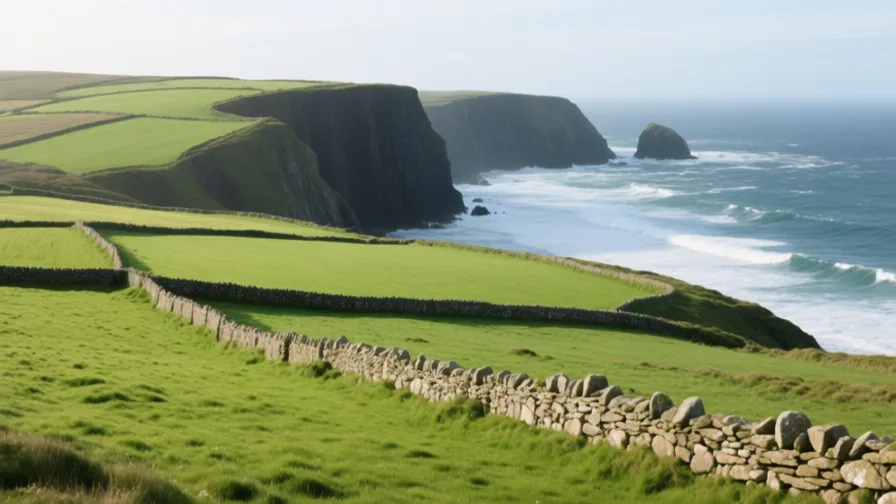 Ireland · AI landscape illustration · Artistic impression
Country · Europe
Ireland
Saved in this browser — no account needed. Sign in later and it comes with you.
Where it is
The state covers about five-sixths of an island on Europe’s Atlantic edge, and shares its only land border with Northern Ireland. The west is a coast of cliffs, bays, peninsulas and mountains, climbing to Carrauntoohil, at 1,038.6 metres the highest point, in the MacGillycuddy’s Reeks of the south-west. The middle is a low basin of glacial clay and sand, with bogs and lakes, crossed by the Shannon. The Gulf Stream and the ocean give a mild, wet climate. The wettest ground is in the south-west, while Dublin gets the least rain, and the north and west are among the windiest regions of Europe.
The land and water around it
The central lowlandsplain
A basin covered in glacial clay and sand, scattered with bog and lakes. Blanket bog and the clearing of woodland for farming are blamed for stripping the forest, so that only about a tenth of the country is woodland and just 2 per cent is native forest.
The Shannonriver
At 386 kilometres, the longest river in Ireland, crossing the central lowlands.
The Atlantic west coastcoast
More rugged than the east, with many islands, peninsulas, headlands and bays. Its exposure to Atlantic wind gives some of the best wind-power potential in Europe.
Its history, in short
The earliest settlers are thought to have come from Iberia after the last ice age, and later migrants brought a Celtic language and Gaelic culture, which became dominant; Irish people today descend from Gaelic, Norse, Anglo-Norman, French and British ancestors. Anglo-Norman settlers arrived in the 12th century, a slow conquest and colonisation began in the 16th, and English took over as the language of power. The whole island was ruled from London as one kingdom from 1801 to 1922. The Great Famine of 1845 to 1849 cut a population of over 8 million by 30 per cent and set a pattern of emigration that lasted into the 1960s. Home Rule was blocked, the Easter Rising of 1916 turned opinion toward independence, and a war with Britain ended in the Anglo-Irish Treaty of December 1921. The treaty created the Irish Free State of 26 counties and split the nationalist side into a civil war in 1922–23. A new constitution in 1937 named the state Ireland, and it was declared a republic in 1949. Ireland joined the European Communities in 1973, and the Good Friday Agreement of 1998 brought co-operation with Northern Ireland.
Timeline
Dates are shown on a timeline rather than as changing shapes on the map. The globe draws modern boundaries only, and tinting a modern outline to stand for a historical one would state something we cannot source.
Industrial & imperial
1 January 1801
The Act of Union
The whole island is merged into a single kingdom with Great Britain, and stays so until 6 December 1922.
1845–1849
The Great Famine
About a million people die of starvation and disease, and another one and a half million emigrate, mostly to the United States. Emigration continues for generations, and population declines until the 1960s.
Well attestedWikipedia24 April 1916
The Easter Rising
The Irish Volunteers and the Irish Citizen Army proclaim a republic and fight for a week, mainly in Dublin. The rebels surrender, but the execution of the leaders turns public opinion; in 1918 Sinn Féin wins 73 of 105 seats.
6 December 1921
The Anglo-Irish Treaty
Negotiators led by Michael Collins accept dominion status for a new Irish Free State, without a republic. Northern Ireland, which already had its own government, opts out two days after the Free State is established in 1922.
Well attestedWikipediaJune 1922 – May 1923
The Civil War
Pro-Treaty forces led by Collins and anti-Treaty forces led by Éamon de Valera, who held that the treaty abolished the republic of 1919 and demanded an oath to the British king, fight each other. Collins is killed in an ambush at Béal na mBláth in August 1922.
29 December 1937
A new constitution
The constitution names the state Éire, or Ireland in English, and claims the whole island as national territory while limiting the state’s jurisdiction to the former Free State. It is officially declared a republic in 1949.
Well attestedWikipedia
Contemporary
1973
Joining the European Communities
Ireland applies in 1961, because of its economic links with the United Kingdom, and enters in 1973 after delays following de Gaulle’s opposition to British accession.
Well attestedWikipedia1998
The Good Friday Agreement
After the conflict known as the Troubles, the Irish and British governments and Northern Irish parties sign an agreement that creates the North/South Ministerial Council, through which the two administrations co-operate on a number of policies.
Well attestedWikipedia
Places that carry meaning
Brú na BóinneNeolithic
One of the Neolithic structures that survive across the island, alongside the Poulnabrone dolmen and the Drombeg stone circle.
The GaeltachtPresent day
The scattered districts of the west and south where Irish remains a community language and the primary language of everyday life, the only part of the country where road signs are not routinely bilingual.
The Four Courts, Dublin1922
The centre of the Irish legal system, occupied by anti-Treaty forces in April 1922 and assaulted by the Free State government for a week in July, which turned the standoff into open civil war.
Languages here
Places are usually multilingual. This lists what is actually spoken, not one language per border.
IrishCeltic family
The national language and first official language under the constitution.
About 1.76 million people, roughly 40 per cent, said they could speak Irish to some extent in 2016, but under 74,000 spoke it daily. It is a community language only in the Gaeltacht, though it is taught as a core subject in schools and runs on TG4 and RTÉ Raidió na Gaeltachta. It became an official EU language in 2007.
EnglishGermanic family
The second official language, and the dominant one across the country.
English spread after the Tudor conquest and the Ulster Plantation, and national schooling in the 19th century, backed by the Church, completed its dominance. The local varieties of Hiberno-English are the everyday vernacular throughout the island.
Shelta
A cant used by Irish Travellers.
Based on Irish and English, with Irish supplying most of the vocabulary. Travellers traditionally keep it private from outsiders, and disguise its structure when non-Travellers are present.
Irish Sign Language
The main sign language, used by about 6,500 deaf people on the island.
It has little relation to spoken Irish or English and is closer to French Sign Language. It lacks formal recognition in Irish law.
Learn the language here
Check yourself
What was the effect of the Great Famine on Ireland’s population?
It fell by about 30 per cent through death and emigration
From over 8 million, the population fell by about 30 per cent between 1845 and 1849, and continuing emigration meant that it kept falling until the 1960s.
What status does the Irish language have under the constitution?
National language and first official language
Irish is the national and first official language, with English as the second official language, although English is the one most people use in daily life outside the Gaeltacht.
Worth arguing about
- The constitution of 1937 claimed the whole island as the national territory while limiting the state’s jurisdiction to the south. What does a state gain or lose by claiming more than it governs?
- Irish is the first official language, yet only a small share use it daily. What should a state do to keep a language alive, and who decides?
What we have not established
These are open questions, listed rather than filled in. We would rather show a gap than a plausible guess.
How many people in Ireland speak Irish?
The answer depends on the question asked. In the 2016 census about 1.76 million people said they could speak Irish to some extent, while under 74,000 said they spoke it daily, so ability and everyday use are very different numbers.
Sources
- Wikipedia · Republic of IrelandWikipedia · encyclopedia · checked 2026-11-24
- Wikipedia · History of the Republic of IrelandWikipedia · encyclopedia · checked 2026-11-24
- Wikipedia · Languages of IrelandWikipedia · encyclopedia · checked 2026-11-24
Reviewed by Globe Quest editorial on 2026-11-24. Drafted with AI assistance and checked against the sources above before publication.