 Globe Quest
 Human Quest · LearningSign in
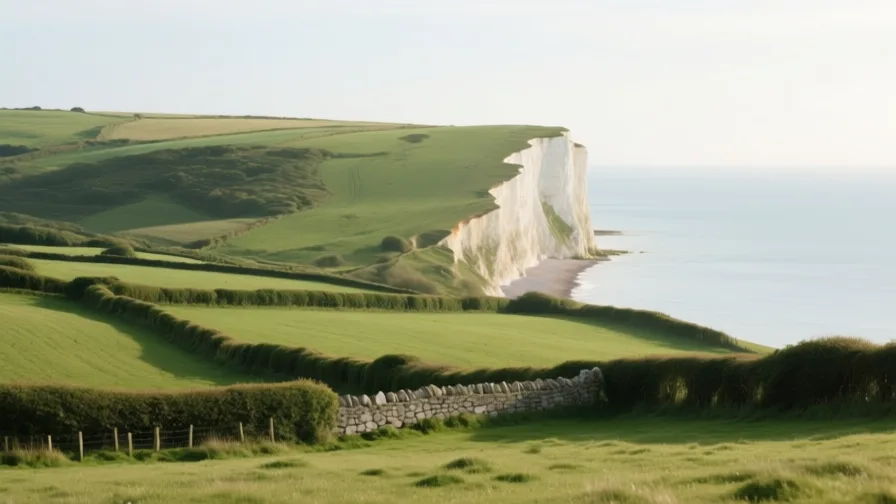 United Kingdom · AI landscape illustration · Artistic impression
Country · Europe
United Kingdom
Saved in this browser — no account needed. Sign in later and it comes with you.
Where it is
The United Kingdom takes up most of the British Isles, off the north-western coast of continental Europe: the island of Great Britain, the north-eastern sixth of Ireland and many smaller islands, some 244,000 square kilometres in all. Its south-east coast comes within 35 kilometres of France across the English Channel, and its only land border, 499 kilometres long, runs through Ireland. Water surrounds it on all sides: the Atlantic, the North Sea, the Channel, the Celtic Sea and the Irish Sea. A line from the Tees to the Exe roughly divides lowland England, to the south-east, from the uplands of the north and west. The prevailing south-westerly wind brings mild, wet weather from the Atlantic, so the west is wetter and the east drier.
The land and water around it
The Tees–Exe lineplain
An imaginary line that separates lowland Britain from upland Britain. South-east of it lie plains and downs, with the Thames, Severn and Humber as the main rivers and estuaries; north-west of it rise the Pennines, the Lake District, Exmoor and Dartmoor.
The Highlandsmountains
Scotland is the most mountainous part of the UK, and the ten tallest mountains in the country are all there. Ben Nevis, at 1,345 metres, is the highest point in the British Isles. The Highlands hold most of Scotland's high ground, including the Cairngorms.
The English Channelstrait
The narrow sea between Britain and northern France has shaped defence, invasion and trade, and the Channel Tunnel now links the two shores.
Its history, in short
People have lived in these islands continuously since the ice retreated about 11,500 years ago, and by the end of prehistory the population was largely Insular Celtic, divided into Brittonic Britain and Gaelic Ireland. Rome conquered the south from AD 43 and ruled it for about four centuries; after the Romans left, Anglo-Saxon settlers pushed the Brittonic area back mainly to Wales, Cornwall and the north. The Kingdom of England emerged in the 10th century and was conquered by the Normans in 1066. The modern state was assembled in steps: England and Scotland united in 1707 as Great Britain, Ireland was added in 1801, and most of Ireland left in 1922, which produced the present United Kingdom of Great Britain and Northern Ireland. Britain was the first industrialised country, and after the defeat of Napoleon in 1815 it was the leading naval and imperial power, ruling at its height in the 1920s around a quarter of the world's land and population. The two world wars and decolonisation ended that position. After 1945 the state created the National Health Service and nationalised major industries, and in 2016 voters chose to leave the European Union, which the UK did in 2020.
Timeline
Dates are shown on a timeline rather than as changing shapes on the map. The globe draws modern boundaries only, and tinting a modern outline to stand for a historical one would state something we cannot source.
Classical world
AD 43
The Roman conquest begins
Rome begins its conquest and then rules southern Britain for about 400 years. Rule ends between 383 and 410.
Well attestedWikipediafrom about 450
Anglo-Saxon settlement
Germanic settlers move in after the Roman departure. They reduce the Brittonic area mainly to Wales, Cornwall and, for a time, the north of England and southern Scotland.
Approximate dateWikipedia
Post-classical world
1066
The Norman conquest
The Normans conquer England, which had been unified as a single kingdom in the 10th century.
Well attestedWikipedia
Early modern & oceanic
1 May 1707
Great Britain
The Acts of Union join the kingdoms of England and Scotland. Scottish law, the Church of Scotland and Scotland's separate education system continue. A Jacobite attempt to restore the Stuarts ends in defeat at Culloden in 1746.
Industrial & imperial
1 January 1801
Ireland joins
The parliaments of Great Britain and Ireland each pass an Act of Union, merging the two kingdoms into one state that begins on that date.
Well attestedWikipedia1815–1914
Pax Britannica
After the Napoleonic Wars Britain is unchallenged at sea and London is the biggest city in the world from about 1830.
Well attestedWikipedia1922
Partition of Ireland
Most of Ireland leaves as the Irish Free State, so only the north-east of the island stays in the UK. The state takes its present name in 1927.
Well attestedWikipedia
Contemporary
2016–2020
Leaving the European Union
In 2016, 51.9 per cent of voters back leaving the EU, and the UK leaves in 2020. A 2014 referendum had seen Scotland vote by 55.3 to 44.7 per cent to stay in the UK.
Well attestedWikipedia
Places that carry meaning
LondonRoman origin to the present
The capital and largest city. It was the world's largest city from about 1830 and is now Europe's largest city economy, with Edinburgh as the UK's second financial centre.
EdinburghCapital of Scotland
Capital of Scotland, which has had its own government and parliament, with wide powers over devolved matters, since 1999.
LiverpoolFrom the 1730s
A port city with the oldest black population in the country, going back to at least the 1730s, and a Chinese community that dates from the 19th century and is the oldest in Europe.
Languages here
Places are usually multilingual. This lists what is actually spoken, not one language per border.
EnglishGermanic family
The de facto official language and the most widely spoken.
The UK has no single declared official language, but English is the common language of government and daily life. It is spoken with many dialects and accents, often distinctly different in nearby regions; one prestige accent, Received Pronunciation, is linked with educated speakers in the south.
WelshCeltic family
An official language in Wales, with a growing number of speakers.
Welsh descends from Brittonic and is spoken natively in Wales; the 2021 census counted 538,300 speakers there. It is strongest in the north-west, where Gwynedd had a large majority of speakers in the 2001 census.
Scottish Gaelic, Scots and IrishCeltic family
The regional languages of Scotland and Northern Ireland.
Scottish Gaelic, spoken by about 57,000 people in 2011, has its stronghold in the Outer Hebrides. Scots grew out of Northumbrian Old English and is a Germanic relative of English; Ulster Scots is its Northern Irish form. Irish, a de jure official language in Northern Ireland since 2022, is spoken by about 124,000 people there.
Cornish and immigrant languagesCeltic family
A revived Celtic language, and the tongues of newer communities.
Cornish lost its last native speaker around 1777 and was revived from 1903; the UN classes it as critically endangered. Alongside it, migrants and their descendants speak many languages, among them Polish, Hindi and Urdu, and British Sign Language is the language of some 125,000 Deaf adults.
Learn the language here
Check yourself
Which union created the Kingdom of Great Britain in 1707?
England and Scotland
The Acts of Union of 1707 joined the kingdoms of England and Scotland. Ireland was added later, in 1801.
Why did the state change its name in 1927?
Because Ireland left in 1922, leaving only Northern Ireland on the island
After most of Ireland became the Irish Free State, the state took a new name, since only Northern Ireland remained from the island of Ireland.
Worth arguing about
- England, Scotland, Wales and Northern Ireland are called countries within a country. What holds such a union together, and what would loosen it?
- The British Empire once covered a quarter of the world's land. How should a country with that past tell its own story to its immigrants?
What we have not established
These are open questions, listed rather than filled in. We would rather show a gap than a plausible guess.
How many people speak the Celtic languages of the UK today?
The surviving regional languages are counted in separate censuses for Wales, Scotland and Northern Ireland, in different years and on different definitions, so there is no single combined total of Celtic-language speakers.
Sources
- Wikipedia · United KingdomWikipedia · encyclopedia · checked 2026-11-24
- Wikipedia · History of the United KingdomWikipedia · encyclopedia · checked 2026-11-24
- Wikipedia · Geography of the United KingdomWikipedia · encyclopedia · checked 2026-11-24
- Wikipedia · Languages of the United KingdomWikipedia · encyclopedia · checked 2026-11-24
Reviewed by Globe Quest editorial on 2026-11-24. Drafted with AI assistance and checked against the sources above before publication.