 Globe Quest
 Human Quest · LearningSign in
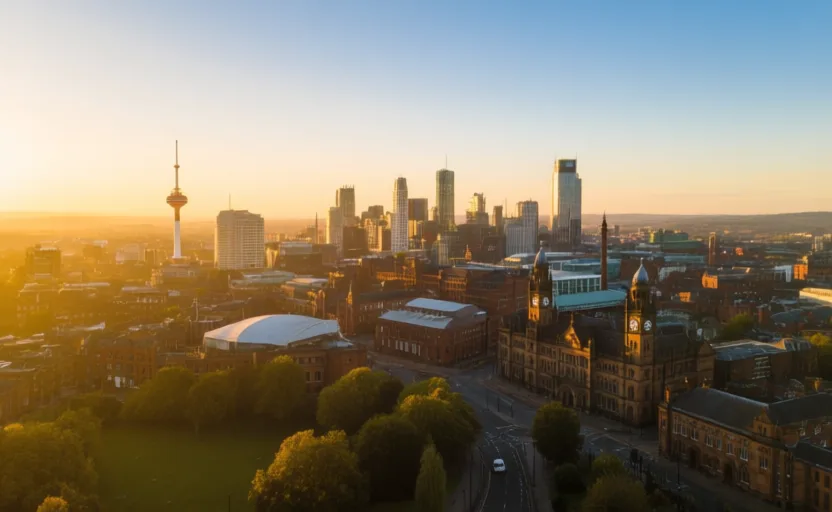 Manchester · AI city illustration · Artistic impression
City · Europe
Manchester
Saved in this browser — no account needed. Sign in later and it comes with you.
Where it is
Manchester lies in a bowl of low ground, with the Pennines rising to the north and east and the flat Cheshire Plain opening to the south. The city centre stands on the east bank of the Irwell, close to where the Medlock and the Irk join it, and the Mersey crosses the south of the city. The climate is temperate oceanic and notably damp, with soft water and high humidity. Those conditions, along with rivers for power and nearby coal, are the physical reasons a cotton city grew here, 35 miles from the port of Liverpool.
The land and water around it
The Pennine bowlmountains
The Pennines enclose the city to the north and east, and snow that rarely settles in the streets falls on the Peak District and moors above, closing the roads out toward Sheffield. The hills also supplied water and a damp climate that suited cotton.
The Irwell, Irk and Medlockriver
Three small rivers meet at the old centre. Their water powered early mills, and the Irwell was later canalised as part of the Ship Canal, which runs 36 miles from Salford to the tidal Mersey at Eastham.
The Cheshire Plainplain
South of the city the ground flattens into the Cheshire Plain. The Mersey flows through this southern edge, and parts of Cheshire south of it were absorbed into Manchester during the 20th century.
Its history, in short
The Brigantes held a sandstone outcrop by the Irwell where the cathedral now stands, and in AD 79 the Romans built the fort of Mamucium on the same ground to guard the roads between Chester and York. After the Romans left, the settlement shifted to the meeting of the Irwell and the Irk. Through the Middle Ages it was a manorial township under the Grelley family, with a market charter in 1301, a collegiate church from the 1420s and a community of Flemish weavers by the 14th century, which seeded a local cloth trade. Around 1800 that trade exploded. Spinning in south Lancashire and north Cheshire fed a town that became the world's largest market for cotton goods and, in a phrase of the time, the first industrialised city. Growth was rapid and unplanned. The Ship Canal, finished in 1894, gave Manchester its own link to the sea. After 1945 the cotton exchange closed, the port closed in 1982 and the city lost 150,000 manufacturing jobs between 1961 and 1983. The 1996 bomb in the centre brought a wave of rebuilding, and the old mills now hold flats and offices.
Timeline
Dates are shown on a timeline rather than as changing shapes on the map. The globe draws modern boundaries only, and tinting a modern outline to stand for a historical one would state something we cannot source.
Classical world
AD 79
The fort of Mamucium
Agricola orders a fort built on the sandstone bluff by the Irwell to protect Roman interests at Chester and York. Fragments of it still show in Castlefield, and the city's name comes from it.
Well attestedWikipedia
Post-classical world
1301
A market charter
Manchester receives its charter as a market town. It loses its borough status in a court case in 1359 and does not regain it until 1838.
c. 1422
The collegiate church
Thomas de la Warre, lord of the manor and a priest, founds a collegiate church. Building runs into the early 16th century, and it later becomes Manchester Cathedral.
Industrial & imperial
1853
City status
Manchester is granted city status, at a time when it was the most productive centre of cotton processing and the world's largest marketplace for cotton goods.
Well attestedWikipedia1888–1894
The Ship Canal
A 36-mile canal, built partly by canalising the Irwell and Mersey, links the city to the Irish Sea and makes an inland port.
Well attestedWikipedia22–25 December 1940
The Christmas Blitz
Two nights of German air raids destroy much of the historic centre, killing an estimated 376 people. The cathedral takes twenty years to restore.
Well attestedWikipedia
Contemporary
1982
The port closes
Container ships are too large for the canal, traffic dwindles and the port shuts. The cotton exchange had already closed in 1968.
Well attestedWikipedia15 June 1996
The Corporation Street bomb
The Provisional IRA detonates a lorry bomb in the city centre, the largest to be set off on British soil. The rebuilding that follows, helped by the 2002 Commonwealth Games, reshapes the centre.
Places that carry meaning
CastlefieldAD 79 onward
The site of the Roman fort, where fragments of Mamucium can still be seen. Central Manchester has been continuously settled since.
Chetham's Library and School15th–17th century
The medieval manor house given to the cathedral's priests, one of the finest medieval religious buildings in Britain. Its library, open since 1653, is the oldest free public reference library in the UK.
Trafford Park1910
Founded after the Ship Canal opened and described as the world's first industrial park. American firms such as Ford and Westinghouse arrived, and the grid of numbered streets still shows their influence.
Languages here
Places are usually multilingual. This lists what is actually spoken, not one language per border.
EnglishGermanic family
The everyday language of the city.
English is the main language of the United Kingdom. Residents are still called Mancunians, a word taken from the Latin form of the city's name.
Brittonic and LatinCeltic family
The sources of the city's name.
The name Manchester is generally thought to be a Latinised form of an older Brittonic name, with the English suffix -chester from Old English ceaster, a Roman fort. Scholars differ on whether the Brittonic root meant a breast-shaped hill or a mother, for a river goddess.
Learn the language here
- 1Understand which languages are spoken hereManchester is multilingual. Start with which languages are used, by whom, and for what — the phrase list only covers one of them.Written by Globe Quest
- 2Learn 11 phrasesCurated everyday phrases for Manchester, with audio and a written form.Written by Globe Quest
- 3Say them out loudSpeaking practice with pronunciation feedback, one phrase at a time.Globe Quest material, your own additions
- 4Come back to themSpaced review, so what you learned this week is still there next month.Written by Globe Quest
Check yourself
What stood on the sandstone bluff by the Irwell from AD 79?
A Roman fort called Mamucium
The fort protected Roman interests in Chester and York, and its Latin name survives in the modern name of the city and in the word Mancunian.
What did the Ship Canal of 1894 do for Manchester?
It linked the inland city to the Irish Sea, 36 miles away
Built partly by canalising the Irwell and Mersey, the canal made Manchester a seaport. It declined when container ships outgrew it and the port closed in 1982.
Worth arguing about
- Manchester was the world's first industrialised city and then lost much of its industry. What does a place keep when the reason for its growth disappears?
- Manchester and Birmingham each claim to be the second city of the United Kingdom. What would a fair test of that claim measure?
What we have not established
These are open questions, listed rather than filled in. We would rather show a gap than a plausible guess.
Which languages do Mancunians speak at home?
The census records the city's ethnic makeup, in which Pakistani, African, Chinese and Arab residents are among the larger groups, but not what language each household uses. Ethnicity is not a guide to language, so the entry does not name community languages.
Sources
- Wikipedia · ManchesterWikipedia · encyclopedia · checked 2026-11-24
- Wikipedia · History of ManchesterWikipedia · encyclopedia · checked 2026-11-24
- Wikipedia · United KingdomWikipedia · encyclopedia · checked 2026-11-24
Reviewed by Globe Quest editorial on 2026-11-24. Drafted with AI assistance and checked against the sources above before publication.