 Globe Quest
 Human Quest · LearningSign in
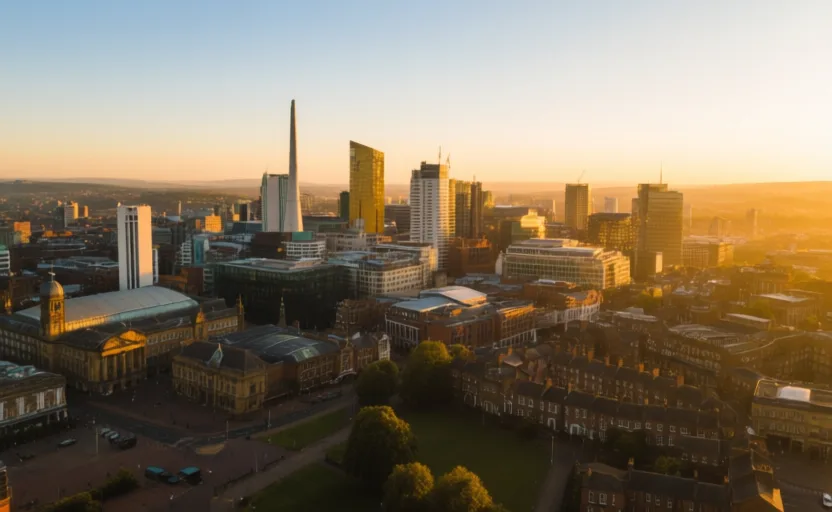 Birmingham · AI city illustration · Artistic impression
City · Europe
Birmingham
Saved in this browser — no account needed. Sign in later and it comes with you.
Where it is
No major city in England is further from the sea than Birmingham. It stands on a plateau of high ground, a little west of the traditional centre of England, across the main north-south watershed between the Severn and the Trent. Only small rivers cross it, chiefly the Tame with its tributaries the Rea and the Cole, and the nearest large river is the Severn some 20 miles west. The nearest tidal water is Liverpool Bay. Instead of a river, the city has canals. The climate is temperate maritime, with a strong urban heat island in the centre.
The land and water around it
The Birmingham Plateauplateau
An area of relatively high ground that carries the watershed between the basins of the Severn and the Trent. Its forest cover was a barrier to the advancing Roman legions, and the Anglo-Saxon settlers arrived later in a heavily wooded landscape.
The Birmingham Faultvalley
A fault cuts across the city on a diagonal, from the Lickey Hills in the south west to Sutton Coldfield in the north east, taking in Edgbaston and the Bull Ring on the way. Harder Keuper Sandstone lies to its north and west, under much of the city centre, and softer Mercia Mudstone to the south and east, cut by the valleys of the Tame, Rea and Cole.
The canalsriver
Because the rivers are small, transport relied on the Birmingham Canal Navigations. They link the city to a wider network, and the city has long been described as one of canals before cars.
Its history, in short
The name is Old English, from a settlement of the Beormingas on the Rea, probably founded by the early 7th century in the forest of Arden. Roman roads converged on the area, and a fort at Metchley, in modern Edgbaston, was the focus of the network. The turning point came in 1166, when Peter de Bermingham, who held the manor, bought a charter for a weekly market at his castle and then planned a market town beside what became the Bull Ring. The medieval guild and the lordship collapsed between 1536 and 1547, leaving the town unusually free. Iron working was recognised as central by 1538, and by the 1600s Birmingham's merchants were the hub of a network of forges stretching from South Wales to Cheshire. Its growth in the Industrial Revolution rested on small workshops and skilled trades, not on a single bulk product like cotton. Across 1760 to 1850 its residents registered over three times the patents of any other British town or city, and banking followed. Political radicals such as Thomas Attwood pressed for the Reform Act of 1832. The Blitz of 1940 to 1943 and the planners who followed rebuilt the centre, and postwar migration from the Commonwealth and beyond changed who lived there.
Timeline
Dates are shown on a timeline rather than as changing shapes on the map. The globe draws modern boundaries only, and tinting a modern outline to stand for a historical one would state something we cannot source.
Classical world
c. AD 48
Metchley Fort
The Romans build a large fort in what is now Edgbaston and make it the focus of a road network. It is abandoned and reoccupied more than once before being given up for good.
Post-classical world
6th or 7th century
The Beormingas
A small Anglo-Saxon settlement is established in the Arden region of Mercia. The place name, which ends in the element used for early settlements, suggests it existed by the early 7th century at the latest.
Approximate dateWikipedia1166
The market charter
Peter de Bermingham obtains a royal charter for a weekly market at his castle and lays out a planned market town. A lawsuit later upheld the claim that the market had been held since before the Norman Conquest.
Early modern & oceanic
1538
Iron goods are central
The importance of ironwork to the local economy is recognised, and the town becomes a centre for the merchants who finance, supply and market the industry's products.
Well attestedWikipedia1765 and 1775
Banking and building societies
Lloyds Bank begins here in 1765, and in 1775 Ketley's opens as the first building society anywhere. By 1800 the region had a higher density of bank offices than London or anywhere else in Britain.
Well attestedWikipedia
Industrial & imperial
1831–1832
The Political Union
Thomas Attwood's Birmingham Political Union holds the largest political meetings Britain had seen, on Newhall Hill, and helps push through the Reform Act. Lord Durham wrote that the country owed Reform to Birmingham.
Well attestedWikipedia1940
The Blitz and two discoveries
Bombing begins that summer and lasts until spring 1943. In the same year, scientists in the city outline how a practical nuclear weapon could be built and invent the cavity magnetron, the key component of radar.
Well attestedWikipedia
Contemporary
1951
Population peak
The city reaches 1,113,000 residents. After the war it was redeveloped with tower blocks, a rebuilt Bull Ring and a new New Street station, and Commonwealth immigration changed its makeup.
Well attestedWikipedia
Places that carry meaning
The Bull Ring1166 onward
The market place around which the planned town was laid out. St Martin in the Bull Ring, the original parish church, was rebuilt on a large scale around 1250 and has a spire 200 feet high.
DigbethFrom about 8400 BCE
The area on the Rea where Beorma's people are thought to have settled. A 10,400-year-old hunter-gatherer settlement was found here in 2009, the oldest in the city.
The Gun QuarterFrom 1630
An industrial area north of the centre, where the first recorded gun maker worked in 1630. Locally made muskets were used in the Civil War, and for years the quarter was a centre of world gun-making.
Languages here
Places are usually multilingual. This lists what is actually spoken, not one language per border.
EnglishGermanic family
The everyday language of the city.
People from the city are called Brummies, after its nickname Brum, which comes from the old name Brummagem.
Old EnglishGermanic family
The source of the city's name.
Beormingahām, meaning the home of Beorma's people, is the root of Birmingham. The names of surrounding places ending in words for farm, clearing and enclosure are likely to come from later expansion of the same settlers.
Learn the language here
- 1Understand which languages are spoken hereBirmingham is multilingual. Start with which languages are used, by whom, and for what — the phrase list only covers one of them.Written by Globe Quest
- 2Learn 11 phrasesCurated everyday phrases for Birmingham, with audio and a written form.Written by Globe Quest
- 3Say them out loudSpeaking practice with pronunciation feedback, one phrase at a time.Globe Quest material, your own additions
- 4Come back to themSpaced review, so what you learned this week is still there next month.Written by Globe Quest
Check yourself
What is unusual about Birmingham's setting among large British cities?
It is the most inland major city, on high ground with only small rivers
Birmingham sits on a plateau across the Severn-Trent watershed, far from any sea, which is why canals and later railways, not a river, carried its trade.
What distinguished Birmingham's industry from that of the northern textile towns?
Thousands of small workshops in skilled, specialised trades
Birmingham's economy relied on skilled craftsmen in many different trades, which encouraged invention. Its inventors outdid every other British town in registering patents between 1760 and 1850.
Worth arguing about
- Birmingham's economy grew from many small workshops, not a few large mills. Does that kind of economy make a city more adaptable, and what does it do to its politics?
- Postwar planners rebuilt Birmingham around the car and tower blocks, and later reversed some of it. What should a city keep when it rebuilds?
What we have not established
These are open questions, listed rather than filled in. We would rather show a gap than a plausible guess.
When was the fort at Metchley built?
One account dates the fort to AD 48, while another places it soon after the Roman invasion of AD 43 and says it was abandoned in AD 70, reoccupied, and abandoned again in AD 120. The dating of the first phase is not settled.
How many people live in Birmingham?
The 2021 census counted 1,144,900 within the city boundary, while other figures round to 1.2 million. The urban area and the wider metropolitan area, at 2.7 and 4.3 million, depend on where the boundary is drawn.
Sources
- Wikipedia · BirminghamWikipedia · encyclopedia · checked 2026-11-24
- Wikipedia · History of BirminghamWikipedia · encyclopedia · checked 2026-11-24
Reviewed by Globe Quest editorial on 2026-11-24. Drafted with AI assistance and checked against the sources above before publication.