 Globe Quest
 Human Quest · LearningSign in
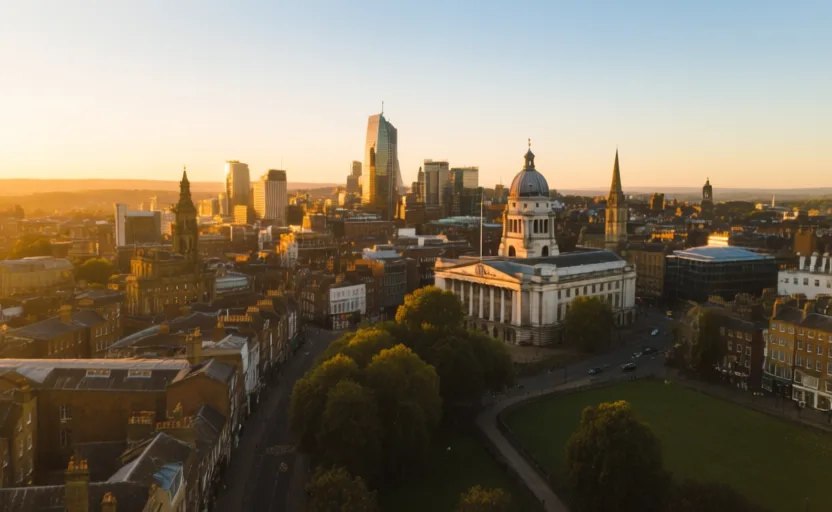 Nottingham · AI city illustration · Artistic impression
City · Europe
Nottingham
Saved in this browser — no account needed. Sign in later and it comes with you.
Where it is
Low hills along the lower Trent valley carry the city, with a sandstone outcrop above the river where the castle was built. Around it the land changes in every direction: Sherwood Forest to the north, the Nottinghamshire, Derbyshire and Yorkshire coalfield to the west, and the flat Vales of Trent and Belvoir to the east and south. Nottingham sits in the middle of England, far from any coast, and the climate is temperate and oceanic, with rain through the year and air frost on about 37 days a year at Watnall. A green belt drawn up from the 1950s now rings the built-up area.
The land and water around it
The River Trentriver
The valley gave the area its route and its early bridge, thought to date from about 920. Iron Age dugout canoes and a spoked wheel found in gravels at Holme Pierrepont show the Trent was a trade road long before the town existed.
Sherwood Forestforest
The old woodland north of the city, now a national nature reserve, lends the place its best-known legend: the Sheriff of Nottingham of the Robin Hood stories.
The sandstone outcropplateau
A rock face above the Trent carried the castle. Caves cut into it may explain the name Asser gave the place, “cave house”, although it is unclear whether that was a real Welsh name or his own invention.
Its history, in short
The written story starts in 868, with the Anglo-Saxon Chronicle, and the name means the homestead of the people of a man called Snot. Danish Vikings took it, it became one of the Five Burghs of the Danelaw, and Edward the Elder recovered it around 918. After the Norman Conquest the town split in two: an English borough around the old Saxon settlement on the hill that is now the Lace Market, and a French borough around the castle opposite, until the space between filled up around what became the Market Square. The Black Death killed perhaps 60 per cent of the population in 1349. In the 15th century the town exported religious sculpture carved in Nottingham alabaster as far as Iceland. From 1730 hosiery, then lace, made it a factory city, and in the 20th century its main employers were Boots, John Player and Raleigh. Textiles declined after the Second World War and the other two moved their production, and the economy shifted towards services and the life sciences. City status came in 1897.
Timeline
Dates are shown on a timeline rather than as changing shapes on the map. The globe draws modern boundaries only, and tinting a modern outline to stand for a historical one would state something we cannot source.
Post-classical world
868
First written mention
The Anglo-Saxon Chronicle names the place as Snotengaham. Place-names of this form usually mark settlements founded in the 6th or 7th century.
Well attestedWikipedia918–919
Taken back from the Danes
Edward the Elder recovers the town, which Danish Vikings had captured in 867, and puts up a fortress across the Trent on its south bank. The two Wikipedia articles give 918 and 919.
1194
Siege of the castle
Richard the Lionheart returns from the Crusades and besieges the castle, then held for Prince John, among them the Sheriff of Nottingham, and takes it after a brief, fierce fight.
Well attestedWikipedia1349
The Black Death
About 60 per cent of the population is thought to have died. Migration from elsewhere in England began the recovery.
Approximate dateWikipedia1449
County corporate
A charter gives the town effective self-government “for eternity”, though the castle and Shire Hall stay outside it.
Well attestedWikipedia
Early modern & oceanic
22 August 1642
The Royal Standard
Charles I raises his standard in Nottingham at the start of the English Civil War.
Well attestedWikipedia
Industrial & imperial
1831
Castle burned
Citizens riot angered that the Duke of Newcastle opposed parliamentary reform, and burn his house on the castle site.
Well attestedWikipedia1897
City status
Awarded to mark Queen Victoria’s sixty years on the throne, despite the city having no Anglican cathedral, which had been the old test for the title.
Well attestedWikipedia
Places that carry meaning
The Lace MarketAnglo-Saxon settlement; 19th-century lace trade
The district where the first Saxon settlement stood, later the centre of the lace trade. Its Victorian warehouses were restored and put to new uses after textile production left.
St Mary’s ChurchMedieval; present building 1377–1485
The oldest and largest of the city’s medieval parish churches, regarded as its mother church. Nottingham has no Anglican cathedral: the bishop sits at Southwell Minster, 14 miles away.
Nottingham Castle11th century
Built on a sandstone outcrop by the Trent soon after the Norman Conquest, then rebuilt as a ducal residence that was burned in 1831.
St Barnabas Cathedral1844
The Roman Catholic cathedral, designed by Augustus Pugin and consecrated in 1844, which stands in for the Anglican one the city lacks.
Languages here
Places are usually multilingual. This lists what is actually spoken, not one language per border.
EnglishGermanic family
The everyday language, with a name from Old English and Old Norse roots.
The name Snotingaham is Old English, and the personal name it contains is probably Old Norse. The regional speech belongs to East Midlands English.
Languages of Asian and Black communities
Spoken at home by many of the 2021 residents who were not White.
In 2021, 65.9 per cent of residents were White, 14.9 per cent Asian and 10 per cent Black, and the city has 32 mosques. Ethnicity is not language, so exactly which languages are used at home is not recorded.
Polish, Hindi and Urdu
Among the many languages of immigrant families in the United Kingdom.
Nationally, migrant languages such as Polish, Hindi and Urdu are heard alongside English. This is a picture for the whole country, as the city’s own home-language figures are not given here.
Learn the language here
- 1Understand which languages are spoken hereNottingham is multilingual. Start with which languages are used, by whom, and for what — the phrase list only covers one of them.Written by Globe Quest
- 2Learn 13 phrasesCurated everyday phrases for Nottingham, with audio and a written form.Written by Globe Quest
- 3Say them out loudSpeaking practice with pronunciation feedback, one phrase at a time.Globe Quest material, your own additions
- 4Come back to themSpaced review, so what you learned this week is still there next month.Written by Globe Quest
Check yourself
What were Nottingham’s two boroughs after the Norman Conquest?
An English borough and a French borough
The Saxon settlement became the English Borough and the settlement under the castle became the French Borough. The space between was eventually built over around the Market Square.
Why is it unusual that Nottingham became a city in 1897?
It has no Anglican cathedral
A city traditionally needed an Anglican cathedral. Nottingham has none, and gained the title as part of Queen Victoria’s Diamond Jubilee celebrations.
Worth arguing about
- Boots, John Player and Raleigh were the city’s three big employers. What happens to a place when a few firms carry it and then leave?
- Nottingham was left out of most of Roman Britain’s story yet is one of the best-known names in medieval legend. Why do myths attach to places the record barely covers?
What we have not established
These are open questions, listed rather than filled in. We would rather show a gap than a plausible guess.
Which languages do Nottingham’s residents speak at home?
The 2021 ethnic breakdown is available, but ethnicity is not language, and no home-language figures were found to describe the city’s immigrant languages accurately.
Sources
- Wikipedia · NottinghamWikipedia · encyclopedia · checked 2026-11-24
- Wikipedia · History of NottinghamWikipedia · encyclopedia · checked 2026-11-24
- Wikipedia · Languages of the United KingdomWikipedia · encyclopedia · checked 2026-11-24
Reviewed by Globe Quest editorial on 2026-11-24. Drafted with AI assistance and checked against the sources above before publication.