 Globe Quest
 Human Quest · LearningSign in
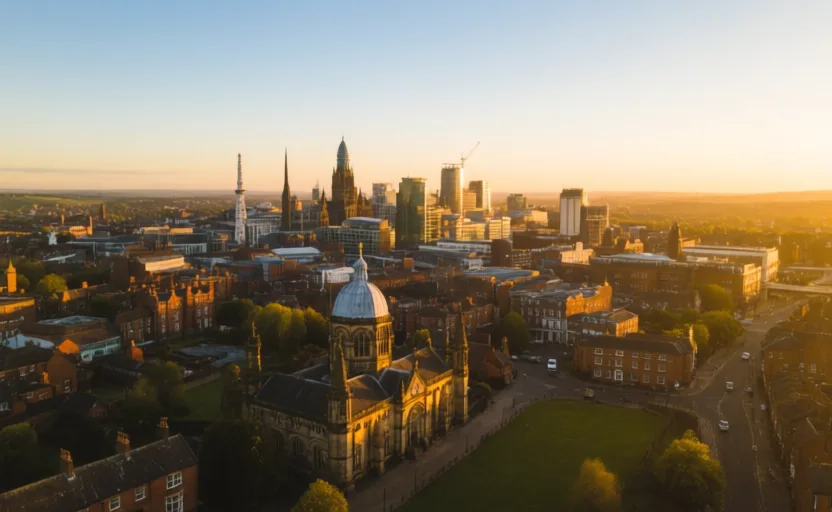 Leicester · AI city illustration · Artistic impression
City · Europe
Leicester
Saved in this browser — no account needed. Sign in later and it comes with you.
Where it is
In the middle of England and as far from the sea as the country allows, Leicester stands on the River Soar, which was once called the Ligor and gave the town its name. The ground is gently undulating, and the city sits near the eastern end of the National Forest, about 90 miles north-north-west of London. Rainfall averages around 684 mm a year, spread through the year, with mild to warm summers and cool winters and low sunshine levels. Roads and railways meet here: two railway lines cross, and the M1, M69, A6 and A46 converge. Birmingham is 33 miles to the west-south-west, with Nottingham and Derby each around 21 miles north.
The land and water around it
The River Soarriver
The river carries the name of the Ligore people, from which Leicester takes its name, and the Iron Age roundhouses lay along 8 hectares of its east bank. Its name is thought to be Brittonic, and may be related to the Loire.
The Fosse Way crossingvalley
The Romans placed their town at a bridge on the Fosse Way, the road between the camps at Exeter and Lincoln. Roads and railways still converge on the same spot.
An inland climateclimate
The highest temperature ever recorded in the city is 36.7°C on 15 July 1868, and the average year has about 55 air frosts. Rain falls on about 121 days a year.
Its history, in short
The Iron Age settlement on the east bank of the Soar was already established when the Romans arrived around AD 47. It grew into Ratae Corieltauvorum, the capital of the Corieltauvi tribe, beside a bridge on the Fosse Way, and received a forum and bathhouse in the 2nd century. Knowledge of the centuries after the Romans left is limited, but the town was continuously occupied. Later it passed to the Mercians and then, as one of the Five Boroughs, to the Vikings. After the Normans, it belonged to the Beaumont and De Montfort earls, and from 1265 to the House of Lancaster, who made the castle a stronghold and, after 1399, a royal residence. Parliaments met here in 1318, 1414 and 1450, and Richard III spent his last days here and was buried here in 1485. The 19th century brought canals, railways and the hosiery and shoe industries. City status came in 1919. Since the 1960s immigration from the Commonwealth has made Leicester one of the most ethnically diverse cities in the country.
Timeline
Dates are shown on a timeline rather than as changing shapes on the map. The globe draws modern boundaries only, and tinting a modern outline to stand for a historical one would state something we cannot source.
Classical world
From about AD 50
Ratae Corieltauvorum
The Roman settlement slowly develops as the tribal capital of the Corieltauvi, taking shape a century or so after the Iron Age settlement it replaced. Whether the Romans fortified it is unclear.
Approximate dateWikipedia
Post-classical world
1265
Death of Simon de Montfort
After the rebel earl’s death the town passes to the House of Lancaster, whose stronghold Leicester Castle becomes.
Well attestedWikipedia
Early modern & oceanic
August 1485
Richard III
The king spends his last days in the town before the Battle of Bosworth, and is buried in the Greyfriars church after his death.
Well attestedWikipedia30 May 1645
Royalist assault
Charles I and Prince Rupert attack the Parliamentarian stronghold to draw the New Model Army away from Oxford. Royalist guns open fire from Raw Dykes.
Well attestedWikipedia
Industrial & imperial
1832
The first railway
The Leicester and Swannington Railway brings coal to the town. The Grand Union Canal had linked it to London and Birmingham in the 1790s, and the Midland Counties Railway followed by 1840.
Well attestedWikipedia1919
City status
Recognised as a city in acknowledgement of its contribution to the British war effort in the First World War.
Well attestedWikipedia
Contemporary
From the 1960s
Immigration from South Asia
Immigrants from the Indian subcontinent begin arriving, boosted in the early 1970s by Asian arrivals from Kenya and Uganda. Polish servicemen who could not return home after the war and Irish migrants had arrived earlier.
Approximate dateWikipedia2015
Richard III reburied
The king’s remains, discovered in the foundations of the lost Greyfriars chapel, are reburied in Leicester Cathedral more than 500 years after his death.
Well attestedWikipedia
Places that carry meaning
The Jewry WallRoman
A surviving fragment of the Roman bathhouse complex and a scheduled monument. Few Roman walls of its height still stand in England.
Leicester Castle and the NewarkeMedieval
The Lancastrian stronghold and later royal residence, with the Newarke Magazine Gateway nearby. The castle is both a scheduled monument and a listed building.
Leicester CathedralCathedral since 1927
The Church of England cathedral, made a cathedral only after the new diocese was founded in 1926, and now holding the tomb of Richard III.
Belgrave Road, the Golden MileLate 20th century
A street of jewellers near the city centre and the centre of the city’s Diwali celebrations, said to be the largest outside India.
Languages here
Places are usually multilingual. This lists what is actually spoken, not one language per border.
EnglishGermanic family
The shared language of a city where White British people are about a third of residents.
In 2021, 43.4 per cent of residents were Asian (34.3 per cent Indian) and 33.2 per cent were White British. The city’s Welsh name, Caerlŷr, is a reminder of how old its British name is.
PolishSlavic family
The language of a community that started with post-war servicemen.
Polish servicemen who could not return to a communist homeland made a small community here after the Second World War, and the city council’s 2008 profile expected Polish to feature strongly in language statistics.
Learn the language here
- 1Understand which languages are spoken hereLeicester is multilingual. Start with which languages are used, by whom, and for what — the phrase list only covers one of them.Written by Globe Quest
- 2Learn 13 phrasesCurated everyday phrases for Leicester, with audio and a written form.Written by Globe Quest
- 3Say them out loudSpeaking practice with pronunciation feedback, one phrase at a time.Globe Quest material, your own additions
- 4Come back to themSpaced review, so what you learned this week is still there next month.Written by Globe Quest
Check yourself
Why is Leicester Cathedral known beyond the city?
Richard III was reburied there in 2015
Richard III’s remains were found in the foundations of the lost Greyfriars chapel and reburied in the cathedral more than 500 years after the king’s death.
Where does the name Leicester come from?
A people named for the river Ligor, plus the Old English word for a Roman fort
The Ligore took their name from the river now called the Soar, and ceaster meant a Roman fort or town. The name is first recorded in Old English in 924.
Worth arguing about
- Leicester is one of the few UK cities in which White British people are a minority. What does a city lose, and gain, when no single community sets its default?
- The city’s most famous resident was found under a car park. What do places owe to history that has to be dug up?
What we have not established
These are open questions, listed rather than filled in. We would rather show a gap than a plausible guess.
Which languages other than English are spoken at home in Leicester?
The 2021 census records ethnic groups, not home languages, and a 2008 council profile is not specific, so the many South Asian languages spoken in the city are not named here.
Sources
- Wikipedia · LeicesterWikipedia · encyclopedia · checked 2026-11-24
Reviewed by Globe Quest editorial on 2026-11-24. Drafted with AI assistance and checked against the sources above before publication.