 Globe Quest
 Human Quest · LearningSign in
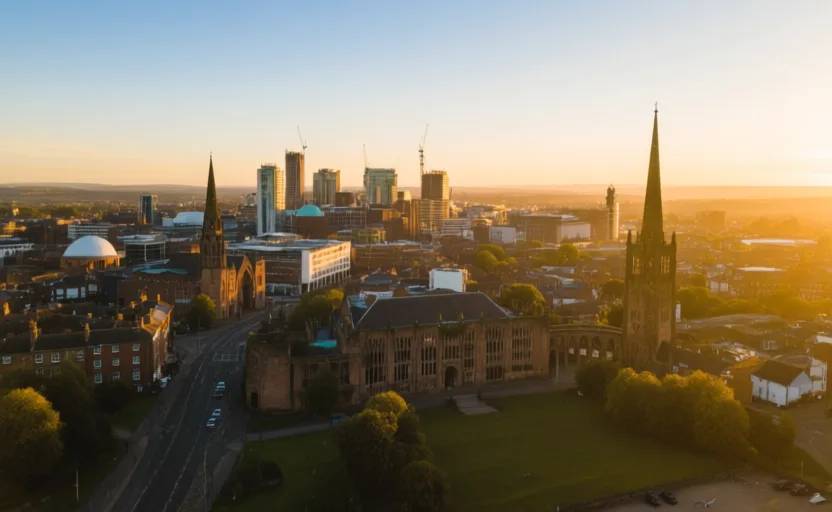 Coventry · AI city illustration · Artistic impression
City · Europe
Coventry
Saved in this browser — no account needed. Sign in later and it comes with you.
Where it is
Coventry rose on heavy clay soil at the north-eastern edge of the old Forest of Arden, rather than on the lighter, easily worked ground where the Celts and Romans chose to settle at Baginton and Corley. The small River Sherbourne ran through it and powered mills. Its advantage was position: it is the most central city in England, only 12 miles south-west of the country’s geographical centre, close to the Roman roads of Watling Street and the Fosse Way. Cleared forest became pasture for sheep, which gave the town its wool. A protected green belt, including the Meriden Gap towards Birmingham, now surrounds the city on every side.
The land and water around it
The Forest of Arden clayforest
The city was built on heavy clay covered in marsh and woodland, so settlers had to clear the land, which they put to cattle and sheep. The wool trade followed from that choice.
The River Sherbourneriver
A small river through the town that supplied water and mill power. Timber, stone from nearby Whitley and Cheylesmore, and arable land completed the local resources.
The Meriden Gapplain
The green belt that separates Coventry from Birmingham, 19 miles away, and that has also kept it from merging with Kenilworth, Nuneaton, Rugby and other nearby towns.
Its history, in short
A Saxon nunnery founded around 700 by St Osburga was destroyed by Danish raiders in 1016. The earl Leofric of Mercia and his wife Godiva rebuilt it in 1043 as a Benedictine monastery, and the market, castle and two parish churches that grew up around it made a town. By the 13th century wool had made Coventry rich, and its dyers produced a non-fading blue cloth that is believed to be the origin of “true blue”. It received a city charter in 1345, built walls of nearly 2.2 miles, and hosted parliaments. The silk ribbon and watch-making trades of the 18th and 19th centuries lost out to Birmingham, but bicycles in the 19th century and motor vehicles in the 20th brought a boom, and in 1960 over 81,000 people worked in vehicle and aircraft production. The air raid of 14 November 1940 destroyed much of the centre and left the cathedral a shell. The city was rebuilt on the Gibson Plan, the car industry collapsed in the 1970s and 1980s, and universities and services have led the revival.
Timeline
Dates are shown on a timeline rather than as changing shapes on the map. The globe draws modern boundaries only, and tinting a modern outline to stand for a historical one would state something we cannot source.
Classical world
c. AD 60 to 280
The Lunt Fort
The Romans build a large fort at Baginton, probably in connection with the Boudican revolt, and use it sporadically until around 280. It has since been excavated and partly reconstructed.
Approximate dateWikipedia
Post-classical world
c. 700
St Osburga’s nunnery
The first settlement grows around a Saxon nunnery. King Canute’s Danish army destroys it in 1016.
1043
Leofric and Godiva’s monastery
A Benedictine monastery dedicated to St Mary is founded on the nunnery’s remains. The legend of Godiva riding naked through the streets to protest her husband’s taxes is placed in this period.
1345
City charter
Edward III grants self-government, including the right to elect a mayor. The city motto, Camera Principis, refers to his son the Black Prince.
Well attestedWikipedia
Early modern & oceanic
August 1642
Charles I turned away
A Royalist force led by the king attacks the Parliamentarian city but cannot breach the walls after a two-day battle.
Well attestedWikipedia1769
The Coventry Canal
The canal links the city to the national network, yet during the 18th century Birmingham overtakes Coventry in size.
Well attestedWikipedia
Industrial & imperial
14–15 November 1940
Operation Moonlight Sonata
More than 500 aircraft bomb the city for 11 hours. More than 4,000 houses are damaged or destroyed, along with about three quarters of the industrial plants, and the old cathedral is left a shell and a spire.
Well attestedWikipedia
Contemporary
1962
The new cathedral
Basil Spence’s St Michael’s Cathedral is consecrated beside the ruins. Its steel spire was lowered in by helicopter.
Well attestedWikipedia
Places that carry meaning
The old and new cathedrals14th century and 1962
The ruined 14th-century cathedral stands next to Spence’s new building. Its 300-foot spire is said to rank third among English cathedral spires and survived because the tower had no internal wooden floors.
Ford’s Hospital1509
An almshouse founded by a wool merchant on Greyfriars’ Lane for five poor men and their wives, one of the Tudor-era charities that survived the destruction of the centre.
The city walls1355 to 1534
Built in stages of red sandstone around nearly 2.2 miles, with 32 towers and 12 gatehouses, they made Coventry the best-defended city outside London.
Coventry Transport MuseumModern
Houses the world’s biggest public display of road vehicles built in Britain, including the Thrust2 and ThrustSSC record cars.
Languages here
Places are usually multilingual. This lists what is actually spoken, not one language per border.
EnglishGermanic family
The everyday language, spoken in an accent that looks both ways between the West and East Midlands.
The Coventry accent resembles Northern English in its short vowels, for instance in lacking the split between the vowels in “bath” and “trap”.
Early IrishCeltic family
A stone with ogham writing found in a Coventry garden.
A portable stone carved in ogham, a script for early Irish, was dug up in a Coventry garden in 2020 and dates to the 4th to 6th centuries.
South Asian languages
The languages of large Sikh and Hindu communities.
Coventry’s ethnic minority population includes significant numbers of South Asians, and Sikhs are 5.0% of residents against 0.8% across England, with Hindus at 4.0%. Hindi and Urdu are among the immigrant languages spoken across the UK, though no figure is given for Coventry itself.
Learn the language here
- 1Understand which languages are spoken hereCoventry is multilingual. Start with which languages are used, by whom, and for what — the phrase list only covers one of them.Written by Globe Quest
- 2Learn 13 phrasesCurated everyday phrases for Coventry, with audio and a written form.Written by Globe Quest
- 3Say them out loudSpeaking practice with pronunciation feedback, one phrase at a time.Globe Quest material, your own additions
- 4Come back to themSpaced review, so what you learned this week is still there next month.Written by Globe Quest
Check yourself
What was “Coventry blue”?
A non-fading woad-dyed cloth prized across Europe
Coventry’s dyers made a cloth from woad that kept its colour, and it is believed to be the origin of the phrase true blue.
Why did the old cathedral’s spire survive the 1940 raid?
The tower had no internal wooden floors and a stone vault below the belfry
Because the tower had no wooden floors to burn and a stone vault under the belfry, the spire and outer walls stood while the rest of the building was destroyed.
Worth arguing about
- Coventry rebuilt itself twice, after 1940 and after the car industry collapsed. What does a city keep when it has to start again?
- The old cathedral was left as a ruin beside a new one. When should a place keep its wounds in view?
What we have not established
These are open questions, listed rather than filled in. We would rather show a gap than a plausible guess.
Which languages are spoken in Coventry’s South Asian communities?
The 2021 census shows Sikh, Hindu and Muslim communities that are far larger than in the rest of the West Midlands, but gives religion and ethnicity, not home language.
Sources
- Wikipedia · CoventryWikipedia · encyclopedia · checked 2026-11-24
- Wikipedia · History of CoventryWikipedia · encyclopedia · checked 2026-11-24
- Wikipedia · Languages of the United KingdomWikipedia · encyclopedia · checked 2026-11-24
Reviewed by Globe Quest editorial on 2026-11-24. Drafted with AI assistance and checked against the sources above before publication.