 Globe Quest
 Human Quest · LearningSign in
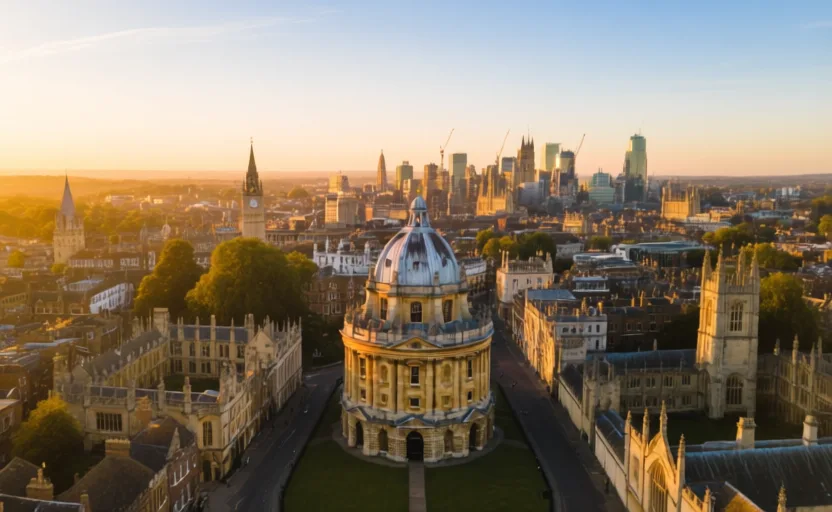 Oxford · AI city illustration · Artistic impression
City · Europe
Oxford
Saved in this browser — no account needed. Sign in later and it comes with you.
Where it is
Oxford grew where the upper Thames, here split into several shallow channels, meets the Cherwell, about 51 miles west-north-west of London. The two rivers meet south of the centre, and their flood plains hold the old town in a small area: the centre is compact, built round the crossroads at Carfax,. The climate is maritime temperate, with rain spread evenly through the year from Atlantic weather. The Radcliffe Meteorological Station has recorded temperature and rainfall continuously since January 1815, the longest such series for one site in Britain.
The land and water around it
The Thames, or Isisriver
Locally the upper Thames is called the Isis, supposedly from the Latinised name Thamesis. At Oxford it splits into many channels, which made the crossing shallow enough for people and animals to use and is the reason for the town's site.
The Cherwell and the flood plainsriver
The Cherwell joins the Thames south of the centre. The flood meadows of both rivers limit how far the central city can spread, and much of that open land is now within the Oxford Green Belt.
The low-lying south-westplain
Most of the archaeological evidence for the ford points to the south-west of the town, where the ground is low and the streams branch into shallow crossings. The causeway of Grandpont was built to carry traffic over this ground.
Its history, in short
Anglo-Saxons settled where cattle drovers crossed the Thames, and the name means the ford of the oxen. About 900, a north to south cattle route needed to cross the river here, and the town grew on the Mercian side opposite Wessex, making it a frontier post that was raided by Danes. After 1066 the Norman governor Robert D'Oyly built a castle and a stone causeway, Grandpont, across the flood plain. Teaching began in the 11th century, and the University grew from scholars teaching about 1120. Its relations with the town were often violent: when the town hanged two scholars in 1209, some left and founded Cambridge, and a riot in 1355 killed about 93 people. The university gained power over the town as the town declined, and its colleges began with University College in 1249. Oxford became a city in 1542, when its diocese was created, and Christ Church's chapel became the cathedral. Charles I made it his capital from 1642 to 1646. From 1910 William Morris's car plant at Cowley made Oxford a manufacturing town too, and printing was already a major employer. Those industries declined in the 1970s and 1980s, leaving education and publishing.
Timeline
Dates are shown on a timeline rather than as changing shapes on the map. The globe draws modern boundaries only, and tinting a modern outline to stand for a historical one would state something we cannot source.
Post-classical world
912
The earliest record
The Anglo-Saxon Chronicle names Oxford alongside London as a place that owed obedience to Edward, son of Alfred the Great. In the 10th century it is a frontier town between Mercia and Wessex.
Well attestedWikipedia1071
Oxford Castle
Robert D'Oyly, the Norman lord, builds the castle to secure control of the area after the Conquest. A small monastic community in the castle became an early place of formal education, where Geoffrey of Monmouth wrote in 1139.
1209
Scholars leave for Cambridge
A townsman hangs two scholars over an alleged murder, and some academics flee and found a university at Cambridge. In 1214 a papal legate drew up an ordinance giving the scholars special rights.
1355
St Scholastica Day Riot
A feud between town and gown lasts several days and leaves around 93 students and townspeople dead.
Well attestedWikipedia
Early modern & oceanic
1542
City status
The Diocese of Oxford is created and the chapel of Christ Church becomes its cathedral, which gives the town city rank. The Reformation had already closed its monasteries in the 1530s.
Well attestedWikipedia1555–1556
The Oxford Martyrs
Bishops Hugh Latimer and Nicholas Ridley are burned for heresy in the autumn of 1555, and Thomas Cranmer, once archbishop, follows in March 1556. The Martyrs' Memorial in St Giles' was built in the Victorian era.
Well attestedWikipedia1642–1646
The king's capital
Expelled from London, Charles I moves his court to Oxford and uses it as headquarters until it surrenders to Parliament's forces under Fairfax in 1646.
Industrial & imperial
1910
Morris Motors
William Morris, later Lord Nuffield, begins a car business in Oxford and opens an assembly plant at Cowley, taking the city's economy beyond the university.
Well attestedWikipedia
Places that carry meaning
Christ ChurchFrom 1546
The only foundation that is both a college chapel and a cathedral. It was originally St Frideswide's Priory, enlarged into Cardinal's College and refounded as Christ Church in 1546.
The Ashmolean Museum1678–1683
Housed in a building erected to hold a cabinet of curiosities given to the University in 1677. It was the world's first university museum and is the oldest museum in the UK.
Carfax and the High StreetMedieval
The crossroads at Carfax is the traditional centre of the city. The High, longest of the four streets from it, is lined mostly with university and college buildings.
Languages here
Places are usually multilingual. This lists what is actually spoken, not one language per border.
EnglishGermanic family
The everyday language of the city.
English is the main language of the United Kingdom. Around 35 per cent of residents in 2023 were born outside the country, and roughly 35,000 students attend the city's two universities.
Old English and Old NorseGermanic family
The languages that gave the city its name.
The name was Oxnaford in Old English and Öxnafurða in Old Norse, both meaning the oxen's ford. In the Middle English period it became Oxenford, as in Chaucer's Clerk of Oxenford, and by the 15th century it had shortened to Oxford.
Learn the language here
- 1Understand which languages are spoken hereOxford is multilingual. Start with which languages are used, by whom, and for what — the phrase list only covers one of them.Written by Globe Quest
- 2Learn 11 phrasesCurated everyday phrases for Oxford, with audio and a written form.Written by Globe Quest
- 3Say them out loudSpeaking practice with pronunciation feedback, one phrase at a time.Globe Quest material, your own additions
- 4Come back to themSpaced review, so what you learned this week is still there next month.Written by Globe Quest
Check yourself
What does the name Oxford refer to?
A ford of oxen, a shallow crossing of the Thames
The Thames splits into many channels here, so cattle drovers could cross. The Old English name meant oxen's ford.
How is Oxford connected to the founding of Cambridge University?
A group of academics left Oxford in 1209 after townspeople hanged two scholars
The dispute between town and gown in 1209 sent some scholars away, and they settled at Cambridge, where a new university grew up.
Worth arguing about
- For centuries Oxford's university held legal privileges over the town it sat in. How does a city balance a dominant institution against its other residents?
- The green belt around Oxford protects the flood meadows but is blamed for making it the least affordable city outside London. What should it protect?
What we have not established
These are open questions, listed rather than filled in. We would rather show a gap than a plausible guess.
When was Oxford founded?
One account says the town was founded in the eighth century, but the earliest written record is the Anglo-Saxon Chronicle entry for 912, and the location of the ford that gave the town its name is still debated.
Sources
- Wikipedia · OxfordWikipedia · encyclopedia · checked 2026-11-24
- Wikipedia · History of OxfordWikipedia · encyclopedia · checked 2026-11-24
- Wikipedia · United KingdomWikipedia · encyclopedia · checked 2026-11-24
Reviewed by Globe Quest editorial on 2026-11-24. Drafted with AI assistance and checked against the sources above before publication.