 Globe Quest
 Human Quest · LearningSign in
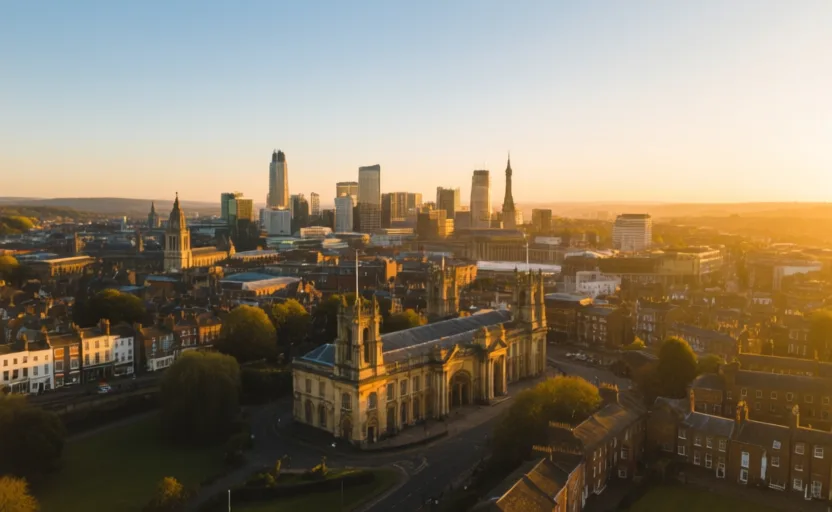 Bristol · AI city illustration · Artistic impression
City · Europe
Bristol
Saved in this browser — no account needed. Sign in later and it comes with you.
Where it is
Bristol is a hilly city on the tidal Avon, a few miles upstream of the Severn Estuary, between Gloucestershire and Somerset. It lies on limestone, running between the Mendips and the Cotswolds, and the Avon and the Frome have cut through to the clay beneath, which gives the city its steep streets. West of the centre the Avon runs through a gorge. Winters are mild under an oceanic climate, and the city is among the warmest and sunniest in the United Kingdom, though exposed to the Bristol Channel.
The land and water around it
The Avon Gorgecanyon
West of the centre the Avon cuts through limestone in a gorge formed largely by meltwater after the last ice age. It sheltered the medieval port, but by the 19th century the tidal gorge had become a liability. The land on either side is protected as the Downs and Leigh Woods.
The Avon and Frome confluenceriver
The port grew where the Frome met the Avon next to the bridge. The Avon runs in from Bath through flood plains that were marsh before the city grew, and the central docks later became the Floating Harbour.
The Severn Estuaryestuary
The city's modern docks lie where the Avon enters the estuary, at Avonmouth and Royal Portbury. The council boundary still reaches out over a rectangle of the estuary, a survival of the 14th-century charter.
Its history, in short
Bristol was a trading town by 1000 and had a mint by about 1020. Its name is Old English, Brycgstow, the place at the bridge, and the port grew up around the meeting of the Frome and the Avon beside that crossing. Under Norman rule its castle ranked among the strongest in the south, and merchants here helped to fund the invasion of Ireland. A royal charter came in 1155, and in 1373 the city became its own county, with a boundary that still takes in a stretch of the estuary. By the 15th century only London's port was busier. John Cabot sailed from here in 1497 and made landfall in North America. From 1700 to 1807, the city was deeply involved in the transatlantic slave trade, in which, by a cautious estimate, more than 2,000 ships took some 500,000 Africans into slavery across the Atlantic. Competition from Liverpool, war with France and abolition in 1807 weakened its position, and the tidal gorge that had protected the port became a liability. Brunel's railway to London replaced the canal as the main route for goods. In the twentieth century aircraft building at Filton, the docks' move down to Avonmouth, and the 1940 Blitz transformed the centre.
Timeline
Dates are shown on a timeline rather than as changing shapes on the map. The globe draws modern boundaries only, and tinting a modern outline to stand for a historical one would state something we cannot source.
Post-classical world
c. 1020
A mint at Brycgstow
The town is a trading centre with a mint striking silver pennies that bear its name. By 1067 it is a well-fortified burh, and its townsmen drive off a raid from Ireland.
Approximate dateWikipedia1155
A royal charter
Bristol receives a royal charter. The town is split between Gloucestershire and Somerset until a new charter in 1373 makes it a county in its own right.
Well attestedWikipedia
Early modern & oceanic
1497
John Cabot reaches North America
The Venetian John Cabot, sailing from Bristol, makes landfall in North America. Two years later William Weston of Bristol leads the first English-commanded expedition there.
Well attestedWikipedia1700–1807
The slave trade
By a conservative estimate, more than 2,000 slave ships take about 500,000 Africans to the Americas. Between the 1720s and 1740s Bristol is Britain's main slave-trading port, and in 1755 it has 237 slave traders against London's 147.
Well attestedWikipedia
Industrial & imperial
1804–09
The Floating Harbour
William Jessop designs a floating harbour to improve the port. It proves a costly mistake, requiring high harbour fees.
Well attestedWikipediaNovember–December 1940
The Bristol Blitz
German raids flatten the Broadmead area and Hitler claims to have destroyed the city. Across the war about 1,300 people in Bristol were killed and nearly 100,000 buildings damaged. The old centre by the bridge is now a park with two bombed-out churches.
Contemporary
1963
The Bristol Bus Boycott
A colour bar by the bus company, which refused to hire Black or Asian crews, is successfully challenged, and the boycott is seen as instrumental in the Race Relations Act of 1968.
Well attestedWikipedia7 June 2020
The Colston statue
Protesters pull a statue of Edward Colston from its plinth and push it into the harbour, after more than a decade of argument over a plaque that did not mention his part in the slave trade. It is now in a museum.
Well attestedWikipedia
Places that carry meaning
The Floating Harbour and the old docks1804 onward
The central docks, replaced by Avonmouth and Royal Portbury downstream, were redeveloped as cultural and heritage sites from the 1980s on, rather than being allowed to become derelict.
St James' Priory1129
A Benedictine priory founded by Earl Robert of Gloucester, an illegitimate son of Henry I. It is the oldest of Bristol's Grade I listed buildings, and Bristol Cathedral with its Great Gatehouse is the second.
Filton1910 onward
The base of the aeroplane company founded in 1910 by the owner of Bristol Tramways. It built Concorde, and parts of Airbus aircraft are still made there.
Languages here
Places are usually multilingual. This lists what is actually spoken, not one language per border.
EnglishGermanic family
The everyday language, in a distinctive West Country form.
Longtime residents speak Bristolian, a West Country dialect that keeps the rhotic r. It adds an l to words ending in a or o, the terminal l, so that area sounds like areal. The name of the city itself shows the effect: the older form Brycgstow gained its final l in the 12th century.
Old EnglishGermanic family
The source of the city's name.
Brycgstow, from Old English, meant the assembly place by the bridge. The surname Bristow preserves the older form.
Learn the language here
- 1Understand which languages are spoken hereBristol is multilingual. Start with which languages are used, by whom, and for what — the phrase list only covers one of them.Written by Globe Quest
- 2Learn 11 phrasesCurated everyday phrases for Bristol, with audio and a written form.Written by Globe Quest
- 3Say them out loudSpeaking practice with pronunciation feedback, one phrase at a time.Globe Quest material, your own additions
- 4Come back to themSpaced review, so what you learned this week is still there next month.Written by Globe Quest
Check yourself
What does the Old English name Brycgstow mean?
The assembly place by the bridge
The name refers to a crossing of the Avon, and the final l that appears from the 12th century may reflect the local habit of adding an l to words ending in a vowel.
How did the Avon Gorge serve Bristol's port?
It protected the medieval harbour but later became a liability for larger ships
The tidal gorge helped secure the port during the Middle Ages. By the 19th century it counted against the port as Liverpool and newer manufacturing centres pulled ahead.
Worth arguing about
- Bristol grew rich from a trade in human beings, and a statue of one of its beneficiaries was thrown into the harbour. How should a city decide what stays on its plinths?
- Bristol was once the second port of England, then lost the position to Liverpool. How much was geography, and how much choices made in the city?
What we have not established
These are open questions, listed rather than filled in. We would rather show a gap than a plausible guess.
Which languages other than English are spoken at home in Bristol?
The 2021 census figures for the city record ethnic groups, among them a fairly large share of White residents who are not British or Irish, and Indian, Pakistani, Chinese and African communities. They do not record home languages, so none is named here beyond English.
Sources
- Wikipedia · BristolWikipedia · encyclopedia · checked 2026-11-24
- Wikipedia · History of BristolWikipedia · encyclopedia · checked 2026-11-24
Reviewed by Globe Quest editorial on 2026-11-24. Drafted with AI assistance and checked against the sources above before publication.