 Globe Quest
 Human Quest · LearningSign in
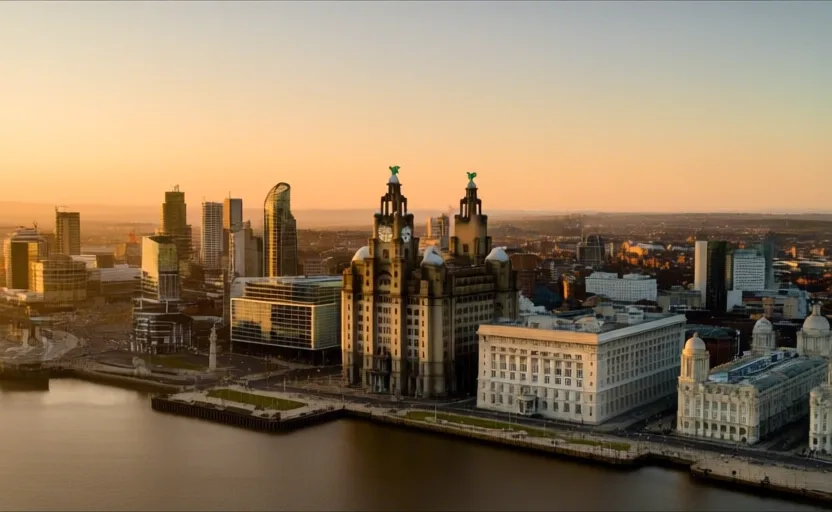 Liverpool · AI city illustration · Artistic impression
City · Europe
Liverpool
Saved in this browser — no account needed. Sign in later and it comes with you.
Where it is
Liverpool is built along the east bank of the Mersey where the estuary opens onto Liverpool Bay and the Irish Sea, about 178 miles north-west of London. The land rises from the water on a ridge of sandstone hills, reaching around 70 metres at Everton, the southern edge of the West Lancashire Coastal Plain. The estuary separates the city from the Wirral Peninsula. The climate is temperate maritime, with mild summers, cool winters and rain through the year, and air frost is relatively infrequent for the United Kingdom.
The land and water around it
The Mersey Estuaryestuary
The tidal mouth of the Mersey holds the Port of Liverpool and divides the city from the Wirral. The Port of Liverpool was still the fourth largest in the UK in 2023, and the mouth of the river was the base of the city's Atlantic trade.
The Poolharbour
A tidal creek into which two streams drained, long since filled in. It gave the borough both its name, from Old English words for muddy water and a pool, and its first harbour.
The sandstone ridgeplateau
The city climbs on sandstone hills from the water, to around 70 metres at Everton Hill. It is the southern end of the West Lancashire Coastal Plain.
Its history, in short
A tidal creek called the Pool, which gave the city its name, formed a natural harbour. In 1207 King John issued letters announcing a new borough here, probably as a convenient point from which to ship men and stores to Ireland, and a port outside the Earl of Chester's control. For centuries it was small, holding no more than a thousand people in the mid 14th century and about 600 by the mid 16th, and it counted as subordinate to Chester until the 1650s. Then the Dee began to silt up, and trade moved to the Mersey. Liverpool's growth in the 18th century was driven by Atlantic commerce, including the slave trade, in which it became the European port most heavily involved. The Old Dock of 1715 was the first enclosed wet dock. By the 19th century cotton from the American South, emigrants bound for North America and Irish refugees from the Famine passed through the port, and by 1851 a quarter of the city was Irish-born. The first intercity railway linked it to Manchester in 1830. Liverpool called itself the second city of the Empire. Its docks were bombed in the Second World War, and then containerisation made them obsolete. Unemployment was very high in the early 1980s, and revival since the 1990s was crowned by the European Capital of Culture year in 2008.
Timeline
Dates are shown on a timeline rather than as changing shapes on the map. The globe draws modern boundaries only, and tinting a modern outline to stand for a historical one would state something we cannot source.
Post-classical world
28 August 1207
King John founds the borough
Letters patent invite settlers to a new borough, then spelled Liuerpul. It is thought King John wanted a port free from the Earl of Chester and a dispatch point for troops sent to Ireland.
Early modern & oceanic
1715
The Old Dock
The world's first enclosed commercial wet dock opens. Liverpool goes on to pioneer dock technology, industrial canals and railways.
Industrial & imperial
1830
The Liverpool and Manchester Railway
The first railway between two cities opens, linking the port to the cotton mills of Lancashire. Lime Street, in the city centre, is the world's oldest still-operating main line station.
1840s–1851
The Irish arrive
Hundreds of thousands of Irish migrants come in the 1840s because of the Great Famine. By 1851 a quarter of the city's population was born in Ireland. Many went on to the United States or to other industrial towns.
1880
City status
Liverpool is granted city status. The Royal Albert Dock of 1846 had been the first non-combustible warehouse system.
Well attestedWikipediaMay 1941
The May Blitz
Directing the Battle of the Atlantic from here, Liverpool suffers eighty air raids on Merseyside. A concentrated series in May 1941 halts operations at the docks for almost a week. About 2,500 people are killed.
Well attestedWikipedia
Contemporary
1981
Toxteth riots
Riots take place in a year when the Tate and Lyle sugar works also close. Police use tear gas on civilians for the first time anywhere in the UK except Northern Ireland. By 1985 unemployment is above 20 per cent.
Well attestedWikipedia2008
European Capital of Culture
The title reverses much of the mid-century decline and, by one estimate, brings more than £800 million to the local economy within a year.
Well attestedWikipedia
Places that carry meaning
The Pier Head and the waterfrontEarly 20th century
The Pier Head carries three waterfront landmarks, the Royal Liver, Cunard and Port of Liverpool buildings. They were completed by 1916 at what was regarded as the peak of the city's economic success.
Royal Albert Dock1846
The best-known of the city's docks, with the largest single group of Grade I listed buildings anywhere in Britain.
William Brown Street and St George's Hall19th century
A cultural quarter of civic buildings and museums, built from the wealth of trade by an administration that wanted to run the city with pride.
Speke HallCompleted 1598
A timber-framed Tudor manor house in the south of the city, one of the oldest surviving buildings in Liverpool and one of few such houses left in the north of England.
Languages here
Places are usually multilingual. This lists what is actually spoken, not one language per border.
EnglishGermanic family
The everyday language, in the Scouse accent.
People from the city are formally Liverpudlians but more often called Scousers, after scouse, a stew popular with sailors, and the local accent takes the same name.
Old EnglishGermanic family
The source of the city's name.
The name joins Old English lifer, thick or muddy, with pol, a pool or creek, and appears around 1190 as Liuerpul. Another suggestion, that it refers to the eels of the Mersey, has also been made.
Irish and WelshCeltic family
The Celtic languages of the neighbouring peoples who settled the port.
Immigrants came especially from Ireland and Wales, and by 1851 a quarter of Liverpool’s people were Irish-born. Irish was the predominant language of the Irish for most of their recorded history, and Welsh is spoken natively in Wales.
ChineseSino-Tibetan family
The language of Europe’s oldest Chinese community.
Liverpool is home to the oldest Chinese community in Europe, one of several long-established communities that give the port its diversity.
Learn the language here
- 1Understand which languages are spoken hereLiverpool is multilingual. Start with which languages are used, by whom, and for what — the phrase list only covers one of them.Written by Globe Quest
- 2Learn 13 phrasesCurated everyday phrases for Liverpool, with audio and a written form.Written by Globe Quest
- 3Say them out loudSpeaking practice with pronunciation feedback, one phrase at a time.Globe Quest material, your own additions
- 4Come back to themSpaced review, so what you learned this week is still there next month.Written by Globe Quest
Check yourself
What does Liverpool's name most likely refer to?
A muddy pool or creek that once served as the harbour
The Pool was a tidal creek into which two streams drained. It was later filled in, but the name remains.
Which of these did Liverpool open first in the world?
A commercial enclosed wet dock, in 1715
The Old Dock let ships stay afloat at a fixed water level while loading, which made it a model for ports elsewhere.
Worth arguing about
- Liverpool grew rich as the European port most involved in the Atlantic slave trade. How should the city and its heritage bodies present that wealth?
- The docks that once defined the city were made obsolete by containers. Can a port city reinvent itself around culture, or does it need another industry?
What we have not established
These are open questions, listed rather than filled in. We would rather show a gap than a plausible guess.
Who are Liverpool's language communities?
The 2021 census records ethnic groups, among them an old Chinese community, Irish, Welsh and Scandinavian descendants, but not home languages. Community languages other than English are therefore not named here.
Sources
- Wikipedia · LiverpoolWikipedia · encyclopedia · checked 2026-11-24
- Wikipedia · History of LiverpoolWikipedia · encyclopedia · checked 2026-11-24
- UNESCO · Liverpool – Maritime Mercantile CityUNESCO World Heritage Centre · intergovernmental · checked 2026-11-24
- Wikipedia · Languages of the United KingdomWikipedia · encyclopedia · checked 2026-11-24
Reviewed by Globe Quest editorial on 2026-11-24. Drafted with AI assistance and checked against the sources above before publication.