 Globe Quest
 Human Quest · LearningSign in
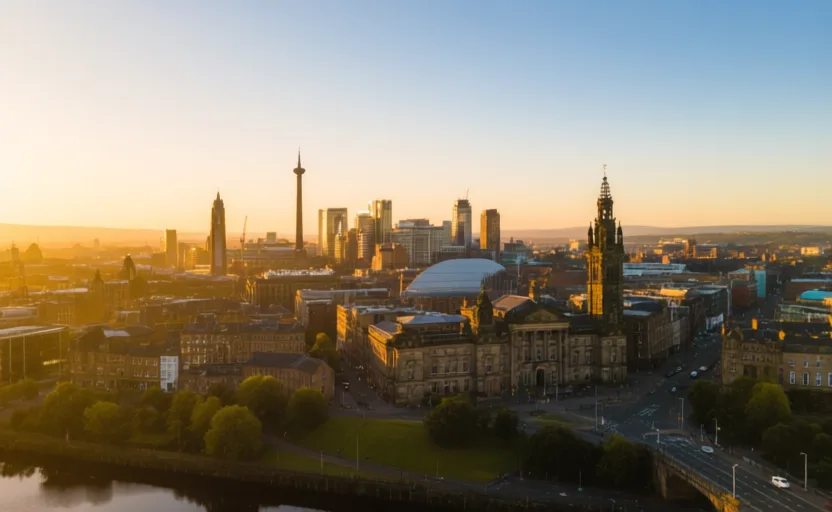 Glasgow · AI city illustration · Artistic impression
City · Europe
Glasgow
Saved in this browser — no account needed. Sign in later and it comes with you.
Where it is
Glasgow spreads along the Clyde in west central Scotland, at the point where the river could be forded furthest downstream, where the little Molendinar Burn runs in. The Kelvin joins from the north. The latitude is close to Moscow's, but the warm North Atlantic Drift and the nearness of the Celtic Sea keep the climate oceanic and mild, and wet: it is the rainiest city in the United Kingdom, with rain falling on well over 170 days in a typical year. The river was too shallow for sea-going ships above the lower estuary, a fact that shaped the city's trade.
The land and water around it
The River Clyderiver
The city grew at the lowest crossing of the river. The Clyde was too shallow above its estuary for merchant ships, which is why Port Glasgow was built downstream in the 17th century.
The Molendinar Burn and the River Kelvinriver
The Molendinar is the small stream beside which the cathedral stands, and the Kelvin is the larger tributary that joins the Clyde on the north bank. The physicist Baron Kelvin took his title from it.
A wet oceanic climateclimate
Warm Atlantic water makes winters mild for the latitude. The coldest month on record, December 2010, still had a daytime high above freezing, while the warmest day, in 2018, reached 31.9 °C. The price of that mildness is rain on most days of the year.
Its history, in short
Tradition says the missionary Kentigern, also called Mungo, built a church on the Molendinar Burn about 540 with the blessing of the king of Strathclyde, and a community grew around it. For centuries Glasgow was a cathedral town, then a bishopric and a royal burgh from 1611, with a bridge over the Clyde recorded about 1285. Its early trade was in salmon, herring, brewing and farm goods. In 1668 the magistrates built a deep-water port at Port Glasgow, 20 miles downstream, because the river above it was too shallow. After the Acts of Union in 1707 the city turned to the Americas, trading in tobacco, sugar and cotton, and it prospered from the Atlantic slave trade that those crops depended on. Shipbuilding, locomotives and heavy engineering followed, and by 1821 Glasgow had passed Edinburgh as Scotland's largest city. Its population peaked at 1,127,825 in 1938. Cholera in 1848 and 1849 led to a gravity water supply from Loch Katrine. After the Second World War, slum clearance moved people to new towns and the Clyde's yards and docks declined; since the mid-1980s finance, culture and services have taken their place.
Timeline
Dates are shown on a timeline rather than as changing shapes on the map. The globe draws modern boundaries only, and tinting a modern outline to stand for a historical one would state something we cannot source.
Post-classical world
c. 540
Kentigern and the Molendinar
The missionary known as Saint Kentigern or Mungo is welcomed by Rhydderch Hael, king of Strathclyde, and builds a church where the cathedral now stands. Glasgow's origin as a religious centre goes back to this tradition.
Approximate dateWikipedia1190
The Glasgow Fair begins
A yearly fair is established in the medieval town, and a bridge over the Clyde is recorded around 1285.
Well attestedWikipedia
Early modern & oceanic
1611
A royal burgh
Glasgow is raised to the status of royal burgh. The merchants' and trades' houses established in 1605 had already begun to shape its council.
Well attestedWikipediaAfter 1707
The Atlantic trade
The Union opens the empire's markets to Scottish merchants, and Glasgow becomes a hub for sugar, tobacco and cotton from the Americas. From 1717 to 1766 Scottish ships, mostly working from Glasgow's outer ports, carried about 3,000 enslaved Africans across the Atlantic.
Well attestedWikipedia
Industrial & imperial
1859
Water from Loch Katrine
After about 4,000 deaths from cholera in 1848 and 1849, a 26-mile aqueduct brings clean water to the city by gravity from Loch Katrine, at a cost of £980,000.
Well attestedWikipedia1938
Population peak
After boundary extensions in 1912, 1926, 1931 and 1936 tripled its area, the city reaches 1,127,825 people. It stays above a million until 1965.
Well attestedWikipedia
Contemporary
1977
Renewal replaces clearance
The Glasgow Eastern Area Renewal scheme begins refurbishing tenements instead of demolishing them. It marks a break with the post-war plans that had emptied the inner city into new towns and peripheral estates.
1990
European Capital of Culture
The designation celebrates the city's museums, galleries and orchestras and marks a shift from an industrial to a service and cultural economy.
Well attestedWikipedia
Places that carry meaning
Glasgow Cathedral13th century
Glasgow's main medieval landmark, beside the Molendinar Burn where Kentigern is said to have built his church. Very little else of medieval Glasgow survives, though the old street plan east of the centre largely does.
Provand's Lordship15th century
With the cathedral, one of the two main surviving landmarks of medieval Glasgow.
The Govan Stones10th and 11th centuries
Medieval carved stones at Govan Old Parish Church, thought lost when a shipyard building came down in the 1970s and found again in 2019. Archaeologists read them as evidence that Govan was a major early medieval centre of power.
The BriggaitFrom about 1285
The district that grew up around the oldest recorded bridge over the river, on the spot now taken by Victoria Bridge. No crossing lay lower down the Clyde, so traffic had to come this way.
Languages here
Places are usually multilingual. This lists what is actually spoken, not one language per border.
EnglishGermanic family
The everyday language of the city.
English is the main language of the United Kingdom and of the city.
ScotsGermanic family
A Germanic language of Lowland Scotland, still widely spoken or read.
In the 2022 census, 170,403 residents aged three and over, 28.2 per cent, said they could speak or read Scots.
Scottish GaelicCeltic family
The leading centre of Gaelic outside the Highlands and Islands.
In 2011, 5,878 residents, 1.0 per cent, spoke Gaelic. Only Inverness, among Scotland's 25 largest settlements, had a higher share. The Gaelic name of the city is Glaschu, from the same Brittonic roots as Glasgow.
Learn the language here
- 1Understand which languages are spoken hereGlasgow is multilingual. Start with which languages are used, by whom, and for what — the phrase list only covers one of them.Written by Globe Quest
- 2Learn 11 phrasesCurated everyday phrases for Glasgow, with audio and a written form.Written by Globe Quest
- 3Say them out loudSpeaking practice with pronunciation feedback, one phrase at a time.Globe Quest material, your own additions
- 4Come back to themSpaced review, so what you learned this week is still there next month.Written by Globe Quest
Check yourself
What does the name Glasgow probably mean?
Green hollow, from Brittonic roots
The name is Brittonic, from glas meaning grey-green and a word for a hollow. The popular form dear green place is an affectionate nickname rather than a firm etymology.
Why did Glasgow's magistrates found Port Glasgow in 1668?
The river upstream was too shallow for sea-going merchant ships
The Clyde was too shallow for ocean-going vessels beyond the lower estuary, so the city built a deep-water harbour about 20 miles down river and shipped goods the rest of the way.
Worth arguing about
- Glasgow's wealth in the 18th century rested on trade in goods produced by enslaved people. How should a city remember a past that built its streets?
- Post-war planners moved hundreds of thousands out of the inner city, and later planners decided that had gone too far. What does the story say about large-scale rebuilding?
Sources
- Wikipedia · GlasgowWikipedia · encyclopedia · checked 2026-11-24
- Wikipedia · History of GlasgowWikipedia · encyclopedia · checked 2026-11-24
- Wikipedia · United KingdomWikipedia · encyclopedia · checked 2026-11-24
Reviewed by Globe Quest editorial on 2026-11-24. Drafted with AI assistance and checked against the sources above before publication.