 Globe Quest
 Human Quest · LearningSign in
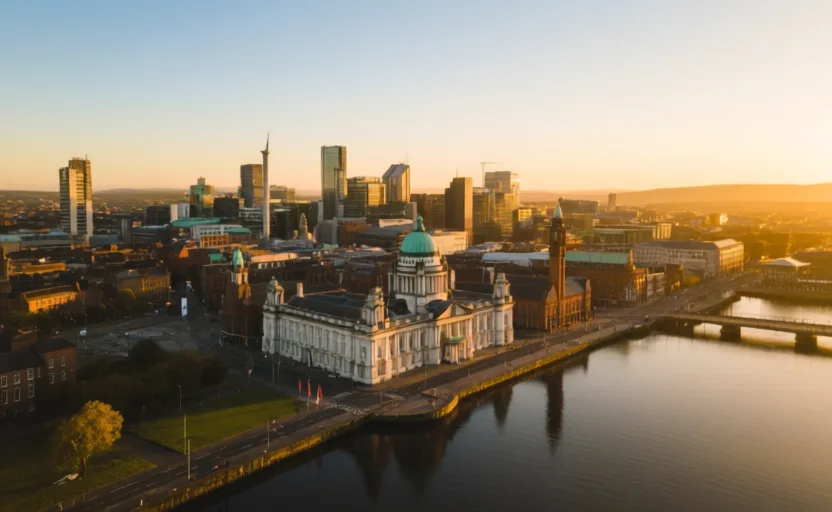 Belfast · AI city illustration · Artistic impression
City · Europe
Belfast
Saved in this browser — no account needed. Sign in later and it comes with you.
Where it is
Belfast lies at the head of a sea lough, where the River Lagan widens into a tidal estuary and the water opens through the North Channel to the Irish Sea. The city fills the flat land at the river mouth and climbs the hills that enclose it, among them Cavehill to the north, where an Iron Age hill fort overlooks the water. Its position at the head of the lough made it a port, and shipbuilding grew from that. The climate is mild for the latitude, thanks to the Gulf Stream, with rain on 157 days a year and about 846 mm in total, and the days run from sunrise after 08:30 in midwinter to sunset after 22:00 in June.
The land and water around it
The Lagan and the Farsetriver
The early settlement grew at a low-water crossing near the present Queen’s Bridge, where the Farset joined the Lagan. The Farset was culverted in the late 18th century, and its course now runs under High Street.
Belfast Loughharbour
A sheltered sea inlet opening through the North Channel. It let coal and raw materials arrive by sea for the mills and shipyards, and it was the setting for the ship-building that defined the city. Belfast Lough also served in 1914 as the stage for a decoy ship while guns were landed elsewhere.
Cavehill and the surrounding hillsmountains
The hills that wall the city to the north and west carry Iron Age forts, among them McArt’s Fort on Cavehill. Near the city the Giant’s Ring, a henge about 5,000 years old, shows the site was settled long before the Normans.
Its history, in short
The name comes from the Irish Béal Feirste, the mouth of the Farset, a river that once crossed a sandbar into the Lagan along what is now High Street. The Normans built a fort, a church and a mill at the ford in the early 13th century, but the town only took shape after 1613, when Sir Arthur Chichester planted it with English and Manx settlers and Scottish Presbyterians followed. Linen, introduced by the Scots together with French Huguenots, carried its trade across the Atlantic in the 18th century. After 1820 it industrialised faster than any other Irish place, first on cotton and then on flax, and it drew Catholic workers from the countryside into a largely Protestant town. By 1914 its shipyards built close to one eighth of world output, including the Titanic. City status came in 1888, and in 1920 it became the capital of the six north-eastern counties that stayed within the United Kingdom. The Troubles from the late 1960s killed about 1,500 in the city, and the Good Friday Agreement of 1998 brought a power-sharing assembly. Since then the docks have been rebuilt for services, film and tourism.
Timeline
Dates are shown on a timeline rather than as changing shapes on the map. The globe draws modern boundaries only, and tinting a modern outline to stand for a historical one would state something we cannot source.
Post-classical world
Early 13th century
Normans at the ford
The Normans set up a fort, a watermill and a parish church, now St George’s, at the crossing. The fort becomes the first Belfast Castle.
Approximate dateWikipedia
Early modern & oceanic
1613
The Plantation of Belfast
Under a commission from James VI, Sir Arthur Chichester builds a new castle and brings in mainly English and Manx settlers. Scottish Presbyterians arrive afterwards.
Well attestedWikipedia1649
The only siege
An English Parliamentarian army expels the town’s Scottish Presbyterians for defying London, and John Milton condemns them as ungrateful guests. Many return afterwards.
Industrial & imperial
1888
City status
Belfast is the world’s largest centre of linen manufacture, nicknamed Linenopolis, and its shipyards are growing.
Well attestedWikipedia1911
Titanic launched
Harland and Wolff launch the RMS Titanic, then the largest ship afloat. By 1914 Belfast builds close to one eighth of world shipping.
Well attestedWikipedia1920–1922
Partition and violence
The Government of Ireland Act of December 1920 creates Northern Ireland, with its parliament in Belfast. Sectarian violence erupts in the city in these years.
Spring 1941
The Belfast Blitz
Four German air raids destroy or severely damage more than half of the city’s housing and devastate the old centre around High Street. More than a thousand are killed, the largest loss of life in any air raid outside London.
Well attestedWikipedia
Contemporary
Late 1960s–1998
The Troubles
Protests give way to communal violence and paramilitary campaigns, and the British Army is deployed on the streets from August 1969. About 1,500 people were killed in the city before the 1998 Belfast Agreement restored power-sharing at Stormont.
DisputedWikipediaNationalist and unionist accounts differ over why the 1960s protests turned violent
Places that carry meaning
Harland and Wolff and the Titanic Quarter19th and 20th centuries
The shipyard that built the Titanic is now much reduced, and the former docks have become a service-economy district known as the Titanic Quarter.
The Belfast Entries17th century
Alleyways off High Street that survive from the pre-Victorian town, including White’s Tavern, rebuilt in 1790.
The peace walls and muralsLate 20th century
Barriers separating Protestant and Catholic working-class districts remain, and the murals and flags around them draw tourists. Opposing sides there also take sides in the Israeli-Palestinian conflict.
Mulholland’s Mill1828
A cotton mill on York Street that burned down in 1828 and was rebuilt to spin flax, the technology that made Belfast the linen capital.
Languages here
Places are usually multilingual. This lists what is actually spoken, not one language per border.
EnglishGermanic family
The everyday language of the city.
The 2021 census found just under a tenth of residents had been born outside the British Isles, which adds immigrant languages that the census figures here do not break down.
IrishCeltic family
One of the city’s two indigenous minority languages.
In 2021, 14.93 per cent of residents reported some knowledge of Irish, 3.74 per cent used it daily and 0.75 per cent (2,192 people) said it was their main language. The city’s name is Irish in origin.
Ulster ScotsGermanic family
The other indigenous minority language, tied to the Scottish settlement.
7.17 per cent of residents had some knowledge of Ulster Scots in 2021, and 0.83 per cent used it daily. Its speakers pronounce the city’s name in forms such as Bilfawst.
Learn the language here
- 1Understand which languages are spoken hereBelfast is multilingual. Start with which languages are used, by whom, and for what — the phrase list only covers one of them.Written by Globe Quest
- 2Learn 13 phrasesCurated everyday phrases for Belfast, with audio and a written form.Written by Globe Quest
- 3Say them out loudSpeaking practice with pronunciation feedback, one phrase at a time.Globe Quest material, your own additions
- 4Come back to themSpaced review, so what you learned this week is still there next month.Written by Globe Quest
Check yourself
What does the name Belfast come from?
The mouth of the Farset, a river that joined the Lagan
Béal Feirste means the mouth of the Farset, a river that formed a sandbar or ford where it met the Lagan. The settlement grew at that crossing.
Why does Belfast matter to the history of shipbuilding?
It built the Titanic and close to one eighth of the world’s ships by 1914
Harland and Wolff launched the Titanic in 1911, and by 1914 Belfast’s yards produced about one eighth of world tonnage.
Worth arguing about
- Belfast’s growth drew Catholics from the countryside into a Protestant town, and the tension followed. Can a city grow without sorting itself by community?
- The peace walls and murals are now tourist attractions. Who should decide what a city keeps from a conflict and what it takes down?
What we have not established
These are open questions, listed rather than filled in. We would rather show a gap than a plausible guess.
What caused the late-1960s protests to turn into sustained violence?
Nationalist and unionist accounts differ, and the question remains disputed. This entry describes the sequence of events without choosing between them.
Sources
- Wikipedia · BelfastWikipedia · encyclopedia · checked 2026-11-24
- Wikipedia · History of BelfastWikipedia · encyclopedia · checked 2026-11-24
Reviewed by Globe Quest editorial on 2026-11-24. Drafted with AI assistance and checked against the sources above before publication.