 Globe Quest
 Human Quest · LearningSign in
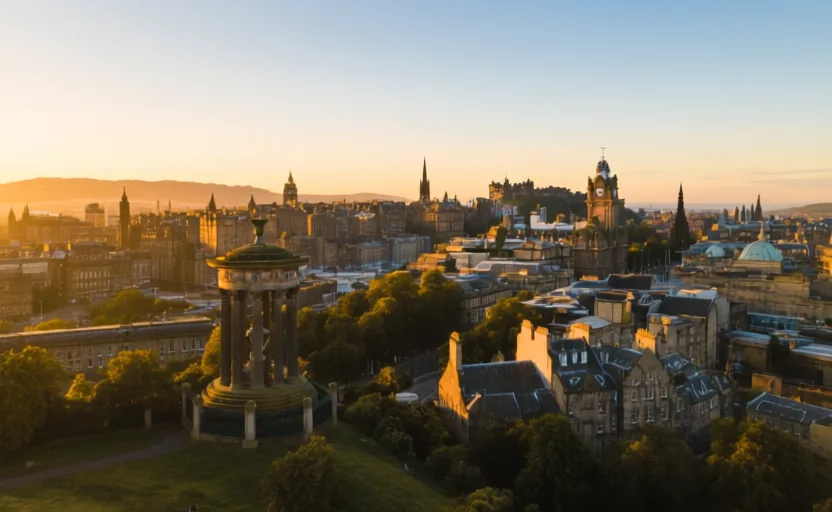 Edinburgh · AI city illustration · Artistic impression
City · Europe
Edinburgh
Saved in this browser — no account needed. Sign in later and it comes with you.
Where it is
Edinburgh fills a narrow gap in Scotland's Central Belt, between the Firth of Forth on one side and the Pentland Hills, with their outliers, on the other. The ground was shaped twice: first by volcanic activity and faulting some 350 to 400 million years ago, which left hard basalt plugs, then by intensive glaciation. The sea keeps the climate cool temperate and maritime, milder than the latitude would suggest, with summer temperatures rarely above 22 °C and winter days seldom below freezing.
The land and water around it
Volcanic plugs and the Old Town ridgevolcano
Hard basalt plugs, left by igneous activity hundreds of millions of years ago, dominate much of the local landscape. The Old Town follows a ridge that slopes down from the castle rock, and the narrow plots on either side of its main street explain why the medieval city built so tall.
The Firth of Forthestuary
The estuary bounds the city on the north. Leith, on its shore, was the port of Edinburgh, and the Forth Bridge crosses the firth to link the city's railway to Fife.
The Pentland Hillsmountains
The hills close the city's southern side and, with the firth, squeeze it into a narrow gap. Traces of Bronze Age and Iron Age settlement have been found among them as well as on Castle Rock and Arthur's Seat.
Its history, in short
A hillfort called Din Eidyn, probably on Castle Rock, was the main stronghold of the Gododdin, a Brittonic-speaking people. The city's name descends from it: as Northumbrian English and then Scots replaced the older language, din gave way to burh. The Angles took the area after a siege in 638 and held it for about three centuries, until the fortress passed to the Scots around 950. About 1130 David I made a royal burgh of the town below the castle, allotting strips of land along one long market street, and the closes of the Old Town still run back from that spine. Because walls fixed the town's limits, it grew upward, and houses of eleven storeys or more were common in the 1600s. The crowns united in 1603 and the parliaments in 1707, yet Edinburgh kept its law, church and university. From 1767 a planned New Town spread over the glacial plain to the north and drew the professional classes out of the crowded Old Town. Glasgow had overtaken Edinburgh by 1821, and the Old Town sank into slum until improvements began in the 1860s. A Scottish Parliament was re-established in the city after devolution in the late twentieth century.
Timeline
Dates are shown on a timeline rather than as changing shapes on the map. The globe draws modern boundaries only, and tinting a modern outline to stand for a historical one would state something we cannot source.
First cities & states
c. 8500 BCE
A camp at Cramond
Evidence of a Mesolithic camp at Cramond, now part of the city, is the oldest trace of people living near the future city.
Approximate dateWikipedia
Post-classical world
638
Siege of Din Eidyn
Forces loyal to King Oswald of Northumbria besiege the Gododdin stronghold, and control of Lothian passes to the Angles for roughly three centuries.
Well attestedWikipediac. 1130
A royal burgh
David I founds a burgh of the crown here, among the first in Scotland, under the protection of the castle, with merchants' plots laid out along both sides of a single market street.
Approximate dateWikipedia
Early modern & oceanic
1582
The university is founded
The University of Edinburgh begins; today it is one of four universities in the city, which became a centre of medicine, law, philosophy and engineering.
Well attestedWikipedia1 May 1707
Union of the parliaments
The Acts of Union take effect and the Parliament of Scotland merges into the Parliament of Great Britain at Westminster. Many Scots opposed the Union and there were riots in the city.
Well attestedWikipedia1767–1890
The New Town is built
A collection of seven planned developments is laid out on the glacial plain north of the Old Town, in ashlar-faced neoclassical ensembles by architects such as Robert Adam and William Playfair.
Well attestedUNESCO World Heritage Centre
Industrial & imperial
By 1821
Glasgow overtakes Edinburgh
Glasgow, enriched by Atlantic trade and then manufacturing, becomes Scotland's largest city. Edinburgh's own industry stays comparatively modest, built on printing, brewing and distilling.
1920
Leith is merged
The old port burgh of Leith, confirmed as Edinburgh's port by a royal charter in 1329, is absorbed into the city, to much resentment. It still keeps a separate identity.
Well attestedWikipedia
Places that carry meaning
The Old Town12th century onward
A medieval ridge town of closes, wynds and courts running off the High Street, with tall tenements and 16th- and 17th-century merchants' houses. Gladstone's Land, restored, rises six storeys. The Victorian rebuilding after the 1860s gave the quarter much of the look it has today.
The New Town1767–1890
A planned neoclassical district, with gardens laid out to use the slope and a system of public and private open space. It survives almost intact and covers a very large area. Together with the Old Town it is a World Heritage Site, and the contrast between the two is the reason.
LeithFrom at least the 14th century
The port on the Forth, through which the kingdom's wool and hide exports were routed once Berwick was lost to English occupation in the 1330s. Its parliamentary seat is still called Edinburgh North and Leith.
The Forth Bridge1890
A railway bridge over the firth, 2,529 metres long, built of about 54,000 tons of mild steel. It was the first great multispan cantilever bridge anywhere, and trains still cross it.
Languages here
Places are usually multilingual. This lists what is actually spoken, not one language per border.
EnglishGermanic family
The everyday language of the city.
English is the most widely spoken language of the United Kingdom. Most Edinburgh residents born in the UK were born in Scotland, and about 14 per cent of them were born in England.
ScotsGermanic family
The Germanic speech of the region before English took over.
Scots developed from Northumbrian Old English after the Angles took the area in the seventh century and displaced the Brittonic speech of the Gododdin. It is the reason the city's name ends in burh, not din.
Cumbric and Scottish GaelicCeltic family
The earlier and the later Celtic names of the city.
Cumbric, a Brittonic language formerly spoken here, gave the city the root Eidyn. Scottish Gaelic gives it the modern name Dùn Èideann, from the same stronghold.
Learn the language here
- 1Understand which languages are spoken hereEdinburgh is multilingual. Start with which languages are used, by whom, and for what — the phrase list only covers one of them.Written by Globe Quest
- 2Learn 12 phrasesCurated everyday phrases for Edinburgh, with audio and a written form.Written by Globe Quest
- 3Say them out loudSpeaking practice with pronunciation feedback, one phrase at a time.Globe Quest material, your own additions
- 4Come back to themSpaced review, so what you learned this week is still there next month.Written by Globe Quest
Check yourself
Where does the second half of the name Edinburgh come from?
The Old English burh, a fortress, which replaced the Brittonic din
The first half comes from Eidyn, a district name in Cumbric, and the second from burh once Northumbrian English and Scots replaced the older Brittonic speech.
Why did the professional classes move to the New Town from 1767?
To escape the crowded, unhealthy Old Town for lower-density streets on land to the north
The Old Town was hemmed in by its walls and had grown upward, with repeated outbreaks of disease. The New Town offered space, regular streets and gardens on the plain to the north.
Worth arguing about
- A city that lost its parliament in 1707 and regained one nearly three centuries later: what did it keep in between, and what held it together?
- The Old Town and the New Town are listed together because they contrast. Is it better to preserve a district intact, or to let a living city keep rebuilding?
Sources
- Wikipedia · EdinburghWikipedia · encyclopedia · checked 2026-11-24
- Wikipedia · History of EdinburghWikipedia · encyclopedia · checked 2026-11-24
- Wikipedia · United KingdomWikipedia · encyclopedia · checked 2026-11-24
- UNESCO · Old and New Towns of EdinburghUNESCO World Heritage Centre · intergovernmental · checked 2026-11-24
- UNESCO · The Forth BridgeUNESCO World Heritage Centre · intergovernmental · checked 2026-11-24
Reviewed by Globe Quest editorial on 2026-11-24. Drafted with AI assistance and checked against the sources above before publication.