 Globe Quest
 Human Quest · LearningSign in
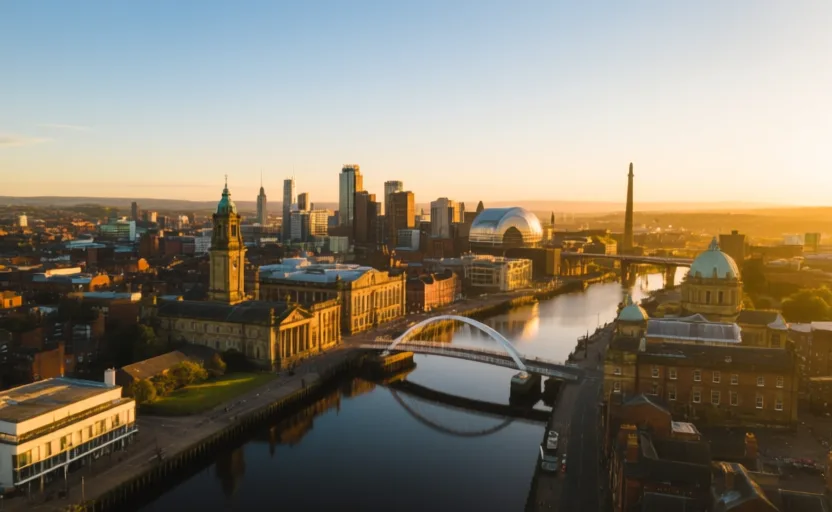 Newcastle upon Tyne · AI city illustration · Artistic impression
City · Europe
Newcastle upon Tyne
Saved in this browser — no account needed. Sign in later and it comes with you.
Where it is
Newcastle is England's northernmost city, about 46 miles south of the Scottish border, on the steep north bank of the Tyne with Gateshead facing it across the water. The river runs here through a gorge, which is why the crossing has always mattered and why a run of bridges now lines the Quayside. The ground below is Carboniferous coal measures, with sandstone and coal, which fed the city's main industry. The city lies in the rain shadow of the North Pennines and is one of the driest in the United Kingdom, with an oceanic climate.
The land and water around it
The Tyne Gorgeriver
At Newcastle the river runs in a gorge between the city and Gateshead. The Romans bridged it at the foot of the gorge, and the bridges since, the High Level Bridge of 1849, the Swing Bridge and the Tyne Bridge of 1928, all hang above the same steep banks.
The coal measuresplain
The rock beneath the city is Carboniferous sandstone and coal, part of the Middle Pennine Coal Measures. Coal exports rose from 15,000 tons in 1500 to 400,000 tons in 1625, and the coal trade built the Hostmen's wealth.
Jesmond Dene and the Ouseburnvalley
A wooded gorge in the east of the city, cut by the Ouseburn, which joins the Tyne at the Ouseburn Valley. The strip of parks along it is one of the main recreation areas in the city.
Its history, in short
The Romans bridged the Tyne here in the 2nd century and named the fort Pons Aelius, after the emperor Hadrian's family; Hadrian's Wall ran through what is now the city. After the Romans left, the Anglo-Saxon settlement was called Munucceaster, or Monkchester, and Danish attacks and then the Norman suppression of Northumbria left it in ruins. In 1080 William the Conqueror's eldest son, Robert Curthose, built a wooden castle, and the town took its name from the New Castle. For the rest of the Middle Ages Newcastle was England's northern fortress, walled in the 13th century against the Scots, and in 1400 Henry IV made it a county in its own right. In 1530 a royal act confined shipments of Tyne coal to the Newcastle quayside, giving a monopoly to a cartel of burgesses called the Hostmen, and the trade made the town rich. Plague in 1636 killed nearly half its people. The Scots stormed the town in 1644. In the 19th century builders and engineers recast the centre and built the great bridges, and the Tyne became one of the world's biggest shipbuilding and repair centres. The last coal pit closed in 1956, and the yards faded between the 1970s and 1990s.
Timeline
Dates are shown on a timeline rather than as changing shapes on the map. The globe draws modern boundaries only, and tinting a modern outline to stand for a historical one would state something we cannot source.
Classical world
122
Pons Aelius
The Romans build the first bridge across the Tyne here, and a fort follows in 150. The name means the bridge of Aelius, Hadrian's family name, and Hadrian probably visited in 122.
Post-classical world
1080
The New Castle
Robert Curthose builds a motte-and-bailey castle, with a stone one replacing it in 1087, and the town takes its name from it. Henry II's stone keep, built between 1172 and 1177, is still the centrepiece.
Early modern & oceanic
1530
The Hostmen's coal monopoly
A royal act restricts all shipments of Tyne coal to Newcastle quayside and gives a monopoly to a cartel of burgesses, the Hostmen. The phrase taking coals to Newcastle is first recorded in 1538.
Well attestedWikipedia1636
Plague
Bubonic plague, thought to have come from the Netherlands in trading ships, kills roughly half the population by one estimate. Infected houses were boarded up with whole families inside.
Industrial & imperial
1849
The High Level Bridge
Robert Stephenson's double-deck bridge carries rail above and road below. Trains can now cross the Tyne directly into the centre and go on to Scotland, and traffic no longer has to climb the narrow Side.
Well attestedWikipedia1876
The Swing Bridge
The arms maker William Armstrong pays for a bridge that rotates to let ships go upriver for the first time, so that warships can reach his Elswick factory to be armed. The mechanism is adapted from his gun mounts.
Well attestedWikipedia1882
City status
Newcastle is granted city status, a few years after Armstrong's yard at Elswick began to build ships as well as arm them.
Well attestedWikipedia
Contemporary
1956
The last pit closes
The city's last coal pit shuts. The shipyards on the Tyne followed through the 1970s, 1980s and 1990s.
Well attestedWikipedia
Places that carry meaning
The Castle Keep1172–1177
A stone keep built for Henry II, which replaced Robert Curthose's wooden castle. The Black Gate, the outer gateway, was added between 1247 and 1250.
Grainger Town1835–1842
The classical heart of the city, laid out by the builder Richard Grainger with architects such as John Dobson on the site of an old mansion. Grey Street, with its elegant curve, is considered one of the finest streets in the country.
The QuaysideMedieval onward
The waterfront between Newcastle and Gateshead, where a royal act once confined all coal shipments. A great fire in 1854 destroyed the homes of 800 families among the narrow alleys, or chares, and offices were built in their place.
Hadrian's Wall in the city2nd century
Fragments of the Roman wall survive along the West Road. The wall can be traced east to the fort of Segedunum in Wallsend, and the Vallum stopped just west of the city, where the Tyne served as a second line.
Languages here
Places are usually multilingual. This lists what is actually spoken, not one language per border.
English, in the Geordie dialectGermanic family
The everyday speech, with a large local vocabulary.
Geordie is both the regional nickname for people from Newcastle and the name of its dialect, which has many words and pronunciations not found elsewhere in the United Kingdom.
LatinItalic family
The source of the Roman and the Norman names.
Pons Aelius was the Roman name, and Novum Castellum the Latin form of the Norman one. A resident of any place called Newcastle can be called a Novocastrian.
Old EnglishGermanic family
The language of Monkchester.
In the Anglo-Saxon kingdom of Northumbria the settlement was known as Munucceaster, a form often modernised as Monkchester.
Learn the language here
- 1Understand which languages are spoken hereNewcastle upon Tyne is multilingual. Start with which languages are used, by whom, and for what — the phrase list only covers one of them.Written by Globe Quest
- 2Learn 13 phrasesCurated everyday phrases for Newcastle upon Tyne, with audio and a written form.Written by Globe Quest
- 3Say them out loudSpeaking practice with pronunciation feedback, one phrase at a time.Globe Quest material, your own additions
- 4Come back to themSpaced review, so what you learned this week is still there next month.Written by Globe Quest
Check yourself
Where does the name Newcastle come from?
A castle built in 1080 by William the Conqueror's eldest son
Robert Curthose built a wooden castle in 1080 and the settlement, until then known as Monkchester, came to be called the New Castle.
Why was the Swing Bridge built?
So that ships, including warships, could pass upriver to Armstrong's Elswick works
The earlier low-level bridge stopped large ships. Armstrong paid for a bridge that turned on a central pivot, allowing them to pass either side.
Worth arguing about
- Newcastle's wealth came from a monopoly over coal, and its decline came with the end of coal and shipyards. What should a city built on one resource do with the places left behind?
- A river crossing made this city, and bridges now define its skyline. How much does a single piece of infrastructure shape a place's identity?
What we have not established
These are open questions, listed rather than filled in. We would rather show a gap than a plausible guess.
When did Elizabeth I grant Newcastle its charter?
One account gives 1589 for a new charter from Elizabeth I, and another dates the charter that gave an exclusive body of electors and the Hostmen's loading rights to 1600. They may be separate grants or one misdated, and the question stays open.
Sources
- Wikipedia · Newcastle upon TyneWikipedia · encyclopedia · checked 2026-11-24
- Wikipedia · History of Newcastle upon TyneWikipedia · encyclopedia · checked 2026-11-24
Reviewed by Globe Quest editorial on 2026-11-24. Drafted with AI assistance and checked against the sources above before publication.