 Globe Quest
 Human Quest · LearningSign in
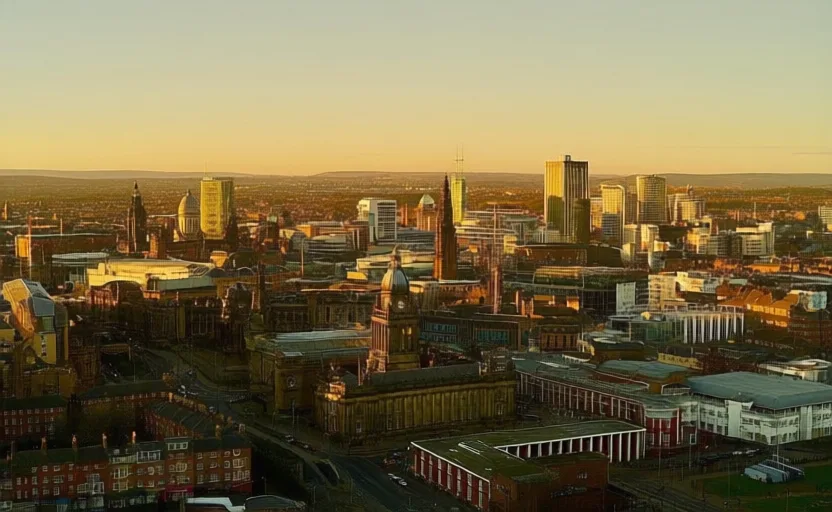 Leeds · AI city illustration · Artistic impression
City · Europe
Leeds
Saved in this browser — no account needed. Sign in later and it comes with you.
Where it is
Leeds stands on the River Aire where the valley narrows, in the eastern foothills of the Pennines, about 190 miles north-north-west of London. The centre is only some 60 metres above sea level, while the wider district climbs to over 340 metres on the slopes of Ilkley Moor in the west and falls to about ten metres where the Aire and the Wharfe leave it in the east. Inner and southern districts lie on coal-measure sandstones. The climate is oceanic and influenced by the hills, with mild summers and chilly, cloudy winters.
The land and water around it
The River Aireriver
The river gave the town its name, its crossing and, once navigations were cut along it, its link to the sea. Improved navigations made it a trade route for cloth and other goods, and mills grew up along its banks.
The Pennine foothillsmountains
The city sits where the Pennines drop away to the east. Over 60 per cent of the district is green belt, and the Yorkshire Dales National Park is less than twenty miles from the centre.
Otley Chevin and the Washburn reservoirsvalley
A gritstone outcrop above Otley is one of the district's natural landmarks. North of the city, the Washburn Valley holds three reservoirs built after 1867 when the Wharfe's water, once pumped into Leeds, became too polluted to use.
Its history, in short
The name comes from an old Brittonic word for the people of a fast-flowing river, and it first appears around 731 in Bede, who calls the region Loidis. The settlement itself is recorded in the Domesday Book of 1086, held under Ilbert de Lacy and spared the worst of the Norman harrying of the north. In 1207 the lord of the manor chartered a small borough beside the river crossing, and in 1626 a new charter incorporated the whole parish. Leeds was a market town by the 16th century and a coordinating centre for the woollen cloth trade, with white broadcloth sold in its cloth hall. By 1770 it handled one-sixth of England's export trade. Better waterways opened its access to markets: the Aire and Calder Navigation of 1699 and the Leeds and Liverpool Canal of 1816, then the railway from 1834. Mills such as Marshall's, from about 1790, spun flax and finished wool, engineering grew up to serve them, and by 1914 printing, chemicals and clothing were also major. Cholera in 1832 and 1849 forced the council to deal with water and drains. Leeds became a city in 1893. The clothing trade collapsed by the 1970s, and since then finance, retail, offices and media have taken its place.
Timeline
Dates are shown on a timeline rather than as changing shapes on the map. The globe draws modern boundaries only, and tinting a modern outline to stand for a historical one would state something we cannot source.
Post-classical world
c. 731
Loidis in Bede
Bede mentions the region of Loidis in his Ecclesiastical History, in a passage about an altar from a church built by Edwin of Northumbria. It names an area rather than a town.
1086
Domesday Book
Leeds is recorded as an agricultural manor under Ilbert de Lacy with a church, a priest and a mill, and a population of at least two hundred. Its overlord was one of William's favourites, which probably spared it the destruction of the harrying of the north.
Well attestedWikipedia1207
The borough charter
Maurice Paynel, lord of the manor, grants a charter to a small part of his manor beside the ford, where the city centre now stands. This is the start of the Borough of Leeds.
Well attestedWikipedia
Early modern & oceanic
1699
The Aire and Calder Navigation
The navigation, with major additional works in the 18th century, accelerates growth in the cloth trade. A canal to Liverpool follows in 1816.
Well attestedWikipedia
Industrial & imperial
1834
The first railway
The Leeds and Selby Railway begins a network that gives Leeds an east-west link to Manchester and the ports of Liverpool and Hull, and so to international markets.
Well attestedWikipedia1867
Reservoirs in the Washburn
After cholera in 1832 and 1849, and the pollution of the Wharfe water supply by 1860, the Waterworks Act allows three reservoirs at Lindley Wood, Swinsty and Fewston.
Well attestedWikipedia1893
City status
Queen Victoria awards a city charter. In the following century Leeds absorbs surrounding villages and overtakes York in population.
Well attestedWikipedia
Contemporary
1975
Quarry Hill flats demolished
The innovative flats that replaced the Quarry Hill slums between the wars come down, though between the wars the council also built more than 18,000 houses on 24 estates.
Well attestedWikipedia
Places that carry meaning
Kirkstall AbbeyFrom about 1152
Cistercian monks settled at Kirkstall in 1147 and began building the abbey about 1152. The ruins now stand in a park and show the beauty and grandeur of Cistercian architecture.
Marshall's Mill and the Aire Valley millsFrom about 1790
One of the first of the factories built in Leeds, most of them woollen finishing and flax mills. Armley Mills, Tower Works and the Egyptian-style Temple Works recall the city's industrial past.
Kirkgate Market and the Victorian arcades19th century
Market and arcades that show Leeds as a shopping city, alongside the Corn Exchange of 1864 and Leeds Town Hall by Cuthbert Brodrick.
Languages here
Places are usually multilingual. This lists what is actually spoken, not one language per border.
EnglishGermanic family
The everyday language of the city.
English is the main language of the United Kingdom. A native of the city is called a Loiner, a word of uncertain origin, possibly from Loidis, or in Latin form a Leodensian.
Brittonic and Old EnglishCeltic family
The languages behind the city's name.
The name is not Old English in form but an English version of an earlier Brittonic one, probably meaning the people of the strongly flowing river. Scholars also link it to an early name for the forest of Elmet or for the Aire itself.
Learn the language here
- 1Understand which languages are spoken hereLeeds is multilingual. Start with which languages are used, by whom, and for what — the phrase list only covers one of them.Written by Globe Quest
- 2Learn 13 phrasesCurated everyday phrases for Leeds, with audio and a written form.Written by Globe Quest
- 3Say them out loudSpeaking practice with pronunciation feedback, one phrase at a time.Globe Quest material, your own additions
- 4Come back to themSpaced review, so what you learned this week is still there next month.Written by Globe Quest
Check yourself
What does the early name behind Leeds probably describe?
The people of a fast-flowing river, the Aire
The name goes back to a Brittonic word, Anglo-Saxonised later, and was first recorded by Bede as Loidis, the name of a region.
Which developments gave Leeds better access to markets in the 17th to 19th centuries?
Navigations, a canal to Liverpool and then railways
The Aire and Calder Navigation of 1699, the Leeds and Liverpool Canal of 1816 and the railways from 1834 connected a landlocked town to the ports of Hull and Liverpool.
Worth arguing about
- Leeds lost its clothing industry by the 1970s and rebuilt on finance, law and retail. What does a city owe the districts where the old industry stood?
- Over 60 per cent of the district is green belt. Does that protect the countryside, or push growth into the centre?
What we have not established
These are open questions, listed rather than filled in. We would rather show a gap than a plausible guess.
What was the original meaning of the name Leeds?
The name is first recorded in Latin as Loidis and is not Old English in form. A Celtic root meaning a strongly flowing river is preferred, but other derivations are possible, and the name may first have referred to a forest or to the river itself.
Sources
- Wikipedia · LeedsWikipedia · encyclopedia · checked 2026-11-24
- Wikipedia · History of LeedsWikipedia · encyclopedia · checked 2026-11-24
- Wikipedia · United KingdomWikipedia · encyclopedia · checked 2026-11-24
Reviewed by Globe Quest editorial on 2026-11-24. Drafted with AI assistance and checked against the sources above before publication.