 Globe Quest
 Human Quest · LearningSign in
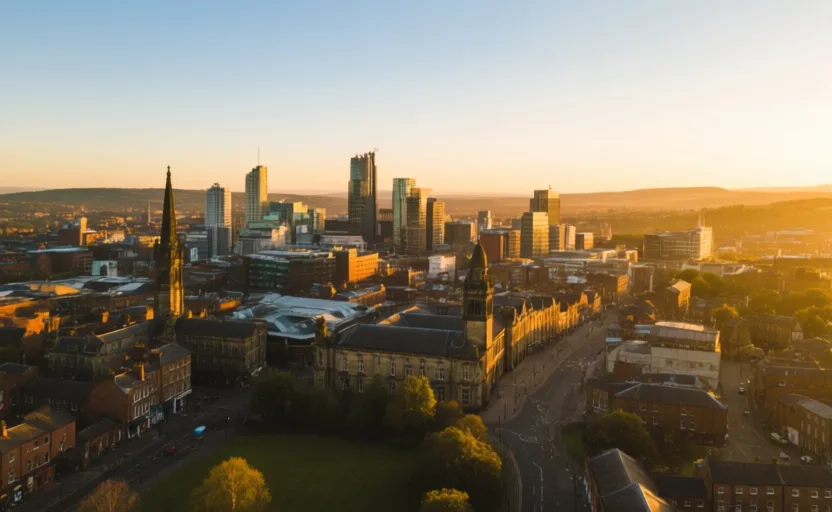 Sheffield · AI city illustration · Artistic impression
City · Europe
Sheffield
Saved in this browser — no account needed. Sign in later and it comes with you.
Where it is
Sheffield is a hill city where five rivers meet, the Don, the Sheaf, the Rivelin, the Loxley and the Porter Brook, on the eastern edge of the Pennines. To the west rise the uplands of the Peak District National Park, the highest point in the city reaching 548 metres, and to the east lies the lower South Yorkshire Coalfield, with the lowest ground only 29 metres above sea level. Much of the city climbs hillsides, and one residential street has a gradient of more than 16 degrees. The Pennines shelter it from the westerly winds, casting a rain shadow, and the climate is temperate oceanic.
The land and water around it
The five riversriver
The Don is joined by the Sheaf, Rivelin, Loxley and Porter. Their streams supplied the water power for the cutlery and steel trades, and the Sheaf, which gave the city its name, now runs through the centre in underground culverts.
The Pennine edgemountains
The city sits between the main upland range and the Peak District in the west and the lower coalfield in the east. A ring of hills isolates it from other places, which together with land around it that was unsuitable for industry helped keep its population stable and gave it the nickname of the largest village in England.
The grit stonesvalley
Gritstone from the geological formations of the Hope Valley provided material for grinding wheels, and with the water power it explains why Sheffield became England's cutlery town.
Its history, in short
Anglo-Saxons founded the settlement in a clearing by the meeting of the Sheaf and the Don between about the 6th century and the early 9th. The area lay on the boundary of Mercia and Northumbria, and in 829 the Northumbrian king Eanred acknowledged Wessex's Egbert as overlord at Dore, now a suburb. The Normans devastated the district after local rebellion, and a castle was built to control it. Sheffield grew as a cutlery town: a cutler paid tax in 1297, and by about 1600 only London rivalled it, with the trade regulated by the Company of Cutlers in Hallamshire. The reason lay in the local streams, which gave water power, and the grit stones of the nearby hills, which gave grinding wheels. Crucible steel in the 1740s and Sheffield plate, a silver coating on copper, spurred the industrial town. Its population rose from 60,095 in 1801 to 451,195 in 1901, and it received a municipal charter in 1843 and city status in 1893. Steelworks made weapons in the war, and the city was bombed in December 1940. Steel and coal collapsed in the 1970s and 1980s, and the city has since been redeveloped.
Timeline
Dates are shown on a timeline rather than as changing shapes on the map. The globe draws modern boundaries only, and tinting a modern outline to stand for a historical one would state something we cannot source.
Post-classical world
829
Submission at Dore
According to the Anglo-Saxon Chronicle, Northumbria's king Eanred met Egbert of Wessex at the hamlet of Dore and offered obedience. It is seen as a step towards a single English kingdom.
1086
The manor of Hallam
Domesday Book gives the earliest known reference to the district, as the manor of Hallun or Hallam, whose Saxon lord Waltheof kept it for some years after the Conquest.
Well attestedWikipedia1297
Robert the Cutler
The earliest official record of cutlery production in Sheffield is a tax return for a man called Robert the Cutler.
Well attestedWikipedia
Early modern & oceanic
1570–1584
Mary, Queen of Scots, in Sheffield
The Earl of Shrewsbury keeps the captive queen at Sheffield Castle and its dependent buildings for most of fourteen years. The castle is demolished by Parliament's forces in 1648.
1740s
Crucible steel and Sheffield plate
A form of the crucible process makes better steel than before, and a technique of fusing thin silver sheet onto copper gives the plated ware called Sheffield plate.
Industrial & imperial
1893
City status
Sheffield, incorporated as a borough in 1843, is made a city after growing to about 450,000 people by 1901.
Well attestedWikipedia12 and 15 December 1940
The Sheffield Blitz
Its steel factories had been set to making weapons and ammunition, so the city was targeted. More than 660 people died in the raids on these two nights.
Places that carry meaning
Manor Lodge and Turret Housec. 1510 and later
The remains of the lodge built by the fourth Earl of Shrewsbury, outside the town, with an Elizabethan Turret House beside it that may have housed Mary, Queen of Scots. Cardinal Wolsey stayed here in 1530.
Sheffield CathedralParish church; cathedral from 1914
The parish church where the sixth Earl of Shrewsbury is buried, with memorials to the fourth and sixth Earls. It became a cathedral when the Diocese of Sheffield was created in 1914.
Park Hill and the postwar rebuilding1950s and 1960s
Many slums were cleared and rebuilt as estates, among them the Park Hill flats, while a new road system including the Inner Ring Road swept away large parts of the centre.
The Peace Gardens and Heart of the City1998–2006
A public-realm project of £470 million renovated the Peace Gardens in 1998 and opened the Millennium Gallery in 2001 and the Winter Garden in 2003.
Languages here
Places are usually multilingual. This lists what is actually spoken, not one language per border.
EnglishGermanic family
The everyday language of the city.
English is the main language of the United Kingdom and of the city.
Old EnglishGermanic family
The source of the city's name.
Sheffield means open ground by the River Sheaf, from Old English feld, with the river's name probably linked to a word for boundary or division.
Old Norse and Brittonic
Traces of earlier and later neighbours in the place names.
Hamlets whose names end in thorpe, such as Grimesthorpe and Netherthorpe, date from the Norse settlement of the late 9th century. Wales and Waleswood nearby record a British presence from the Anglo-Saxon word for natives.
Learn the language here
- 1Understand which languages are spoken hereSheffield is multilingual. Start with which languages are used, by whom, and for what — the phrase list only covers one of them.Written by Globe Quest
- 2Learn 13 phrasesCurated everyday phrases for Sheffield, with audio and a written form.Written by Globe Quest
- 3Say them out loudSpeaking practice with pronunciation feedback, one phrase at a time.Globe Quest material, your own additions
- 4Come back to themSpaced review, so what you learned this week is still there next month.Written by Globe Quest
Check yourself
What explains Sheffield's rise as England's cutlery town?
Water power from many streams and gritstone for grinding wheels
The streams that meet in the city powered the grinding, and gritstone from the nearby hills supplied the wheels.
What happened at Dore in 829?
Eanred of Northumbria submitted to Egbert of Wessex
The Anglo-Saxon Chronicle records the meeting, which took place on the Mercian-Northumbrian border at what is now a Sheffield suburb. It was a step towards the unification of England under Wessex.
Worth arguing about
- Sheffield is called the largest village in England because its hills isolate it. Does geography shape a city's character as much as its industry does?
- The Meadowhall centre created jobs on a former steelworks and hurt the city centre. How should a city weigh jobs against the life of its centre?
What we have not established
These are open questions, listed rather than filled in. We would rather show a gap than a plausible guess.
What does the name Sheffield originally mean?
One account says the river's name Sheaf comes from an Old English word for a boundary and the second element means open countryside, while another derives Sheaf from a word meaning to divide and reads the suffix as a forest clearing. Both agree the name is Old English and refers to the river.
Sources
- Wikipedia · SheffieldWikipedia · encyclopedia · checked 2026-11-24
- Wikipedia · History of SheffieldWikipedia · encyclopedia · checked 2026-11-24
- Wikipedia · United KingdomWikipedia · encyclopedia · checked 2026-11-24
Reviewed by Globe Quest editorial on 2026-11-24. Drafted with AI assistance and checked against the sources above before publication.