 Globe Quest
 Human Quest · LearningSign in
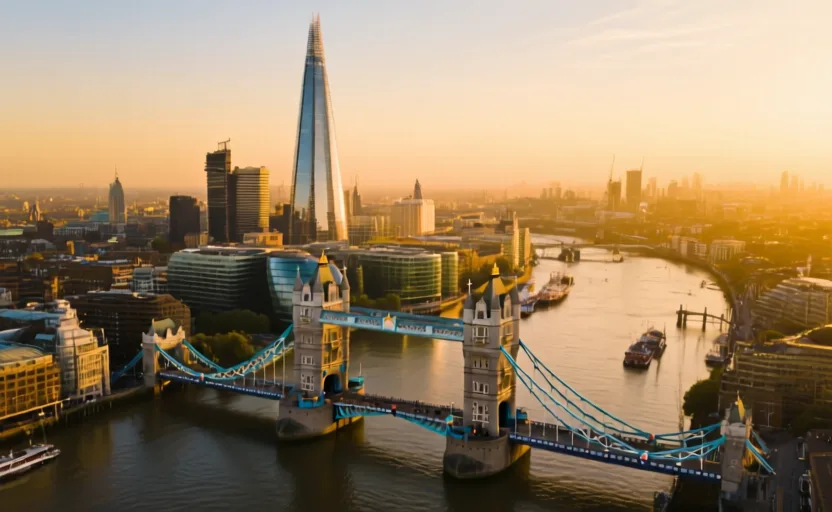 London · AI city illustration · Artistic impression
City · Europe
London
Saved in this browser — no account needed. Sign in later and it comes with you.
Where it is
London is a river crossing that grew into a metropolis. The Thames runs from the south-west to the east through a wide flood plain bordered by gently rolling hills such as Primrose Hill and Parliament Hill, and below the city it widens into a tidal estuary some 50 miles long before reaching the North Sea. Historically the settlement grew at the river's lowest bridging point, where the water was narrow enough to span and the position gave easy access to much of Europe. The climate is temperate and oceanic, with about 600 millimetres of rain a year, spread over more than a hundred wet days.
The land and water around it
The Thamesriver
The city's main geographical feature, a navigable river that crosses it from south-west to east. London grew up at its lowest bridging point and sits at the head of a tidal estuary that reaches the North Sea.
The flood plain and its hillsplain
The valley floor is a flood plain framed by low hills, among them Parliament Hill, the Addington Hills and Primrose Hill.
The Effra crossingriver
Prehistoric timbers have been found on the south foreshore where the now-underground River Effra enters the Thames: a Bronze Age bridge dated to 1750–1285 BC and a much earlier timber structure from about 4800–4500 BC. They show that the crossing mattered before London itself existed.
Its history, in short
No firm evidence of an Iron Age town has turned up, so scholars now widely accept that the Romans founded London around AD 47, four years after invading. Boudica's Iceni burned it about AD 61; it was rebuilt as a planned town, got a defensive wall between about 180 and 225, and shrank as Roman rule ended in 410. A new Anglo-Saxon trading settlement grew up slightly west of the Roman walls, and Alfred is recorded as refounding the walled city in 886. By the 11th century it was the largest town in England, and after William of Normandy was crowned at Westminster Abbey on Christmas Day 1066 two centres developed side by side: Westminster, the seat of government, and the City, the commercial heart with its own corporation. Trade, the Reformation and the East India Company drove growth in the Tudor and Stuart centuries. The Industrial Revolution made it the largest city in the world from about 1831 to 1925, with cholera, sewers and the first underground railway as the costs and answers of that growth. Modern London is a global city whose people speak more than 300 languages.
Timeline
Dates are shown on a timeline rather than as changing shapes on the map. The globe draws modern boundaries only, and tinting a modern outline to stand for a historical one would state something we cannot source.
Classical world
c. AD 47
Londinium
The Romans found a civilian town about four years after their invasion of AD 43. Because no late Iron Age settlement has been found, a purely Roman origin is now widely accepted.
c. AD 61
Boudica's revolt
The Iceni led by Queen Boudica storm the town and burn it to the ground. It is rebuilt as a planned Roman town and recovers within perhaps ten years.
c. 180–225
The London Wall
A defensive wall about 3 kilometres long, 6 metres high and 2.5 metres thick encloses the landward side. It survives for some 1,600 years and still roughly marks the boundary of the City.
Approximate dateWikipedia
Post-classical world
886
Alfred refounds the city
After Viking attacks from the 820s, the Anglo-Saxon trading settlement of Lundenwic is abandoned and life returns to the old Roman walls. The Anglo-Saxon Chronicle records the refounding.
Well attestedWikipedia25 December 1066
William is crowned at Westminster
Duke William of Normandy is crowned king in the newly finished Westminster Abbey. He builds the Tower of London to overawe the inhabitants.
1290
Expulsion of the Jews
London had been the centre of England's Jewish population before Edward I expelled it in 1290. Violence against Jews had already broken out in 1190 on the rumour of an order by Richard I.
Well attestedWikipedia
Early modern & oceanic
1666
The Great Fire
Few buildings in the centre pre-date the fire of 1666, other than the Tower of London.
Well attestedWikipedia
Industrial & imperial
c. 1831–1925
The largest city in the world
The Industrial Revolution brings unprecedented urbanisation. Overcrowding leads to cholera epidemics that kill 14,000 in 1848 and 6,000 in 1866, and the Metropolitan Board of Works builds a modern sewage system.
Approximate dateWikipedia
Places that carry meaning
Tower of LondonFrom 1066
Begun by William the Conqueror as a show of Norman power, sited at a bend in the Thames both to guard and to control the City. It is the most complete 11th-century fortress palace still standing in Europe and was long a base for the nation’s defence, record-keeping and coinage, and the place where the royal treasury came to rest.
Palace of Westminster and Westminster Abbey11th century onward
Edward the Confessor built a palace and church on Thorney Island. The Abbey is where monarchs are crowned and the Palace is still the seat of Parliament, so the pair tell the story from feudal rule to a modern democracy.
Bevis Marks SynagogueOpened 1701
The oldest continually active synagogue in Europe, tied to London's historic Sephardic Jewish community, in the City.
Languages here
Places are usually multilingual. This lists what is actually spoken, not one language per border.
EnglishGermanic family
The first language of most Londoners and the common language of the whole city.
At the 2021 census 78.4 per cent of Londoners had English as their first language. The city has its own accents: Cockney in the East End, Estuary English as an intermediate form, Multicultural London English among young people in diverse areas, and Received Pronunciation, mainly among the upper and upper-middle classes.
Immigrant languages
More than 300 languages are spoken in the city.
After English, the five biggest languages in the 2021 census were Romanian, Spanish, Polish, Bengali and Portuguese. Bengali is concentrated in eastern boroughs such as Tower Hamlets and Newham, where there are large Bengali Muslim communities.
BrittonicCeltic family
The Celtic language from which the city's name comes.
The name London was passed into Latin, Old English and Welsh from Common Brythonic, probably as a lost Celtic form something like *Londonjon.
Learn the language here
- 1Understand which languages are spoken hereLondon is multilingual. Start with which languages are used, by whom, and for what — the phrase list only covers one of them.Written by Globe Quest
- 2Learn 12 phrasesCurated everyday phrases for London, with audio and a written form.Written by Globe Quest
- 3Say them out loudSpeaking practice with pronunciation feedback, one phrase at a time.Globe Quest material, your own additions
- 4Come back to themSpaced review, so what you learned this week is still there next month.Written by Globe Quest
Check yourself
Who founded London, according to the archaeological evidence?
The Romans, around AD 47
No late Iron Age settlement has been found, so a purely Roman origin is now widely accepted. Alfred refounded the walled city in 886, but did not found it.
Why does London have a separate City and Westminster?
Government settled at Westminster while the City remained the commercial centre with its own corporation
From the 12th century the royal government became fixed at Westminster, while the City of London stayed England's largest commercial city under the Corporation of London.
Worth arguing about
- London's name is Celtic but its founding was Roman and its language now mixed. Where does the identity of a city come from when its people are mostly newcomers?
- More than 40 per cent of Londoners were born abroad in 2021, and a majority of school pupils come from ethnic minority backgrounds. What does that make the city's culture?
Sources
- Wikipedia · LondonWikipedia · encyclopedia · checked 2026-11-24
- Wikipedia · History of LondonWikipedia · encyclopedia · checked 2026-11-24
- UNESCO · Palace of Westminster and Westminster Abbey including Saint Margaret’s ChurchUNESCO World Heritage Centre · intergovernmental · checked 2026-11-24
- UNESCO · Tower of LondonUNESCO World Heritage Centre · intergovernmental · checked 2026-11-24
Reviewed by Globe Quest editorial on 2026-11-24. Drafted with AI assistance and checked against the sources above before publication.