 Globe Quest
 Human Quest · LearningSign in
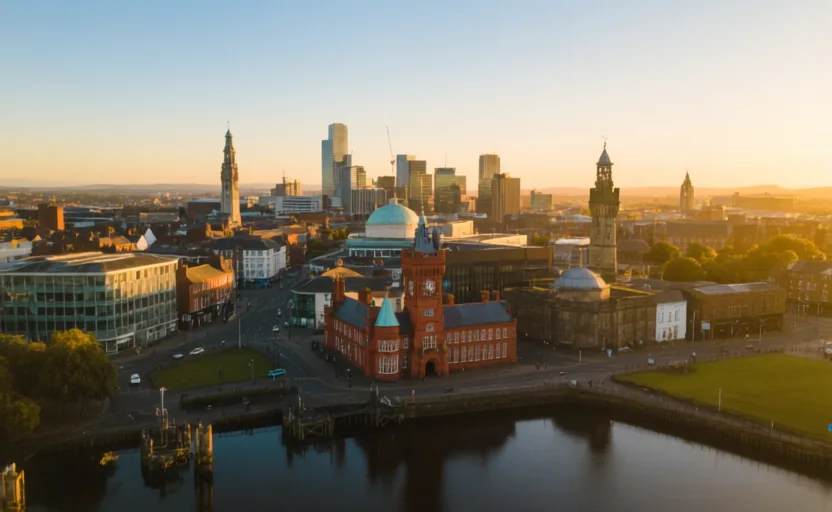 Cardiff · AI city illustration · Artistic impression
City · Europe
Cardiff
Saved in this browser — no account needed. Sign in later and it comes with you.
Where it is
The ground under Cardiff is a low, flat shelf of reclaimed marshland on Triassic rock, squeezed between the Severn Estuary to the south and a rim of hills to the east, north and west. That geometry explains the city's career. The coalfield valleys of South Wales funnel down towards it, and three rivers reach the sea here: the Taff and Ely, which now meet in a freshwater bay, and the Rhymney, which runs straight into the estuary. Garth Hill, at 307 metres, is the top of the council area. The climate is maritime, mild, cloudy and wet, with about 1,200 mm of rain a year.
The land and water around it
The Taff, Ely and Cardiff Bayestuary
The Taff runs past the castle walls and, with the Ely, empties into a freshwater bay behind a barrage. The Taff gave the city its name, and the old quay and harbour on its lower reaches were the starting point for the docks.
The marshland shelfplain
The city centre is built on reclaimed marsh stretching from Chepstow to the Ely estuary. Its flatness made room for docks and rail yards, while the ring of hills beyond kept suburbs on rising ground and farmland out of reach.
The Glamorgan coastcoast
West of Penarth and Barry, striped blue lias limestone cliffs line the only stretch of the Celtic Sea with exposed Jurassic rock. Reefs, sandbanks and gales from the south-west wrecked many ships bound for the coal port, and some wreckers and smugglers worked the shore.
Its history, in short
A Roman fort was built on a native settlement beside the Taff, and the Welsh name Caerdydd still means the fort on that river. The Normans built their castle keep inside the Roman walls, and a small English-settled town grew beneath it. For centuries Cardiff stayed modest: under 2,000 people in the Middle Ages, though already the largest town in Wales by the end of the 13th century. Owain Glyndŵr burned it in 1404. The real change came in the 19th century, when the Marquess of Bute built docks linked by rail to the Rhondda, Cynon and Rhymney valleys, and Cardiff became the great coal port, growing by nearly 80 per cent a decade. Migrants came from England, Ireland and elsewhere in Wales. After the First World War the coal trade collapsed, and the docks lost more than half their trade by 1936. City status came in 1905 and the title of capital in 1955. A devolved parliament has met in the rebuilt bay since 1999.
Timeline
Dates are shown on a timeline rather than as changing shapes on the map. The globe draws modern boundaries only, and tinting a modern outline to stand for a historical one would state something we cannot source.
Classical world
50s AD
A native settlement, then a Roman fort
The Silures set up a settlement with large timber buildings in central Cardiff. The Romans built their first fort on the site of this earlier settlement, where the Taff and Ely reach the Bristol Channel, and rebuilt it smaller in the 70s.
Approximate dateWikipedia
Post-classical world
1081 or 1091
The castle keep
Work starts on a keep inside the old Roman walls. One account links it to William I’s visit in 1081; another names Robert Fitzhamon, Lord of Glamorgan, in 1091.
Wikipedia’s Cardiff article and its separate History of Cardiff article give different years
1404
Burned by Glyndŵr
Owain Glyndŵr takes the castle and burns the town, most of it timber. It is rebuilt and recovers.
Well attestedWikipedia
Industrial & imperial
From the 1830s
The Bute docks
A dock built by the Marquess of Bute is eventually tied to the Taff Vale Railway, making Cardiff the outlet for coal from the Cynon, Rhondda and Rhymney valleys.
Well attestedWikipedia1881
Largest town in Wales
Cardiff overtakes Merthyr and Swansea in the census, after decades of growth fed by migration.
Well attestedWikipedia1905
City status
Edward VII grants Cardiff city status on 28 October. National institutions follow, including the National Museum of Wales and the civic buildings of Cathays Park.
Well attestedWikipedia
Contemporary
1955
Capital of Wales
Cardiff is proclaimed capital. It was refused the National Library of Wales partly because its founder judged the city to have a non-Welsh population.
Well attestedWikipedia1999
The Senedd
The Welsh devolved assembly, now the Senedd, begins work in Cardiff Bay. Its own building opened in 2006.
Well attestedWikipedia
Places that carry meaning
Cardiff CastleRoman fort to Victorian
A Norman keep inside Roman walls, with the original Roman facing still visible. In Victorian times the third Marquess of Bute and his architect William Burges remodelled and enlarged it.
Llandaff CathedralMedieval, within the city since 1922
Where the Bishop of Llandaff, who leads the Church in Wales, has his seat. It was devastated in the Cardiff Blitz of the Second World War.
Cathays ParkEarly 20th century
The civic centre, built of Portland stone brought from Dorset rather than the local Triassic and lias stone used elsewhere in the city.
The Gorsedd stone circles1899 onwards
Cardiff has two permanent circles for the Gorsedd of Bards at the National Eisteddfod: the original in front of the National Museum, and a 1978 replacement in Bute Park.
Languages here
Places are usually multilingual. This lists what is actually spoken, not one language per border.
WelshCeltic family
The city’s majority language from the 13th century until the Victorian boom.
As late as 1850, five of the twelve Anglican churches within today’s boundaries held services only in Welsh and two only in English. By 1891 Welsh speakers were 27.9 per cent of the population, and only a few communities on the edge remained majority Welsh.
EnglishGermanic family
The everyday language, and an export of its own.
Migration from England and Ireland during the coal years tipped the balance. Language schools now bring students from Arab states and other European countries to learn English in the city.
Learn the language here
- 1Understand which languages are spoken hereCardiff is multilingual. Start with which languages are used, by whom, and for what — the phrase list only covers one of them.Written by Globe Quest
- 2Learn 14 phrasesCurated everyday phrases for Cardiff, with audio and a written form.Written by Globe Quest
- 3Say them out loudSpeaking practice with pronunciation feedback, one phrase at a time.Globe Quest material, your own additions
- 4Come back to themSpaced review, so what you learned this week is still there next month.Written by Globe Quest
Check yourself
What does the Welsh name Caerdydd refer to?
The fort on the Taff
Caer means fort and the second part derives from the river Taff, so the name goes back to the Roman fort that the castle later occupied.
What turned Cardiff from a small town into a large one in the 19th century?
Docks serving the coal valleys by rail
Docks built from the 1830s, tied to the Taff Vale Railway, made Cardiff the outlet for the valley coalfields. Between 1840 and 1870 its population rose by nearly four-fifths every ten years.
Worth arguing about
- Cardiff was refused a national library partly because it was thought not Welsh enough, then became the capital. What makes a city Welsh?
- The city grew on coal and the coal trade left it. What should a capital that was once a single-commodity port be built on now?
What we have not established
These are open questions, listed rather than filled in. We would rather show a gap than a plausible guess.
In which year did the castle keep begin?
Accounts date the start of the keep to 1081, under William I, and to 1091, under Robert Fitzhamon. The two are not reconciled here.
Sources
- Wikipedia · CardiffWikipedia · encyclopedia · checked 2026-11-24
- Wikipedia · History of CardiffWikipedia · encyclopedia · checked 2026-11-24
Reviewed by Globe Quest editorial on 2026-11-24. Drafted with AI assistance and checked against the sources above before publication.