 Globe Quest
 Human Quest · LearningSign in
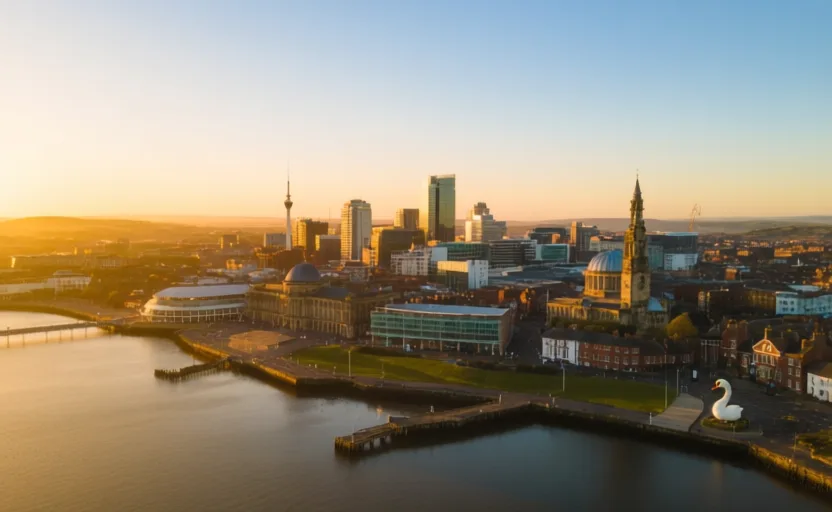 Swansea · AI city illustration · Artistic impression
City · Europe
Swansea
Saved in this browser — no account needed. Sign in later and it comes with you.
Where it is
Welsh speakers call it Abertawe, the mouth of the Tawe, and the name describes the site exactly. The river reaches the sea at the eastern edge of the Gower Peninsula, on a wide bay on the western end of the Bristol Channel. Behind the city, hills and moorland rise towards the Black Mountain, and the South Wales Coalfield runs down to the shore. About three-quarters of the council area is coastal, split between Swansea Bay, the Loughor estuary and the Channel. Atlantic winds bring rain and keep summers cool, and the oceanic climate is milder than inland. The highest point is Penlle’r Castell at 374 metres, on the northern boundary.
The land and water around it
Swansea Bay and the Tawebay
The river mouth gave the town its Welsh name and its harbour. Of the original docks, only those outside the city still work as docks. The North Dock is now Parc Tawe and the South Dock the marina.
The Gower Peninsulapeninsula
Carboniferous Limestone cliffs on its southern edge, sand beaches between steep headlands, salt marsh and dunes on the Loughor estuary to the north. It holds the distinction of being the UK’s earliest Area of Outstanding Natural Beauty.
The South Wales Coalfieldvalley
The coalfield reaches the sea in the Swansea area. The Lower Swansea Valley, where the smelters stood, was left with derelict works and waste mounds, and a reclamation scheme begun in the 20th century continues.
Its history, in short
People were here very early: the Red Lady of Paviland, a ceremonial burial on the Gower coast dated to about 22,000 BC, is the oldest known in Western Europe. The town itself dates from the Norman invasion, when a castle was raised at the river mouth around 1106 and the new Lordship of Gower made Swansea its chief town. Its English name seems to come from Norse traders who used the Tawe mouth between the 9th and 11th centuries. Medieval Swansea was a market town and port, but its real career began in the early 1700s. Cornish copper ore could be shipped to a port beside the coalfield, because smelting needed about three tons of coal for every ton of ore. By the 1850s the lower Tawe valley had more than 600 furnaces and the town was nicknamed Copperopolis. The industry declined from the late 19th century. German bombing in 1941 destroyed much of the centre, city status followed in 1969, and the old smelting valley has been reclaimed since.
Timeline
Dates are shown on a timeline rather than as changing shapes on the map. The globe draws modern boundaries only, and tinting a modern outline to stand for a historical one would state something we cannot source.
Early human world
c. 22,000 BC
The Red Lady of Paviland
A ceremonial burial in a Gower cave, discovered in 1823, is the oldest known in Western Europe. Finds at nearby Long Hole Cave have also been read as the first modern humans in Britain.
Post-classical world
c. 1106
The Norman castle
Henry de Beaumont, who received the new Lordship of Gower, builds a motte-and-bailey castle at the Tawe mouth. Swansea becomes its chief town, and the Welsh attack the castle ten years later.
Between 1158 and 1184
First borough charter
The earl of Warwick grants Swansea its first charter, the earliest document to spell the name in English. King John grants a second in 1215.
Approximate dateWikipedia
Early modern & oceanic
1717
The first copper smelter
Swansea becomes the world’s leading copper-smelting area, receiving ores from Cornwall and Devon and later from the Americas, Africa and Australia.
Well attestedWikipedia
Industrial & imperial
1850s
Copperopolis
More than 600 furnaces work in the valley, and a fleet of about 500 ships carries Welsh coal out and ore back.
Approximate dateWikipedia1880s
The peak
Sixty per cent of the copper ore imported into Britain is smelted in the Lower Swansea Valley. The industry declines severely after.
Approximate dateWikipedia19–21 February 1941
The Three Nights Blitz
German bombing destroys much of the town centre, targeting the port and its industry.
Well attestedWikipedia
Contemporary
1969
City status
Announced on 3 July during the investiture of the Prince of Wales. A lord mayor followed in 1982.
Well attestedWikipedia
Places that carry meaning
Swansea Castlec. 1106; ruins from the late 13th–early 14th century
What can be seen today was built around 1300, and modern buildings now crowd in around it. The castle once sat above the river in a strategic spot.
Oystermouth Castle13th century
The seat of the de Braose family when they held Gower, on the Mumbles shore west of the city.
The Lower Swansea Valley18th–20th century
The belt of former copper, zinc and tinplate works along the Tawe, left derelict in the 20th century, now reclaimed in part as an enterprise zone and parkland.
Tabernacle Chapel, Morriston1872
One of three Grade I listed buildings in the city, built by John Humphreys of Swansea. It reflects the Nonconformist chapel culture of the industrial valleys.
Languages here
Places are usually multilingual. This lists what is actually spoken, not one language per border.
WelshCeltic family
A minority language that is growing again through schooling.
About 13.4 per cent of the population are Welsh speakers. Welsh-medium education is a growing choice: 3,063 primary pupils and just over 1,600 secondary pupils were taught in Welsh by 2017, and there are many Welsh-language chapels.
EnglishGermanic family
The majority language.
Around 82 per cent of residents were born in Wales and 13 per cent in England. Norman lords encouraged English immigration, largely from the West Country, from the 12th century.
Learn the language here
- 1Understand which languages are spoken hereSwansea is multilingual. Start with which languages are used, by whom, and for what — the phrase list only covers one of them.Written by Globe Quest
- 2Learn 13 phrasesCurated everyday phrases for Swansea, with audio and a written form.Written by Globe Quest
- 3Say them out loudSpeaking practice with pronunciation feedback, one phrase at a time.Globe Quest material, your own additions
- 4Come back to themSpaced review, so what you learned this week is still there next month.Written by Globe Quest
Check yourself
Why was Swansea the place to smelt Cornish copper?
Smelting needed far more coal than ore, and the coalfield was beside a good port
Each ton of ore took about three tons of coal, so it was cheaper to carry ore to the coal than coal to the ore. Swansea had both the coalfield and a harbour.
What does the Welsh name Abertawe mean?
Mouth of the Tawe
Aber means river mouth. The English name is a different thing: it comes from Norse traders and first appears, spelt Sweynesse, in a 12th-century charter.
Worth arguing about
- A city that smelted most of Britain’s copper left a valley of waste to clean up. Who should pay for the environmental debt of an industrial boom?
- The Welsh name describes the site and the English name records Norse traders. What do two names for one place say about who it has belonged to?
What we have not established
These are open questions, listed rather than filled in. We would rather show a gap than a plausible guess.
Where was the Norse settlement that gave Swansea its English name?
The Vikings are recorded as arriving between the 9th and 11th centuries and leaving their name, but the nature and location of any settlement is still disputed.
Sources
- Wikipedia · SwanseaWikipedia · encyclopedia · checked 2026-11-24
- Wikipedia · History of SwanseaWikipedia · encyclopedia · checked 2026-11-24
Reviewed by Globe Quest editorial on 2026-11-24. Drafted with AI assistance and checked against the sources above before publication.