 Globe Quest
 Human Quest · LearningSign in
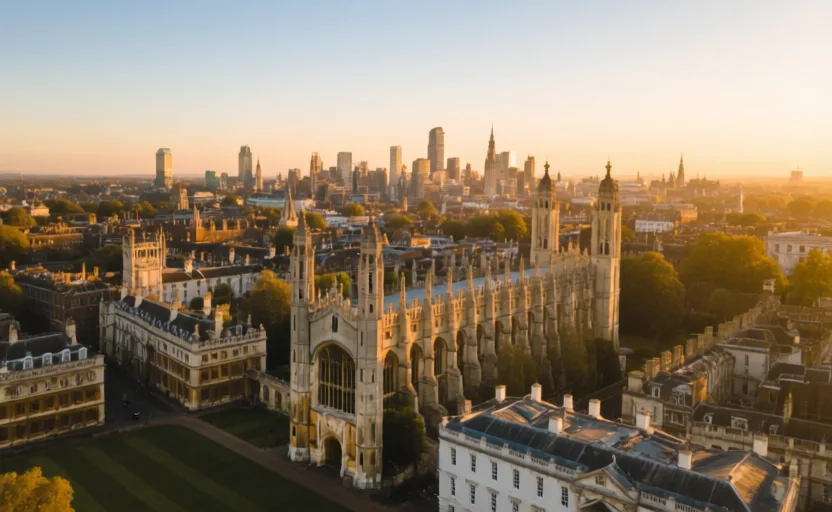 Cambridge · AI city illustration · Artistic impression
City · Europe
Cambridge
Saved in this browser — no account needed. Sign in later and it comes with you.
Where it is
Cambridge is flat, low ground on the River Cam, about 55 miles north-north-east of London and just south of the Fens, at only six metres or so above sea level. The wetlands that once surrounded the town have been drained as it grew. The ground beneath is gault clay and a chalky marl overlaid in places by terrace gravel, and the Cam runs through water meadows from Grantchester. It sits in the driest part of Britain, with around 570 millimetres of rain a year, half the national average, and its inland, easterly position gives it warm summers.
The land and water around it
The River Camriver
The river gave the town its crossing and its trade. Barges once carried butter and other farm goods up from Norfolk to be unloaded for the road to London, and in 1748 the river was reported to be so full of boats that navigation sometimes halted.
The Fen edgemarsh
The city lies just south of the Fens, on level ground about six metres above sea level at its lowest. Wetlands once ringed the town, and the drained land is now held open by a green belt.
The Gog Magog Hillsmountains
The rise south-east of the city, below which lie the springs of Nine Wells. In the early 1600s Hobson's Conduit carried clean water from there into the centre, after repeated outbreaks of pestilence.
Its history, in short
A Bronze Age farmstead lay where Fitzwilliam College now stands, and a British village on Castle Hill gave the Romans their site for a small fort around AD 70, which later passed to civilian use. The Anglo-Saxons who followed called the place Grantebrycge, the Granta bridge, and it prospered because it was a crossing point and a trade route over hard-to-travel fenland. Bede called it a little ruined city. Vikings arrived in 875 and ruled it under the Danelaw, and the centre moved from Castle Hill to the riverside quay. King Henry I gave the town a monopoly on river trade, and fairs such as Stourbridge and Midsummer drew merchants from across the country. The university was founded in 1209. During the Civil War Cambridge became the headquarters of the Eastern Counties Association, a regional Parliamentary army that carried the war effort before the New Model Army, and Cromwell, who had studied here, was given charge of the town in 1643. The railway came in 1845, but the university had the station placed outside the centre. Cambridge received city status in 1951, although it has no cathedral. Today its economy is built on research, software and biomedicine.
Timeline
Dates are shown on a timeline rather than as changing shapes on the map. The globe draws modern boundaries only, and tinting a modern outline to stand for a historical one would state something we cannot source.
First cities & states
c. 1500 BCE
A Bronze Age farmstead
Remains about 3,500 years old at the site of Fitzwilliam College are the earliest clear evidence of occupation in Cambridge.
Approximate dateWikipedia
Classical world
c. AD 70
Roman fort on Castle Hill
A small fort called Duroliponte is built on Castle Hill, where a British village already stood. About fifty years later it is converted to civilian use.
Approximate dateWikipedia
Post-classical world
875–878
Vikings take the town
The Vikings arrive in 875 and impose the Danelaw by 878. Their trading makes the town grow quickly, and its centre shifts from Castle Hill to the river quay.
Well attestedWikipedia1209
The university begins
The University of Cambridge is founded. It is now one of the highest-ranked universities in the world, and its colleges dominate the skyline.
Well attestedWikipedia
Early modern & oceanic
Early 1600s
Hobson's Conduit
A conduit from the springs at Nine Wells, beneath the Gog Magog Hills, supplies the centre with fresh water and sanitation after plague and other outbreaks through the 1500s.
Approximate dateWikipedia
Industrial & imperial
1845
The railway arrives
The Great Eastern Railway opens its London to Norwich line. The university had pressed for the station to be kept outside the town centre to restrict travel by undergraduates, and Romsey Town grew up around it.
Well attestedWikipedia1944
A secret meeting at Trinity
Military leaders gather in Trinity College and lay the foundation for the allied invasion of Europe. Cambridge itself, an RAF training centre and headquarters for the eastern counties, was bombed relatively lightly during the war, with 29 people killed.
Well attestedWikipedia
Contemporary
1951
City status
Cambridge is made a city, a rank usually tied to having a cathedral, which it lacks, because of its history, its administrative weight and its economy. It lies within the Church of England Diocese of Ely.
Well attestedWikipedia
Places that carry meaning
Castle HillIron Age to Anglo-Saxon
The place where a settlement began, with an Iron Age settlement from the 1st century BC, then the Roman fort and later the Anglo-Saxon one. The centre moved off it in the Viking period.
The colleges and the commonsFrom 1209
King's College Chapel, the Cavendish Laboratory and the University Library are among the university buildings. The centre also has large commons and greens, including Jesus Green, Parker's Piece and Midsummer Common, which host fairs and festivals.
Parker's PieceFootball's first game
The green where the first game of association football was played, after Cambridge produced the first Laws of the Game.
Languages here
Places are usually multilingual. This lists what is actually spoken, not one language per border.
EnglishGermanic family
The everyday language of the city.
English is the main language of the United Kingdom and of the city and its university.
Old EnglishGermanic family
The source of the city's name.
The Anglo-Saxons named the settlement Grantebrycge, meaning the Granta bridge. The modern name Cambridge is a worn-down form of it.
Brittonic and LatinCeltic family
The languages of the earlier British and Roman settlement.
The Roman fort was called Duroliponte, and the site is usually identified with Cair Grauth, a name in a medieval list of twenty-eight British cities attributed to Nennius.
Learn the language here
- 1Understand which languages are spoken hereCambridge is multilingual. Start with which languages are used, by whom, and for what — the phrase list only covers one of them.Written by Globe Quest
- 2Learn 11 phrasesCurated everyday phrases for Cambridge, with audio and a written form.Written by Globe Quest
- 3Say them out loudSpeaking practice with pronunciation feedback, one phrase at a time.Globe Quest material, your own additions
- 4Come back to themSpaced review, so what you learned this week is still there next month.Written by Globe Quest
Check yourself
What was the Anglo-Saxon name for Cambridge?
Grantebrycge, the Granta bridge
Duroliponte was the Roman fort. The Anglo-Saxon settlers named it after the bridge over the river, and the name worn down into Cambridge.
Why is Cambridge station outside the town centre?
The university pressed to restrict travel by undergraduates
When the railway arrived in 1845, the university wanted its students kept away from easy travel to London, so the line stopped on the edge of town.
Worth arguing about
- Cambridge has a high share of the best-paid professional jobs and, by one measure, the most unequal incomes of any British city. Does a successful university city have to be an unequal one?
- Green belt has kept the city compact but made housing costly. What should it protect, and what should it give up?
What we have not established
These are open questions, listed rather than filled in. We would rather show a gap than a plausible guess.
Which languages do Cambridge residents speak at home?
Census figures for the city record where residents come from and how they describe their ethnicity, but not what language they use at home, so no community languages besides English are named. Many of the university's students and staff are from overseas.
Sources
- Wikipedia · CambridgeWikipedia · encyclopedia · checked 2026-11-24
- Wikipedia · United KingdomWikipedia · encyclopedia · checked 2026-11-24
Reviewed by Globe Quest editorial on 2026-11-24. Drafted with AI assistance and checked against the sources above before publication.