 Globe Quest
 Human Quest · LearningSign in
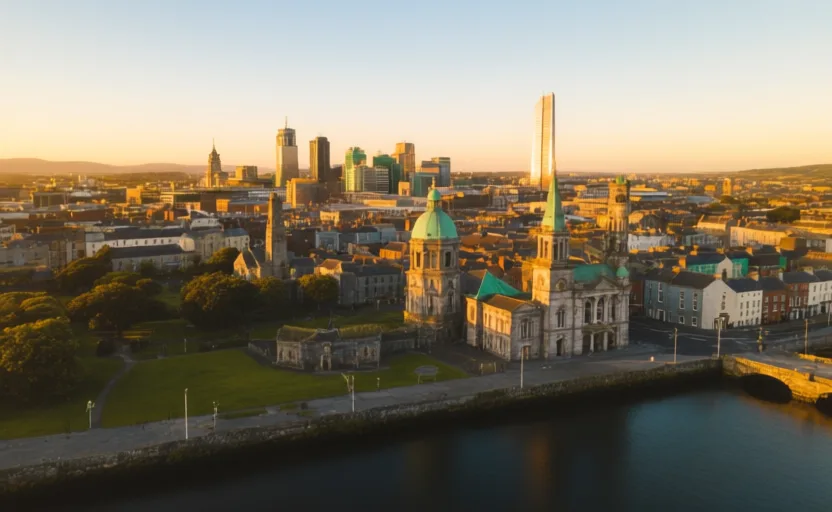 Cork · AI city illustration · Artistic impression
City · Europe
Cork
Saved in this browser — no account needed. Sign in later and it comes with you.
Where it is
The name comes from an Irish word for a marsh, and the old core still reads like one: the city centre is an island held between two channels of the River Lee, which rejoin at its eastern end. Below the quays the river widens into Lough Mahon and then Cork Harbour, one of the largest natural harbours anywhere. The land is low and the weather is oceanic and mild, with about 1,239 mm of rain a year at the airport, fog on nearly a hundred days and almost no lying snow. Being tidal and on the coast, the centre is also prone to flooding.
The land and water around it
The River Lee and its channelsriver
The Lee splits around the centre and rejoins downstream, which turned the medieval town into an island. Quays, bridges and a street plan of narrow lanes follow those channels, and the same water is why the centre floods.
Cork Harbourharbour
A sheltered natural harbour below the city, reached through Lough Mahon. It is what turned a monastic site into a port exporting butter, beef, wool and hides, and later a landing place for a seaborne attack in 1922.
A damp, mild oceanic climateclimate
Frost and heat above 25 °C are both uncommon. Rain falls on about 218 days a year at the airport, and fog on nearly 98. The harbour keeps snow from settling in the city, and the city is still one of the sunnier places in Ireland.
Its history, in short
The city began as a monastery of the sixth century that tradition ties to Saint Finbar. Between 915 and 922 Norse settlers added a trading port beside it, and the two communities lived in a mutually useful arrangement for a long time. A charter from Prince John in 1185 made it a chartered town, walled and run by a dozen or so merchant families who grew rich on wool and hides going out and salt, iron and wine coming in. For much of the Middle Ages it was an English-speaking outpost in a Gaelic countryside, paying “Black Rent” to its neighbours. The eighteenth century brought Huguenot refugees, Georgian rebuilding and an export trade in butter and beef. Cork then stayed at the centre of every Irish upheaval: the burning of its centre in 1920, then the Civil War, when it was held for a while by anti-Treaty forces. Heavy industry closed in the 1980s and gave way to pharmaceuticals, computing and food processing.
Timeline
Dates are shown on a timeline rather than as changing shapes on the map. The globe draws modern boundaries only, and tinting a modern outline to stand for a historical one would state something we cannot source.
Post-classical world
6th century
A monastery on the marsh
Cork begins as a monastic settlement, reputedly founded by Saint Finbar.
915–922
Norse trading port
Norse settlers found a trading port beside the monastery. The monks gain goods they could not otherwise obtain, and the Norse perhaps gain military aid in return.
1185
Charter from Prince John
Prince John, as Lord of Ireland, grants the city its charter. A royal charter of 1318 later creates the office of mayor.
1349
Black Death
Plague arrives and kills almost half of the townspeople, out of a medieval population of about 2,100.
Well attestedWikipedia
Early modern & oceanic
September 1690
Siege in the Williamite War
The Jacobite garrison surrenders to the Earl of Marlborough after a siege.
Well attestedWikipedia
Industrial & imperial
11 December 1920
The Burning of Cork
The Black and Tans start fires that gut the city centre, in reprisal for IRA attacks. More than 300 buildings are destroyed.
Well attestedWikipediaAugust 1922
Retaken from the sea
During the Civil War the pro-Treaty National Army lands troops at Passage West and takes the city from anti-Treaty forces, who had held it as part of a self-styled Munster Republic.
Well attestedWikipedia
Contemporary
1980s
Heavy industry ends
The Ford car factory and the Dunlop tyre plant close in 1984, and shipbuilding ends in the same decade. Later business parks go up on the former factory sites.
Well attestedWikipedia
Places that carry meaning
South and North Main StreetsMedieval
The line of the old walled town. Sections of wall and some gates survive around these streets, the clearest trace of a merchant city that was once fully enclosed.
Christ Church, St Anne’s Shandon and the Customs House1720s
Georgian buildings from the early eighteenth century, when much of the medieval fabric was replaced. They date from the decades when Cork shipped butter and beef across the Atlantic.
The English MarketLong-standing
An indoor food market selling local fish, meat, vegetables, eggs, cheeses and bread, and a place where local foods such as tripe and drisheen are still talked about.
Languages here
Places are usually multilingual. This lists what is actually spoken, not one language per border.
EnglishGermanic family
The everyday language of the city.
Cork speakers use the Southwest dialect of Hiberno-English, with a higher-pitched, rising-and-falling intonation than other Irish accents and local words that come from Irish and from languages Cork people met abroad.
IrishCeltic family
The national and first official language, taught and used officially.
About 40% of people in the state said in 2016 that they could speak Irish, but fewer than 74,000 used it daily. It is a community language only in small rural areas, the Gaeltacht, mostly in the west and south, and not in the city itself. Road signs are bilingual outside the Gaeltacht.
Learn the language here
- 1Understand which languages are spoken hereCork is multilingual. Start with which languages are used, by whom, and for what — the phrase list only covers one of them.Written by Globe Quest
- 2Learn 12 phrasesCurated everyday phrases for Cork, with audio and a written form.Written by Globe Quest
- 3Say them out loudSpeaking practice with pronunciation feedback, one phrase at a time.Globe Quest material, your own additions
- 4Come back to themSpaced review, so what you learned this week is still there next month.Written by Globe Quest
Check yourself
Why was medieval Cork effectively an island?
The River Lee splits into two channels around the centre
The centre sits between two channels of the Lee that rejoin to the east, and that setting also lies behind its name, an Irish word meaning marsh.
What happened to Cork city centre on 11 December 1920?
It was gutted by fires started by the Black and Tans
Over 300 buildings were destroyed in reprisal for IRA attacks. The sea landing at Passage West came later, in the Civil War of August 1922.
Worth arguing about
- Cork’s residents call it the real capital and the rebel city. How do a city’s nicknames record the side it took in its past?
- The old centre is an island between river channels, and it floods. Should a city built on a marsh keep rebuilding on it?
What we have not established
These are open questions, listed rather than filled in. We would rather show a gap than a plausible guess.
How many people live in Cork?
The 2022 census counts about 224,004 people in the city after its 2019 boundary extension. The same area held about 125,000 under the old boundary, and a metropolitan area is counted as more than 300,000, so any single figure depends on where the boundary is drawn.
Sources
- Wikipedia · Cork (city)Wikipedia · encyclopedia · checked 2026-11-24
- Wikipedia · History of CorkWikipedia · encyclopedia · checked 2026-11-24
- Wikipedia · Republic of IrelandWikipedia · encyclopedia · checked 2026-11-24
Reviewed by Globe Quest editorial on 2026-11-24. Drafted with AI assistance and checked against the sources above before publication.