 Globe Quest
 Human Quest · LearningSign in
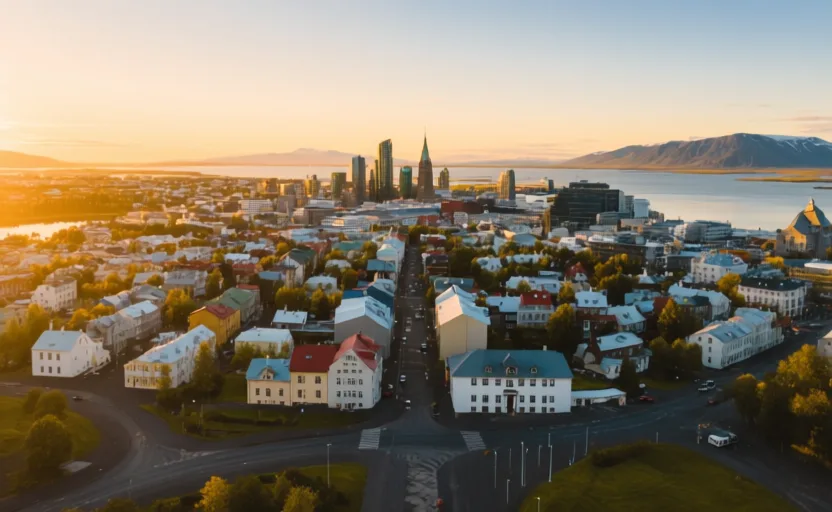 Reykjavík · AI city illustration · Artistic impression
City · Europe
Reykjavík
Also known as Reykjavík
Saved in this browser — no account needed. Sign in later and it comes with you.
Read its story
Where it is
At 64°08′ N, Reykjavík is the northernmost capital of a sovereign state, built mostly on the Seltjarnarnes peninsula on the southwest coast. The shore is a mix of peninsulas, coves, straits and islands, and the hills inside the city, Öskjuhlíð and Skólavörðuholt, are the remains of old shield volcanoes that were once islands. Mount Esja, at 914 metres, closes the view across the bay. The North Atlantic Current keeps winters mild and rarely colder than −15 °C, but summers stay cool, and gales are common in winter. Daylight is almost continuous from 20 May to 24 July, and shrinks to under five hours in midwinter.
The land and water around it
The Seltjarnarnes peninsula and its coastpeninsula
Most of the city sits on this low peninsula, and its coastline of coves, straits and islands gave the settlement its bay. The sea once stood about 43 metres higher, and shells in the sediments on Öskjuhlíð show where it reached.
Volcanic hills and Esjamountains
Öskjuhlíð and Skólavörðuholt are eroded shield volcanoes from the Ice Age, while Esja is the highest mountain nearby. A lava flow from Bláfjöll came down the Elliðaá valley about 4,500 years ago and reached the sea at Elliðavogur.
Geothermal heatclimate
The same volcanism that named the city supplies hot water for heating every building in Reykjavík and its surroundings, for the public pools, and for snow-melting systems under busy streets.
Its history, in short
The settlement story is the one the Book of Settlement tells: Ingólfur Arnarson threw his high-seat pillars overboard and settled where they washed ashore, calling the place “smoke bay” for the steam from hot springs. After that there was no urban life for nine centuries. Reykjavík was farmland until the 1750s, when a Danish-backed corporation founded wool workshops there, and it was only in 1786, when Denmark ended monopoly trading, that it became a chartered trading town, the one among six that kept the status. It became the capital almost by accident in 1845, when the Althing was re-established there. Home rule came in 1904, and the city grew as a trawler port, hit hard by the Depression. British troops arrived in May 1940 and the Americans after them, and the occupation brought full employment, an airport and building work. The republic followed in 1944. Since then, rural depopulation, fishing, finance and tourism have turned a small village into a spread-out, car-dependent city.
Timeline
Dates are shown on a timeline rather than as changing shapes on the map. The globe draws modern boundaries only, and tinting a modern outline to stand for a historical one would state something we cannot source.
Post-classical world
c. 870–874
Ingólfur Arnarson settles
According to the Book of Settlement, the Norwegian chieftain makes the first permanent settlement at Reykjavík. Excavations in the city are consistent with a settlement around 870.
Approximate dateWikipedia
Early modern & oceanic
1752
The estate goes to the Innréttingar
King Frederik V of Denmark gives the Reykjavík estate to a corporation led by Skúli Magnússon, which sets up wool workshops, along with fishing, sulphur mining and shipbuilding.
Well attestedWikipedia1786
Trading charter
The Danish Crown ends monopoly trading and gives six communities a trading charter. Reykjavík is the only one to keep it, so 1786 is counted as the city’s founding.
Well attestedWikipedia
Industrial & imperial
1845
The Althing returns
The assembly is re-established in Reykjavík as an advisory body to the Danish king, which effectively makes it the capital.
Well attestedWikipedia1904
Home rule
The office of Minister for Iceland is created in Reykjavík, moving most executive power to the island. A sovereign Kingdom of Iceland follows on 1 December 1918.
Well attestedWikipedia10 May 1940
British occupation
Four British warships anchor in the harbour and the occupation is over in a few hours, without armed resistance. At times the number of foreign soldiers matches the city’s own population, and the British build Reykjavík Airport.
Well attestedWikipedia
Contemporary
1972 and 1986
Chess and the summit
The city hosts the Fischer–Spassky world chess match in 1972 and the Reagan–Gorbachev summit in 1986.
Well attestedWikipedia
Places that carry meaning
The old harbourEarly 20th century onward
Still used by trawlers, with quays and defensive walls built from stone that a narrow-gauge locomotive hauled from quarries now inside the city. Iceland has no railways today. The larger Sundahöfn in the east is the country’s biggest cargo port.
The Culture House (Safnahúsið)1909
Opened to hold the National Library and National Archives, then a museum, and remodelled in 2000 to present Icelandic heritage.
Reykjavík Airport1940s
Built by the British during the occupation and still used for domestic, medical and Greenland flights, close to the city centre. International flights use Keflavík, built by the Americans 40–50 km away.
Languages here
Places are usually multilingual. This lists what is actually spoken, not one language per border.
IcelandicGermanic family
The language of government, school and everyday life.
The name Reykjavík is still transparent to Icelanders, who can read its parts, smoke and bay, in modern speech. Reykjavík was named a UNESCO City of Literature in 2011.
PolishSlavic family
The language of the largest foreign community.
Immigrants of the first and second generation made up 26.7% of the city in 2026, up from 2.9% in 1998. Poles are the most common foreign citizens, followed by Lithuanians, Ukrainians and Romanians, so their languages are heard in schools, where as many as a third of children in places are of foreign origin.
EnglishGermanic family
A compulsory school subject.
English and Danish are both school subjects across Iceland, and the city is visited by thousands of tourists, students and other temporary residents, who at times outnumber natives in the centre.
Learn the language here
- 1Understand which languages are spoken hereReykjavík is multilingual. Start with which languages are used, by whom, and for what — the phrase list only covers one of them.Written by Globe Quest
- 2Learn 11 phrasesCurated everyday phrases for Reykjavík, with audio and a written form.Written by Globe Quest
- 3Say them out loudSpeaking practice with pronunciation feedback, one phrase at a time.Globe Quest material, your own additions
- 4Come back to themSpaced review, so what you learned this week is still there next month.Written by Globe Quest
- 5Read why the language is what it isThe quest for this place covers how its languages got here and who speaks them.Written by Globe Quest
Check yourself
What does the name Reykjavík mean?
Bay of Smoke
The name comes from Old Norse words for smoke and bay, and is said to refer to steam rising from the hot springs in the area.
Why is 1786 counted as Reykjavík’s founding year?
Denmark gave it a trading charter, which it alone kept
Six places received trading charters when Denmark ended monopoly trade, and Reykjavík was the only one to keep it permanently. Settlement was in the 870s and the Althing arrived in 1845.
Worth arguing about
- Reykjavík was a village until the twentieth century and is now a low-density, car-dependent capital. What would it mean for such a city to densify?
- An occupation by foreign soldiers brought full employment to the city in 1940. How should a country remember a bargain like that?
What we have not established
These are open questions, listed rather than filled in. We would rather show a gap than a plausible guess.
How many people live in Reykjavík?
The municipality counted 139,804 people in January 2026, while the capital region, which includes six neighbouring municipalities, held about 252,000. Which figure counts as the city depends on whether the suburbs are included.
Sources
- Wikipedia · ReykjavíkWikipedia · encyclopedia · checked 2026-11-24
- Wikipedia · IcelandWikipedia · encyclopedia · checked 2026-11-24
Reviewed by Globe Quest editorial on 2026-11-24. Drafted with AI assistance and checked against the sources above before publication.