 Globe Quest
 Human Quest · LearningSign in
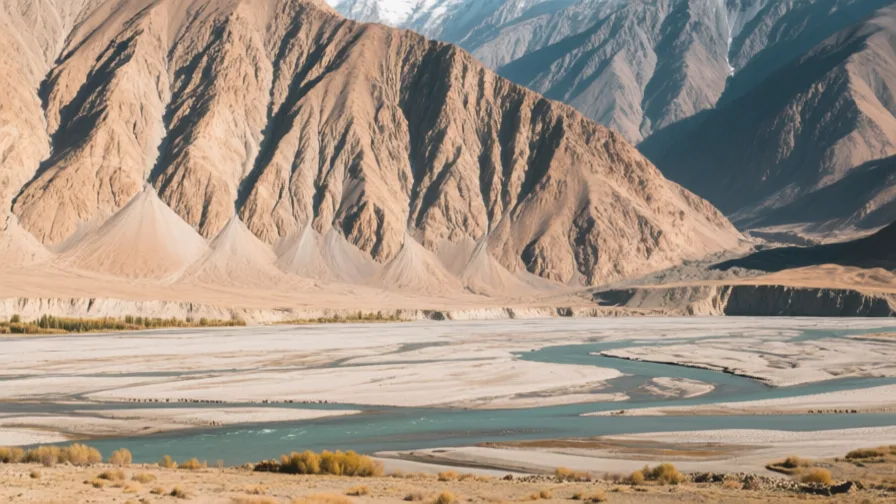 Pakistan · AI landscape illustration · Artistic impression
Country · South Asia
Pakistan
Saved in this browser — no account needed. Sign in later and it comes with you.
Where it is
Pakistan is organised around one river system and the mountains that feed it. In the far north the Hindu Kush, Karakoram and Himalaya climb past 8,000 metres at K2. South of them the Indus gathers the Kabul, Jhelum and Chenab and spreads silt across a plain that holds most of the farmland and most of the people. To the west and south-west the Balochistan plateau covers nearly half the territory but is dry and thinly settled. A coastline of about 1,046 km faces the Arabian Sea. The country lies where the Indian and Eurasian plates meet, so earthquakes and summer floods on the Indus are recurring hazards.
The land and water around it
The Indus plainplain
A broad alluvial plain built from Indus silt, with Punjab and Sindh as its two broad halves. Its tributaries, the Kabul, Jhelum and Chenab among them, all join the main river, and farming communities have worked this ground for at least five thousand years. The same river brings the heavy floods of July and August.
The northern highlandsmountains
Parts of the Hindu Kush, Karakoram and Himalaya meet here. K2, at 8,611 metres, is the second-highest peak in the world, and more than half the summits exceed 4,500 metres. The rugged terrain has long acted as a barrier to movement into the country from the north and east.
The Balochistan plateauplateau
The largest province by area, taking in 48% of the national territory at the eastern edge of the Iranian plateau. Water is scarce and settlement is sparse, concentrated near rivers and streams. The Bolan Pass gives a natural route towards Kandahar, and the Quetta region is prone to earthquakes: the 1935 shock almost destroyed the city.
Its history, in short
The land that is now Pakistan holds some of South Asia's oldest farming and city life: the village of Mehrgarh on the Kachi plain, then Harappa and Mohenjo-daro in the Indus Valley. Its western passes, the Khyber and the Bolan, made it the doorway through which Persians, Greeks, Central Asian dynasties and finally the Mughals entered the subcontinent. Islam arrived from the 8th century, and Sufi missionaries are credited with converting most of the population. Britain took Karachi in 1839 and Sindh in 1843, and by 1893 the whole territory sat inside British India. In 1947 British India was partitioned and Pakistan became independent as a homeland for the subcontinent's Muslims, in a mass migration that cost many lives. East Pakistan broke away as Bangladesh in 1971, and since then government has alternated between civilian and military hands. Kashmir is claimed by both Pakistan and India and has been the cause of repeated military confrontations. The name itself is younger than the state's roots: it was coined in 1933, partly as an acronym of the homelands of the north-west.
Timeline
Dates are shown on a timeline rather than as changing shapes on the map. The globe draws modern boundaries only, and tinting a modern outline to stand for a historical one would state something we cannot source.
First cities & states
from c. 7000 BCE
Mehrgarh
On the Kachi plain of Balochistan, villagers live in mud-brick houses, store grain, work copper and herd sheep, goats and cattle. The site is occupied until about 2600 BCE, when the climate dries and people move to the Indus Valley, where a new urban civilisation is taking shape.
Approximate dateWikipedia
Classical world
c. 518 BCE
Persians through the Khyber Pass
Darius I leads an army through the Khyber Pass and down to the Sindh coast, and sets up satrapies across the Indus lands. It is the first centralised bureaucratic rule in the valley.
Approximate dateWikipedia326 BCE
Alexander in the Indus lands
Alexander the Great enters through the Khyber Pass and a northern route, subdues the tribes of Gandhara and defeats the local king Porus at Jhelum.
Post-classical world
711
Muhammad ibn Qasim in Sindh
The Arab general conquers Sindh and parts of Punjab. The Pakistani government's official chronology treats this as the moment the foundation of Pakistan was laid, a reading that other historians do not necessarily share.
Well attestedWikipedia
Early modern & oceanic
1526
Babur founds the Mughal Empire
Babur crosses the Khyber Pass and founds an empire covering much of what is now Pakistan. Lahore is briefly the Mughal capital near the end of the 1500s, and the dynasty leaves the Lahore Fort and the Badshahi Mosque.
Well attestedWikipedia
Industrial & imperial
1839–1893
British conquest
Karachi, at that point a fishing village guarded by a mud fort, is seized in 1839 as a base for the First Afghan War. Sindh follows in 1843, and by 1893 the whole of present-day Pakistan lies within the British Indian Empire.
January 1933
The name is coined
Choudhry Rahmat Ali publishes the pamphlet Now or Never, using “Pakstan” as an acronym of Punjab, Afghania, Kashmir, Sindh and Baluchistan. Pāk means “pure” in Persian and Pashto and the suffix means “land”.
Contemporary
14 August 1947
Partition and independence
British India is divided into two dominions. Punjab and Bengal are split by the Radcliffe Commission, and communal violence in Punjab leads the two governments to agree an exchange of Muslim and Hindu and Sikh minorities. Accounts allege that Mountbatten influenced the boundary in India's favour.
Accounts alleging that Mountbatten influenced the Radcliffe line in India's favour; the allegation is contested and no account here settles it
1971
East Pakistan becomes Bangladesh
After a nine-month conflict, East Pakistan secedes and Bangladesh emerges as a separate country. General histories of Pakistan call it a civil war, a label that not everyone involved would accept, and no casualty figure is given here.
DisputedWikipediaThe “civil war” framing used in general histories of Pakistan; other parties to the conflict may name and frame it differently
Places that carry meaning
Mohenjo-daroIndus Valley Civilisation
One of the great sites of the Indus Valley Civilisation, which gives South Asia a five-thousand-year history of urban life. With Harappa it anchors the idea that city-building here is as old as anywhere in the world.
Taxila6th century BCE onward
An ancient seat of learning, said to date from the late Vedic period, whose university was recorded by the invading forces of Alexander and by Chinese pilgrims centuries later. It also lay on the road that the Maurya dynasty built from Pataliputra.
Lahore Fort and the Mughal monuments16th–17th century
Lahore, the country's cultural capital, keeps Mughal-era monuments including the fort, the Wazir Khan Mosque, the Badshahi Mosque, the Shalimar Gardens and Jahangir's tomb.
Languages here
Places are usually multilingual. This lists what is actually spoken, not one language per border.
UrduIndo-European family
National language and the lingua franca between ethnic groups.
Only about 9.25% of people gave it as their first language in the 2023 census, yet it is understood almost everywhere. It was chosen as a symbol of unity in 1947, is taught as a compulsory subject through higher secondary school, and is usually written in the calligraphic Nastaʿlīq hand.
EnglishGermanic family
Co-official language of government, law and higher education.
The constitution and laws were first written in English, and it remains the language of the courts, much of the civil service and many universities. Many treat it as the route to advancement, and in better-off circles it is often mixed with local languages.
PunjabiIndo-European family
The most widely spoken first language.
The 2023 census puts first-language speakers at 36.98% of the population, mainly in Punjab province, and written in Pakistan in the Shahmukhi script. Saraiki in the south of the province is largely mutually intelligible with it, and the census counts the two separately.
PashtoIndo-European family
First language of about a fifth of the population, mainly in Khyber Pakhtunkhwa.
Reported by 18.15% of people in 2023. Pashto speakers also live in northern Balochistan and in cities such as Islamabad, Rawalpindi and Karachi. Sindhi (14.31%), Saraiki, Balochi, Hindko and the Dravidian language Brahui are among the other regional languages, in a country with between 75 and 85 languages in all.
Learn the language here
Check yourself
What is true of Urdu in Pakistan?
It is the lingua franca although only about 9% give it as their first language
Urdu works as the shared language between ethnic groups, learned at school by millions whose home language is Punjabi, Pashto, Sindhi or another, which is why a small first-language share sits beside very wide use.
How was the name Pakistan first formed?
From an acronym of homelands including Punjab, Afghania, Kashmir, Sindh and Baluchistan
Rahmat Ali built it in a 1933 pamphlet from the initials of north-western homelands, and it also reads as “land of the pure” in Persian and Urdu.
Worth arguing about
- A state created as a homeland for Muslims then lost half its population when East Pakistan seceded. What does a shared religion hold together, and what does it leave out?
- The Indus gives Pakistan its farmland and its worst floods. How should a country plan around a river that is both a lifeline and a hazard?
What we have not established
These are open questions, listed rather than filled in. We would rather show a gap than a plausible guess.
How big is Pakistan, and how many people live there?
The area figure depends on how the disputed territory of Kashmir is counted: the larger figure of about 881,913 km2 includes it and other sources give around 796,100 km2. Population figures range from about 241.5 million in the 2023 census year to over 255 million in later estimates, so no single total is given.
What is the status of Kashmir?
Pakistan and India both claim it, and the dispute has produced several military confrontations. The sources describe the conflict but not each side's legal case in enough depth to set the positions out fairly, so it is left open here.
Sources
- Wikipedia · PakistanWikipedia · encyclopedia · checked 2026-11-24
- Wikipedia · History of PakistanWikipedia · encyclopedia · checked 2026-11-24
- Wikipedia · Geography of PakistanWikipedia · encyclopedia · checked 2026-11-24
- Wikipedia · Languages of PakistanWikipedia · encyclopedia · checked 2026-11-24
Reviewed by Globe Quest editorial on 2026-11-24. Drafted with AI assistance and checked against the sources above before publication.