 Globe Quest
 Human Quest · LearningSign in
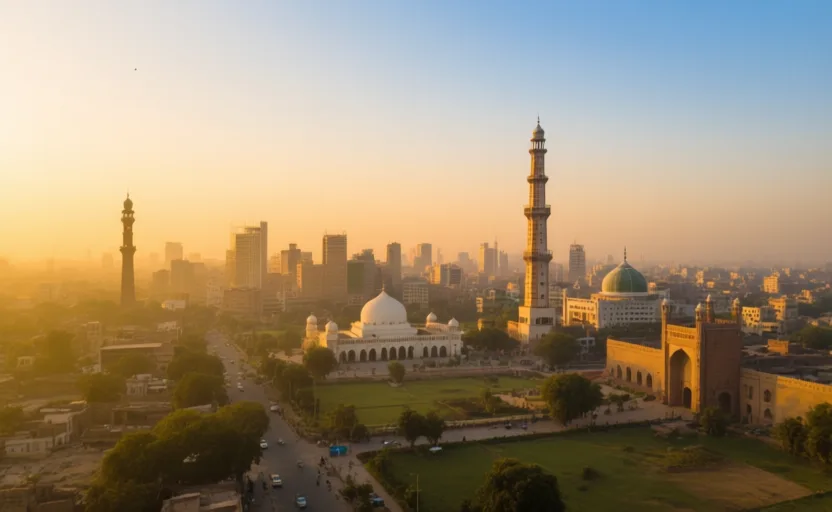 Lahore · AI city illustration · Artistic impression
City · South Asia
Lahore
Also known as Lāhaur
Saved in this browser — no account needed. Sign in later and it comes with you.
Where it is
Lahore lies on flat alluvial ground in the north-east of Pakistan, a short way from the Indian border at Wagah, with the Ravi River passing along its northern edge. The city covers about 404 square kilometres and its walls were once endangered by the river's shifting course. Its climate is hot and semi-arid, edging towards humid subtropical: June temperatures routinely pass 45 degrees Celsius, the monsoon from late June brings the heaviest rain, and winter mornings are foggy. Lahore is the capital of Punjab, the country's most populous province.
The land and water around it
The Ravi Riverriver
The river runs along the northern side of the city, and its course has moved over time. Aurangzeb ordered the Alamgiri Bund, an embankment built in 1662, to stop it undermining the city walls.
Hot semi-arid plainclimate
The summer heat is extreme: a record of 50.4 degrees Celsius was set in June 2003, and a downpour of 337 mm in a single day in August 2024 shows how violent the monsoon can be. January brings dense fog, and a 2024 air-quality report ranked the city among the most polluted in the world.
Its history, in short
Nobody can say exactly when Lahore began. Alexander's historians mention no city here in 326 BCE, and the first sure description is a tenth-century geography that calls it a small town with markets and orchards. The city came into its own under the Ghaznavids from the early 11th century, and then repeatedly changed hands among sultanates, Mongol raiders and local chiefs, suffering a devastating sack in 1241. Its high point came under the Mughals. Akbar made it his capital from 1584 and rebuilt the fort, and his successors added the marble palaces, mosques and gardens that still define its centre. After a long decline, Ranjit Singh made it the seat of the Sikh kingdom in the early 1800s, until the British annexed Punjab in 1849 and built the civic, college and court buildings of the colonial city. Lahore was central to the independence movements, and in 1947 it was torn by rioting as partition divided its Muslim, Hindu and Sikh communities. Today it is a university and publishing centre and the cultural capital of Punjab.
Timeline
Dates are shown on a timeline rather than as changing shapes on the map. The globe draws modern boundaries only, and tinting a modern outline to stand for a historical one would state something we cannot source.
Post-classical world
982
The earliest description
An anonymous Persian geography, the Hudud-i-Alam, describes Lahore as a small town with imposing temples, large markets and orchards, enclosed by mud walls. It is the oldest reliable document about the city.
Well attestedWikipedia1020s
Ghaznavid conquest
Sultan Mahmud takes Lahore between 1020 and 1027 and appoints Malik Ayaz as governor, who later rebuilds and repopulates a city left devastated by the invasion.
Approximate dateWikipedia1241
The Mongol sack
A Mongol cavalry force overruns the city, defeats its governor and levels it. Lahore is reconquered in 1266 and raided again by Mongols in the following decades.
Well attestedWikipedia
Early modern & oceanic
1584
Mughal capital
Akbar begins re-fortifying the ruined citadel, and Lahore becomes his capital. Shah Jahan, who was born in the city in 1592, adds the Naulakha Pavilion in 1633 and the Shalimar Gardens in 1641.
early 1800s
Capital of the Sikh kingdom
Ranjit Singh takes control of Lahore from the Bhangi chiefs after 1799 and makes it his capital. Under him and his successors, the city is rebuilt along Mughal lines and known as a city of gardens.
Industrial & imperial
1849
British annexation
The British occupy the city in 1846, depose Ranjit Singh's heir in 1848 and annex Punjab in 1849. Lahore becomes the provincial capital, and its Indo-Gothic and Indo-Saracenic public buildings date from this period.
1940
The Muslim League session
At a session of the All-India Muslim League held in Lahore, Muhammad Ali Jinnah proposes the Two Nation Theory and demands a separate homeland for the Muslims of India. A resolution for the establishment of Pakistan is passed in the city.
Contemporary
1947
Partition
The future of Lahore was fiercely contested. In 1941 it held 671,659 people, about 64.5% of them Muslim and most of the rest Hindu and Sikh. Rioting at independence caused many deaths and damaged monuments including the fort and the Badshahi Mosque, and industrial output fell to a third of its earlier level by the end of the decade.
Places that carry meaning
Lahore Fort and the Shalimar Gardens16th–17th century
Two Mughal royal complexes seven kilometres apart: the fort, with 21 surviving monuments from Akbar's brick-and-sandstone work to Shah Jahan's marble and mosaic, and the terraced water garden laid out in 1641–42. Together they are inscribed as a World Heritage Site.
The Walled CityMedieval onward
The oldest quarter, grown piecemeal rather than on a grid, with cul-de-sacs, small lanes and bazaars such as Sarafa, Kashmiri and Dabi Bazaar. It holds the Wazir Khan and Badshahi mosques and several Sikh and Sufi shrines.
The temple of Lava in the fortLegendary origins
Oral tradition says that Lahore was founded by Lava, a son of the god Rama, and a vacant temple in the fort is dedicated to him. Written records neither confirm nor rule out this origin; the name itself has several competing explanations.
Hindu oral tradition about Lava, son of Rama, as founder of the city
Languages here
Places are usually multilingual. This lists what is actually spoken, not one language per border.
PunjabiIndo-European family
The first language of most residents.
Almost three quarters of residents, 73.58% in the 2023 census, speak it at home, which makes Lahore the largest Punjabi-speaking city in the world. It appears in local theatre, film and newspapers, and campaigners argue that it should also be the language of primary teaching and of the provincial assembly.
UrduIndo-European family
Official language and the language of schooling and media.
Urdu is the first language of 21.1% of residents in the census and is used by those who speak other languages at home as the shared medium of administration, classrooms and media.
EnglishGermanic family
Second official language, used in administration and education.
English is used alongside Urdu in government and as a medium of instruction.
PashtoIndo-European family
Spoken by a minority of newer migrants from the north-west.
Pashto is the first language of 2.06% of residents in the 2023 census, and Mewati of 2.01%. Pashtun political parties argue that their community is undercounted, since many recent arrivals are not registered as permanent residents.
Learn the language here
- 1Understand which languages are spoken hereLahore is multilingual. Start with which languages are used, by whom, and for what — the phrase list only covers one of them.Written by Globe Quest
- 2Learn 11 phrasesCurated everyday phrases for Lahore, with audio and a written form.Written by Globe Quest
- 3Say them out loudSpeaking practice with pronunciation feedback, one phrase at a time.Globe Quest material, your own additions
- 4Come back to themSpaced review, so what you learned this week is still there next month.Written by Globe Quest
Check yourself
Which ruler turned Lahore into an imperial capital in 1584?
Akbar
Akbar began re-fortifying the ruined citadel in 1584 and ruled from Lahore, the start of the Mughal building programme that created the fort, mosques and gardens.
Which language do most people in Lahore speak at home?
Punjabi
Punjabi is the first language of about 74% of residents, well above Urdu at 21%, even though Urdu and English are the official languages of administration.
Worth arguing about
- Lahore was called the city of gardens under the Sikhs and the Mughals, and is now among the most polluted cities in the world. What would it take to recover that identity?
- Punjabi dominates daily life, but Urdu and English hold official roles. Who gains and who loses from that arrangement?
What we have not established
These are open questions, listed rather than filled in. We would rather show a gap than a plausible guess.
What survives of Lahore before the 1241 Mongol sack?
One account says no building or monument predates the Mongol destruction. UNESCO describes the fort site as occupied for several millennia and gives it its present configuration in the 11th century, so the two statements are hard to reconcile.
How many people live in Lahore?
The 2017 census counted 11,126,285 residents, while later estimates run above 14 million. Pashtun political parties also argue that their community was undercounted in 2017, which would add to the total.
Sources
- Wikipedia · LahoreWikipedia · encyclopedia · checked 2026-11-24
- Wikipedia · History of LahoreWikipedia · encyclopedia · checked 2026-11-24
- UNESCO · Fort and Shalamar Gardens in LahoreUNESCO World Heritage Centre · intergovernmental · checked 2026-11-24
- Wikipedia · PakistanWikipedia · encyclopedia · checked 2026-11-24
Reviewed by Globe Quest editorial on 2026-11-24. Drafted with AI assistance and checked against the sources above before publication.