 Globe Quest
 Human Quest · LearningSign in
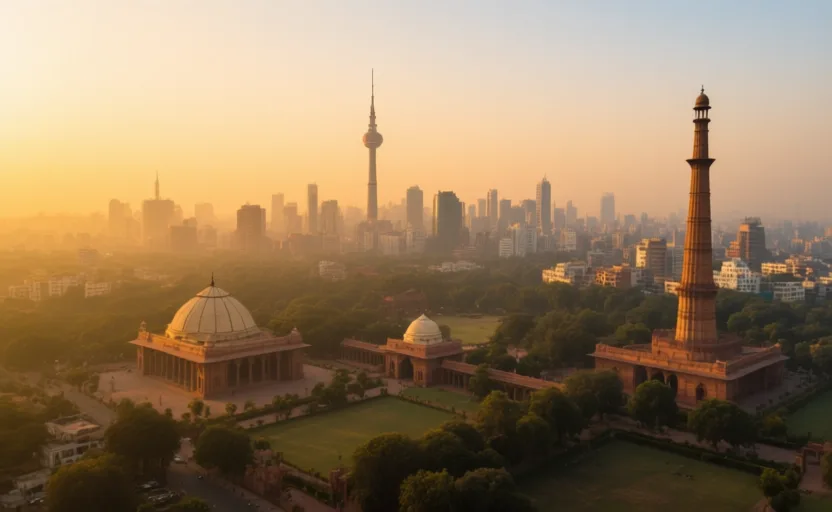 Delhi · AI city illustration · Artistic impression
City · South Asia
Delhi
Saved in this browser — no account needed. Sign in later and it comes with you.
Where it is
Delhi lies in the northern plains on the west bank of the Yamuna, the only major river to cross it. The territory is small, 1,484 square kilometres, and wedged between Haryana on three sides and Uttar Pradesh across the river. Two features set its geography: the river’s flood plain, with fertile alluvial soil that floods repeatedly, and the Delhi Ridge, a spur of the Aravalli Range that curls round the west, north-east and north-west of the city and rises to about 318 metres. The location is strategic for anyone coming down the plains, and the city has been built over and over.
The land and water around it
The Yamuna and its flood plainriver
The river was once the boundary between what are now Haryana and Uttar Pradesh. Its flood plain gives rich farmland and is prone to repeated flooding, and the medieval fort Purana Qila stands on its bank on a knoll that matches the Mahabharata’s description of Indraprastha.
The Delhi Ridgemountains
A spur of the Aravalli Range running up from the south, around 318 metres at its highest, arcs round the west and north of the city. It is a dominant feature of the region and one of the few areas of high ground in a flat plain.
The winter smog seasonclimate
From October to December the air quality index falls to Very Poor, Severe or Hazardous levels. Stubble burning in neighbouring states, firecrackers at Diwali, traffic, industry and cold air all contribute, and an estimate attributes about 41 per cent of fine-particle pollution to vehicles. Smog disrupts air and rail traffic every year.
Its history, in short
Delhi is traditionally counted as seven cities, built one after another by rulers who either sacked the previous capital or decided to build their own. A Tomara dynasty fort at Lal Kot in the eleventh century was taken by the Chauhans, who lost in turn to Muhammad Ghori in 1192. His general Qutb-ud-din Aibak founded the Delhi Sultanate in 1206 and began the Qutub Minar, and a succession of Turkic and Afghan dynasties then built new forts and towns around the Qutb area. Timur sacked the city in 1398. The Mughals, after 1526, ruled mostly from Agra until Shah Jahan built Shahjahanabad, today’s Old Delhi, and made it capital from 1638. Nader Shah looted it in 1739, the Marathas and then the British East India Company held it, and in 1857 it was a focus of the rebellion. The British moved their capital here from Calcutta in 1911, building New Delhi, inaugurated in 1931. At Partition in 1947 the city changed from a Mughal to a Punjabi one, as Muslims left and refugees arrived.
Timeline
Dates are shown on a timeline rather than as changing shapes on the map. The globe draws modern boundaries only, and tinting a modern outline to stand for a historical one would state something we cannot source.
Post-classical world
1206
Capital of the Delhi Sultanate
After Ghori dies without an heir, Qutb-ud-din Aibak, a former slave who became a general, founds the Delhi Sultanate. He begins the Qutub Minar and the Quwwat-al-Islam mosque, the earliest surviving mosque in India.
1398
Timur sacks the city
Timur defeats the Tughlaq army and enters Delhi, which is plundered and left in ruins, with more than 100,000 prisoners reported killed.
Approximate dateWikipedia
Early modern & oceanic
1638
Shahjahanabad
Shah Jahan builds the seventh city of Delhi, including the Red Fort and Jama Masjid, and moves the capital back from Agra. Another account dates the shift to 1648.
1739
Nader Shah
A Persian army routs the Mughals at Karnal in under three hours and sacks Delhi, carrying off the Peacock Throne and the Koh-i-Noor. Mughal power never recovers.
Industrial & imperial
1857
Rebellion and siege
Mutineers capture Delhi on 11 May and declare Bahadur Shah Zafar II emperor. British troops lay siege and retake it on 21 September, and the city passes to direct Crown rule in 1858.
1911
New capital of British India
At a durbar King George V announces that the capital will move from Calcutta to Delhi. Edwin Lutyens designs New Delhi, which is named in 1927 and inaugurated in 1931.
Contemporary
1947
Partition
About 500,000 Hindu and Sikh refugees, mainly from West Punjab, reach Delhi, while about 300,000 of its Muslim residents go to Pakistan. The city loses roughly two-thirds of its Muslims, in part because of pressure from arriving refugees.
Approximate dateWikipedia1984
Anti-Sikh violence
After Indira Gandhi is assassinated by her Sikh bodyguards, Delhi becomes the main site of nationwide anti-Sikh pogroms. Government figures give around 2,800 dead in the city, and independent estimates tend to be higher.
DisputedWikipediaGovernment figures against independent estimates of the death toll
Places that carry meaning
Purana Qila16th century
A fort on the Yamuna bank rebuilt by Sher Shah Suri, whose knoll matches the epic’s description of Indraprastha. Excavations have found painted grey pottery of the eleventh century BCE but no built city or fortifications, so the identification is a tradition and not a finding.
Literary tradition of the Mahabharata against the archaeological record
Qutb complex13th century
Begun by Aibak and completed under Iltutmish, the 72.5-metre Qutub Minar stands beside the Quwwat-al-Islam mosque. Its style is related most closely to minarets raised in Central Asia under the Ghaznavids and Ghurids.
Humayun’s Tomb1560s
Built under Akbar by Persian and Indian craftsmen, the first great Mughal garden-tomb stands in a four-part garden and holds more than 150 family members. It lies beside the shrine of the Sufi saint Nizamuddin Auliya, and seven centuries of burials nearby make it a dense ensemble of medieval Islamic buildings.
Shahjahanabad (Old Delhi)From 1638
The walled city built by Shah Jahan, with the Red Fort and the Jama Masjid, completed in 1656 and India’s largest mosque. On Independence Day the Prime Minister’s address to the nation is given at the Red Fort.
Languages here
Places are usually multilingual. This lists what is actually spoken, not one language per border.
HindiIndo-European family
The most spoken language and the official language of Delhi.
About 81 per cent of Delhi speak Hindi according to a 2014 report. The local Khariboli dialect was part of the development that produced Urdu literature and later Modern Standard Hindi.
PunjabiIndo-European family
An additional official language, and the language of the refugee generation.
Spoken by about 7 per cent. Refugees from West Punjab after 1947 gave the city a lasting Punjabi influence in speech, dress and food.
UrduIndo-European family
An additional official language and the old literary language of the city.
Spoken by about 6 per cent. Delhi poets such as Mir Taqi Mir and Mirza Ghalib wrote in it, and it is tied to the city’s Sufi and Mughal past.
BengaliIndo-European family
The fourth most spoken language.
About 1.5 per cent of residents, part of the pattern of recent migration from other parts of India that is making the city’s speech more mixed.
Learn the language here
- 1Understand which languages are spoken hereDelhi is multilingual. Start with which languages are used, by whom, and for what — the phrase list only covers one of them.Written by Globe Quest
- 2Learn 12 phrasesCurated everyday phrases for Delhi, with audio and a written form.Written by Globe Quest
- 3Say them out loudSpeaking practice with pronunciation feedback, one phrase at a time.Globe Quest material, your own additions
- 4Come back to themSpaced review, so what you learned this week is still there next month.Written by Globe Quest
Check yourself
Which of Delhi’s traditional seven cities is now known as Old Delhi?
Shahjahanabad
Shah Jahan built Shahjahanabad as the seventh city, with the Red Fort and Jama Masjid, and it was the Mughal capital from 1638 until the empire’s fall.
What have excavations at Purana Qila found about the Mahabharata’s Indraprastha?
No signs of an ancient built environment or fortifications
The knoll matches the epic’s description, but excavation turned up painted grey pottery and little else, so the link remains a matter of tradition.
Worth arguing about
- Delhi has been conquered, sacked and rebuilt many times, and each regime built beside or over the last. Is the city’s identity its continuity or its repeated rupture?
- In 1947 the city went from a Mughal to a Punjabi one in a matter of months. How should a city remember a change in who lives in it?
What we have not established
These are open questions, listed rather than filled in. We would rather show a gap than a plausible guess.
When did Shahjahanabad become the Mughal capital?
Accounts give 1638 for the move of the capital from Agra and 1648 for the city becoming the capital. Building the city and declaring it capital may have been separate steps.
How many people live in Delhi?
The 2011 census counted about 16.8 million in the territory, and a figure of over 11 million for the city proper. A United Nations estimate puts the wider urban area at over 28 million, so any total depends on the boundary used, and no census since 2011 has replaced it.
Sources
- Wikipedia · DelhiWikipedia · encyclopedia · checked 2026-11-24
- Wikipedia · History of DelhiWikipedia · encyclopedia · checked 2026-11-24
- UNESCO · Humayun's Tomb, DelhiUNESCO World Heritage Centre · intergovernmental · checked 2026-11-24
Reviewed by Globe Quest editorial on 2026-11-24. Drafted with AI assistance and checked against the sources above before publication.