 Globe Quest
 Human Quest · LearningSign in
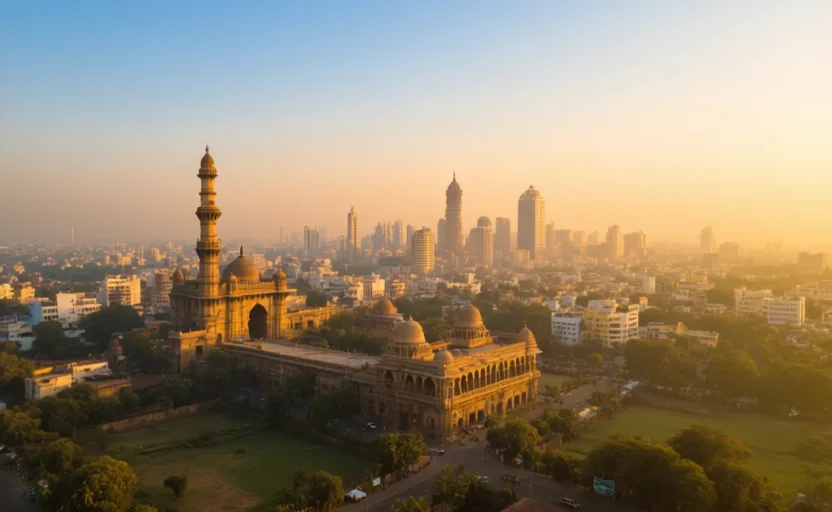 Ahmedabad · AI city illustration · Artistic impression
City · South Asia
Ahmedabad
Saved in this browser — no account needed. Sign in later and it comes with you.
Where it is
Ahmedabad is a dry, flat city in north-central Gujarat, 53 metres above sea level on the Sabarmati River, with only the small hills of Thaltej-Jodhpur Tekra to break the ground. The climate is hot semi-arid, with an average summer maximum of 43 degrees Celsius, about 800 millimetres of rain a year and droughts when the monsoon stops short of the west. The Sabarmati used to shrink to a trickle in summer, and Narmada water is now diverted into it to keep it flowing. The river splits the city into distinct eastern and western halves, with the old walled city on the east bank and the newer districts across the water.
The land and water around it
The Sabarmati Riverriver
The river runs past the old walled city on its east bank and divides the modern city in two. Because it used to dry up in summer, the riverfront project and the Narmada canals now keep water in it all year, a change the city reports as ending its water problems.
The edge of the Rann of Kutchdesert
The Rann’s steady expansion has threatened to spread desertification across the city and much of the state, and Narmada canals are expected to ease it. Sandy dry soil is the city’s base.
Heat and shaking groundclimate
A heat wave in May 2010 that reached 46.8 degrees killed hundreds and led to the Ahmedabad Heat Action Plan, and the record is 48 degrees in 2016. The city also lies in seismic zone 3, and the 2001 Gujarat earthquake collapsed up to 50 multi-storey buildings and killed 752 people.
Its history, in short
An early settlement called Ashaval stood here by the eleventh century, and a Chaulukya ruler, Karna, founded a town called Karnavati beside it, though no one knows exactly where. In 1411 Ahmad Shah I of the Gujarat Sultanate chose a forested stretch of the Sabarmati for his new capital, laid out a walled city and named it after himself. His descendant Mahmud Begada fortified it again in the late fifteenth century with a ten-kilometre wall. Ahmedabad stayed a capital through the Mughal and Maratha periods, taking damage in famine and in contests between the Peshwa and the Gaekwad, until the East India Company took it in 1818. The railway to Bombay opened in 1864 and the city grew into the cotton-textile centre known as the Manchester of India. Gandhi set up two ashrams here in 1915 and 1917 and began the Salt March from his ashram in 1930. It became capital of Gujarat in 1960, until the capital moved to Gandhinagar in the late 1970s. The textile mills closed from the 1970s and the city has since turned to commerce, construction and services.
Timeline
Dates are shown on a timeline rather than as changing shapes on the map. The globe draws modern boundaries only, and tinting a modern outline to stand for a historical one would state something we cannot source.
Post-classical world
11th century
Ashaval and Karnavati
The Chaulukya ruler Karna defeats the Bhil chieftain of Ashaval and founds Karnavati on the Sabarmati. Later references from the fourteenth and fifteenth centuries mention Ashaval but not Karnavati, and the site of Karnavati is not known.
Medieval chronicle accounts against the absence of Karnavati in later references
26 February 1411
Ahmad Shah I founds Ahmedabad
The Sultan lays the foundation at Manek Burj, the first bastion of Bhadra Fort, and declares the city capital on 4 March. It is named after him, or in another version after four saints called Ahmad.
Early modern & oceanic
1486 or 1487
Mahmud Begada’s city wall
A wall about 10 kilometres round, with twelve gates, 189 bastions and more than 6,000 battlements, fortifies the city. Accounts give the date as 1486 or 1487.
Industrial & imperial
1864
Railway to Bombay
The railway link to Bombay connects the city to trade between north and south India and helps establish it as a textile centre.
1915 and 1917
Gandhi’s ashrams
Mahatma Gandhi founds the Kochrab Ashram in 1915 and the Satyagraha Ashram, now the Sabarmati Ashram, in 1917. They become centres of nationalist activity, and in 1919 textile workers burn 51 government buildings in protest against the Rowlatt Act.
Well attestedWikipedia1930
The Salt March
Gandhi sets out on the Dandi March from his ashram, and in the early 1930s mass peaceful protest brings the city’s administration and economic institutions to a halt.
Well attestedWikipedia
Contemporary
2002
The 2002 Gujarat violence
Three days of violence between Hindus and Muslims spread to the city. On 28 February a massacre at the Gulbarg Society in eastern Chamanpura left 69 dead, and refugee camps housed about 50,000 Muslims as well as a few Hindu camps.
DisputedWikipediaAccounts of causes, responsibility and the total number of dead differ; only the figures recorded for Ahmedabad are given here
July 2017
World Heritage listing
The historic city of Ahmedabad is inscribed on the World Heritage List.
Places that carry meaning
Bhadra Fort and Manek Burj1411–1413
The fort was started in 1411 from Manek Burj and completed in 1413. Tradition ties the foundation to the saint Maneknath, and his descendants perform a puja and raise a flag on foundation day and at Vijayadashami each year.
The tradition of the Maneknath family and the city’s founding legend
The pols of the old cityFrom the 15th century
Gated residential streets of timber houses, with inner entrances called khadkis, make up the old city. The World Heritage listing singles out this wooden domestic architecture and the presence of Hindu, Muslim, Jain, Christian and other institutions side by side.
Sidi Saiyyed MosqueLast year of the Sultanate
An entirely arched mosque with ten stone latticework windows on its side and rear arches, from the fusion of Hindu craftsmanship and Persian architecture that marks the city’s Sultanate buildings.
Sabarmati Ashram1917
Gandhi’s base on the banks of the river, from which the Salt March began in 1930.
Languages here
Places are usually multilingual. This lists what is actually spoken, not one language per border.
GujaratiIndo-European family
The language of the state and of the city’s literature.
Gujarati literature is promoted by three institutions set up in the city: the Gujarat Sahitya Sabha, the Gujarati Sahitya Parishad and the Gujarat Vidhya Sabha.
HindiIndo-European family
The official language of India’s federal government.
Hindi is the Union’s official language, though no language is the national language. Hindu migrants from Pakistan after 1947 settled in large numbers in the city.
EnglishGermanic family
The associate official language of India.
Kept alongside Hindi in national use after protests in the south against the imposition of Hindi.
Learn the language here
- 1Understand which languages are spoken hereAhmedabad is multilingual. Start with which languages are used, by whom, and for what — the phrase list only covers one of them.Written by Globe Quest
- 2Learn 11 phrasesCurated everyday phrases for Ahmedabad, with audio and a written form.Written by Globe Quest
- 3Say them out loudSpeaking practice with pronunciation feedback, one phrase at a time.Globe Quest material, your own additions
- 4Come back to themSpaced review, so what you learned this week is still there next month.Written by Globe Quest
Check yourself
Who founded Ahmedabad, and when?
Sultan Ahmad Shah I of Gujarat, in 1411
Ahmad Shah I laid the foundation on 26 February 1411 and named the new walled city after himself. Karna founded the earlier Karnavati, whose site is not known, and the East India Company took the city in 1818.
Why was Ahmedabad called the Manchester of India?
It was a major cotton and textile centre
Cotton-textile mills made the city one of the country’s largest centres of the trade, and it is still the second-largest producer of cotton in India. The mills began closing from the 1970s.
Worth arguing about
- The city’s World Heritage case rests on its timber pols and on people of many faiths living in one urban structure. How do you weigh that against the violence of 1947 and 2002?
- When the textile mills closed in the 1970s and 1980s, tens of thousands lost their work and moved to informal settlements. What does a city owe to the industry that made it?
What we have not established
These are open questions, listed rather than filled in. We would rather show a gap than a plausible guess.
Where was Karnavati, and how did Ahmedabad get its name?
The location of Karnavati is not definitively known, and later references mention only Ashaval. The name is attributed either to Ahmad Shah I himself or to four saints named Ahmad, and the founding date is given in one account as 26 February and in another as 4 March, 1411.
How many people live in Ahmedabad, and what do they speak?
The 2011 census counted 5,570,585 in the city, with an urban area of 6,352,254, and an estimate puts the urban area at about 8.85 million in 2024. The 2021 census was postponed to 2027, so current totals and mother-tongue shares are not known.
Sources
- Wikipedia · AhmedabadWikipedia · encyclopedia · checked 2026-11-24
- Wikipedia · History of AhmedabadWikipedia · encyclopedia · checked 2026-11-24
- UNESCO · Historic City of AhmadabadUNESCO World Heritage Centre · intergovernmental · checked 2026-11-24
- Wikipedia · IndiaWikipedia · encyclopedia · checked 2026-11-24
Reviewed by Globe Quest editorial on 2026-11-24. Drafted with AI assistance and checked against the sources above before publication.