 Globe Quest
 Human Quest · LearningSign in
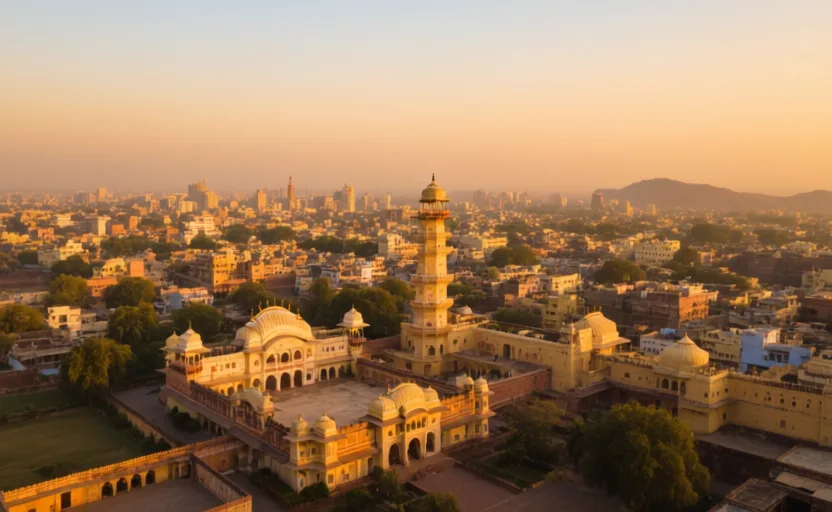 Jaipur · AI city illustration · Artistic impression
City · South Asia
Jaipur
Saved in this browser — no account needed. Sign in later and it comes with you.
Where it is
Jaipur fills a shallow valley in eastern Rajasthan, on the plain just south of the Amber hills. The Aravalli range closes it in: the Nahargarh hills run along the north and the Jhalana hills along the east, while the ground slopes gently south and southeast into alluvial farmland. The climate is hot and semi-arid, with a little over 625 mm of rain a year, nearly all of it in the July and August monsoon. Summer heat has reached 49 °C, and winter nights have dipped below freezing. The Dravyavati River, the main drain through the city, had decayed into an untreated sewage channel by 2014.
The land and water around it
The Aravalli hillsmountains
Hill chains bound the city on the north and east, with the Nahargarh and Jhalana ranges as its nearest ridges. They gave the new city shelter and a ring of forts and watch posts, which let its founder build on open ground instead of on a defensible summit like the older capitals of the region.
The Dravyavati Riverriver
The city’s main drainage line, which by 2014 had turned into an untreated sewage drain. A restoration plan drawn up in 2015 opened a 13 km stretch of riverfront in 2018 and was reported complete in 2022, out of a planned length of 47.5 km.
A semi-arid monsoon climateclimate
Rain is concentrated in two months, so the hottest weeks come in May and June, before the monsoon, rather than in July and August. The old centre also holds heat: the city shows a marked urban heat island effect, and the countryside around it can fall below freezing on winter nights when the streets do not.
Its history, in short
Jaipur was laid out in a single campaign rather than grown over centuries. In 1727 Sawai Jai Singh II, who ruled Amer as a Rajput of the Kachhwaha line, moved his capital about 11 km down onto the plain because his old seat was short of water and crowded. His planner was Vidyadhar Bhattacharya, and the layout follows Vastu Shastra principles on a grid, with the main avenues built as markets, large public squares at the crossings, and traders from elsewhere invited to settle. Most of the infrastructure was finished within four years. Under British rule the city was the capital of the princely state of Jaipur, with metalwork and marble among its crafts and an art school from 1868. In 1876 the old city was painted pink to greet the Prince of Wales, and many avenues still carry that colour. After independence it became the capital of Rajasthan in 1949. The 2011 census counted about 3.05 million people, and in 2019 the historic centre joined the observatory Jai Singh built on the World Heritage List.
Timeline
Dates are shown on a timeline rather than as changing shapes on the map. The globe draws modern boundaries only, and tinting a modern outline to stand for a historical one would state something we cannot source.
Early modern & oceanic
1726
Construction begins
Work starts on the new city, about 11 km from Amer, on a site chosen because it was flatter and less constrained than the hill capital.
Approximate dateWikipedia1727–1731
The city is founded
Jai Singh II founds Jaipur on 18 November 1727. Most of its streets, public squares and royal buildings are completed within four years, and traders are invited to settle in what was designed as a market capital.
Industrial & imperial
1868
A school of art
A school of art is founded in the city. By 1900 the population has reached about 160,000, and metalwork and marble are among the main industries.
Well attestedWikipedia1876
Painted pink
Sawai Ram Singh II orders the old city coloured pink for the visit of Albert Edward, Prince of Wales. The colour gives Jaipur its nickname and is kept on many avenues of the old city.
Well attestedWikipedia
Contemporary
1949
Capital of Rajasthan
Two years after Indian independence, Jaipur is made the seat of government of the new state of Rajasthan.
Well attestedWikipediaAugust 1981
The cloudburst flood
Heavy rain from a cloudburst floods large parts of the city, including the airport, and kills eight people. The damage is worst along the Dravyavati River.
Well attestedWikipedia2010 and 2019
World Heritage listings
The Jantar Mantar observatory is inscribed in 2010. The historic city centre follows on 6 July 2019, recognised as an exceptional example of indigenous city planning in South Asia.
Places that carry meaning
The walled grid city1727 onward
Nine blocks, two for the palace and state buildings and seven for the public, behind ramparts pierced by seven gates. Three main gates face east, west and north: Suraj Pol, the sun gate, Chand Pol, the moon gate, and a northern gate that looks back to Amer. Its market avenues and its public squares at road crossings are what the World Heritage inscription singles out.
Jantar MantarEarly 18th century
An open-air astronomical observatory of about twenty main fixed instruments, built in masonry for observing the sky with the naked eye. It is the best preserved set of monumental instruments from India’s first half of the 18th century, and some are the largest of their kind ever built.
Amer FortBefore 1727
The hill fort of the Kachhwaha rulers, about 11 km from the new city, and the reason the city’s northern gate faces the way it does. It is listed separately as part of the Hill Forts of Rajasthan.
Languages here
Places are usually multilingual. This lists what is actually spoken, not one language per border.
HindiIndo-Aryan family
The official language and the first language of most residents.
At the 2011 census about 70 per cent of residents gave Hindi as their first language. English serves as an additional official language, and the national constitution recognises 22 scheduled languages.
Dhundari
The native dialect of the Jaipur area.
Dhundari is the primary local dialect. About 4 per cent of residents recorded it as their first language, a little below the share who named Marwari, which is recorded separately.
Urdu and SindhiIndo-Aryan family
Community languages of the city’s Muslim and Sindhi populations.
Urdu was recorded as a first language by about 6 per cent of residents and Sindhi by about 2.5 per cent. Muslims are 18.6 per cent of the city’s population, according to the same census.
Learn the language here
- 1Understand which languages are spoken hereJaipur is multilingual. Start with which languages are used, by whom, and for what — the phrase list only covers one of them.Written by Globe Quest
- 2Learn 11 phrasesCurated everyday phrases for Jaipur, with audio and a written form.Written by Globe Quest
- 3Say them out loudSpeaking practice with pronunciation feedback, one phrase at a time.Globe Quest material, your own additions
- 4Come back to themSpaced review, so what you learned this week is still there next month.Written by Globe Quest
Check yourself
Why did Jai Singh II build a new capital instead of staying at Amer?
His seat was crowded and short of water
Amer’s growing population and water scarcity were the stated reasons, and the flat valley to the south allowed a deliberately planned trading city.
When and why was the old city painted pink?
In 1876, to welcome the Prince of Wales
The pink colour is a 19th-century gesture of welcome, not an original feature of the 1727 plan, yet it has become the city’s defining look.
Worth arguing about
- Jaipur was built in four years to a single plan. What does a city gain, and what does it lose, by never having grown organically?
- The Dravyavati River went from drainage channel to sewage drain and back to a restored riverfront. Who should pay to bring a lost river back into a growing city?
What we have not established
These are open questions, listed rather than filled in. We would rather show a gap than a plausible guess.
How many Jaipur residents speak Hindi, Rajasthani, Marwari or Dhundari at home?
The census lists Hindi, Rajasthani, Marwari and Dhundari as separate first languages, but Indian census practice groups many mother tongues under Hindi, so the Hindi share of about 70 per cent cannot be read as a clean count of one language.
Sources
- Wikipedia · JaipurWikipedia · encyclopedia · checked 2026-11-24
- UNESCO · Jaipur City, RajasthanUNESCO World Heritage Centre · intergovernmental · checked 2026-11-24
- UNESCO · The Jantar Mantar, JaipurUNESCO World Heritage Centre · intergovernmental · checked 2026-11-24
- Wikipedia · IndiaWikipedia · encyclopedia · checked 2026-11-24
Reviewed by Globe Quest editorial on 2026-11-24. Drafted with AI assistance and checked against the sources above before publication.