 Globe Quest
 Human Quest · LearningSign in
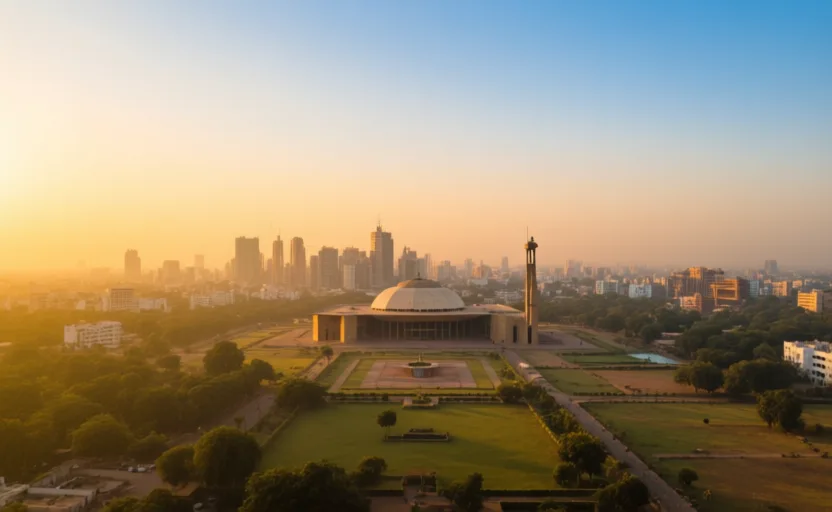 Chandigarh · AI city illustration · Artistic impression
City · South Asia
Chandigarh
Saved in this browser — no account needed. Sign in later and it comes with you.
Where it is
Chandigarh occupies a tongue of flat, fertile ground at the foot of the Shivalik range, where the northern plain begins to climb towards the Himalaya. It covers about 114 km² at an average of roughly 320 m above sea level, with Bhabar ground in its northeast and Terai land elsewhere. Two seasonal streams, the Patiala-ki-rao and the Sukhna Cho, frame the site. The climate is humid subtropical, with very hot summers, mild winters, unreliable rain averaging about 1,040 mm a year, and winter showers from Mediterranean weather systems that can bring hail and damage crops. The city is bordered by Punjab and Haryana, which share it as capital.
The land and water around it
The Shivalik foothillsmountains
The low outer range of the Himalaya lies just north of the city, and its seasonal streams drain across the site. Dense banyan and eucalyptus plantations, and forest on the fringe, support deer, sambar, parrots and peacocks.
Sukhna Lakelake
A rain-fed lake of about 3 km², formed in 1958 when the seasonal Sukhna Choe, which runs down from the Shivaliks, was dammed. It forms the upper edge of the planned city and attracts migratory ducks and geese in winter.
The northern plainplain
Flat, fertile land made a practical site for a capital built in a hurry. The city sits 44 km north of Ambala and 250 km north of Delhi.
Its history, in short
Chandigarh is a city built to answer a loss. When India was partitioned in 1947 Lahore, capital of undivided Punjab, went to Pakistan. East Punjab was left without a capital, and refugees from West Pakistan needed homes and work. Rather than expand an overcrowded old city, the governments decided to build a new one, and Prime Minister Nehru personally endorsed it. The American planner Albert Mayer drew the first plan in 1949, a fan shape between two streams. In 1950–51 the commission passed to Le Corbusier, with Pierre Jeanneret, Maxwell Fry and Jane Drew and a team of young Indian architects, who reworked the plan and designed the Capitol Complex. The city was inaugurated in October 1953 and was meant to be a capital all year round, ending the British habit of moving the government to Shimla for the summer. In 1966 Punjab was divided into Punjab and Haryana, and Chandigarh became a union territory serving both. The status of the city remains disputed between the two states.
Timeline
Dates are shown on a timeline rather than as changing shapes on the map. The globe draws modern boundaries only, and tinting a modern outline to stand for a historical one would state something we cannot source.
Contemporary
1947
Partition leaves Punjab without a capital
Lahore goes to Pakistan, and East Punjab’s government is housed partly in Shimla. A new capital is needed for administration, for refugee resettlement and as a sign of stability.
Well attestedWikipediaDecember 1949
Mayer is chosen
Albert Mayer, an American planner already working in India, is selected to design the city. His fan-shaped plan places the capitol on a promontory between two streams.
Well attestedWikipedia1950–1951
Le Corbusier takes over
A team led by Le Corbusier replaces Mayer’s group and reshapes the plan. Le Corbusier designs the buildings of the Capitol Complex, while other architects design housing and other buildings.
Well attestedWikipedia7 October 1953
Inauguration
President Rajendra Prasad inaugurates the capital. By September all state departments have moved from Shimla, and construction goes on with local materials and much manual labour.
Well attestedWikipedia1958
Sukhna Lake
The seasonal Sukhna Choe is dammed to create an artificial lake at the head of the city.
Well attestedWikipedia1966
Punjab is divided
After a long movement for a Punjabi-majority state, the state is split on linguistic lines into Punjab and Haryana, with some hill areas passing to Himachal Pradesh. Chandigarh is first allotted to Haryana on the 1961 Hindi-speaking majority, then turned into a union territory because of Sikh concern about that decision. Both new states claim it.
DisputedWikipediaPunjab and Haryana, both of which claim the city, and its own residents, whom surveys show preferring union territory status
1970
A proposed settlement
Prime Minister Indira Gandhi assigns the city to Punjab, with Haryana to receive the Fazilka tehsil and funds for a new capital. The city nevertheless remains a union territory.
Well attestedWikipedia2016
World Heritage
UNESCO lists the Capitol Complex as part of a global ensemble of buildings by Le Corbusier.
Well attestedWikipedia
Places that carry meaning
The Capitol Complex1950s
The government buildings Le Corbusier designed, regarded as the culmination of his career. The complex was inscribed on the World Heritage List in 2016 as part of his global ensemble.
The sector grid1950s–1960s
Thirty sectors were planned for the first phase and 17 for the second, with laws passed from 1952 to protect the planned character of the city and a belt of parks running through them. Neighbouring Mohali and Panchkula were developed as satellite towns in Punjab and Haryana.
Rock GardenBeside Sukhna Lake
A garden near Sukhna Lake filled with sculptures made from discarded waste materials, standing alongside the planned city’s formal parks, such as the Zakir Hussain Rose Garden.
Languages here
Places are usually multilingual. This lists what is actually spoken, not one language per border.
HindiIndo-Aryan family
An official language of the union territory and the majority language.
About 68 per cent of residents spoke Hindi in 2011, up from about 51 per cent in 1981. English is the other official language.
PunjabiIndo-Aryan family
The language of the surrounding state and of the Sikh community.
Punjabi was spoken by 22 per cent of residents in 2011, down from 36 per cent in 1981. Government schools use English, Hindi and Punjabi textbooks, and Sikhs make up 13 per cent of the population.
EnglishGermanic family
An official language of the administration and used in schools.
The union territory’s administration works in English and Hindi.
Learn the language here
- 1Understand which languages are spoken hereChandigarh is multilingual. Start with which languages are used, by whom, and for what — the phrase list only covers one of them.Written by Globe Quest
- 2Learn 12 phrasesCurated everyday phrases for Chandigarh, with audio and a written form.Written by Globe Quest
- 3Say them out loudSpeaking practice with pronunciation feedback, one phrase at a time.Globe Quest material, your own additions
- 4Come back to themSpaced review, so what you learned this week is still there next month.Written by Globe Quest
Check yourself
Why was Chandigarh built?
East Punjab needed a new capital after Lahore went to Pakistan
The loss of Lahore, the arrival of refugees and a scattered administration made a new capital urgent, and it was also meant to symbolise stability and independence.
How did the share of Punjabi speakers in Chandigarh change between 1981 and 2011?
It fell from 36 to 22 per cent
Over the same period the share of Hindi speakers grew from about 51 to 68 per cent, one reason the city’s status remains sensitive.
Worth arguing about
- Chandigarh was designed as a complete city by foreign architects for a new nation. Can a city planned from nothing ever feel like it belongs to its people?
- Two states share one capital that neither controls. Is a union territory a workable permanent answer, or only a way to postpone a decision?
What we have not established
These are open questions, listed rather than filled in. We would rather show a gap than a plausible guess.
Which state should hold Chandigarh?
Punjab and Haryana have both claimed the city since the 1966 reorganisation, and a 1970 decision to give it to Punjab was never carried out. The question stays open politically, though surveys indicate that its own inhabitants prefer to remain a union territory.
Sources
- Wikipedia · ChandigarhWikipedia · encyclopedia · checked 2026-11-24
Reviewed by Globe Quest editorial on 2026-11-24. Drafted with AI assistance and checked against the sources above before publication.