 Globe Quest
 Human Quest · LearningSign in
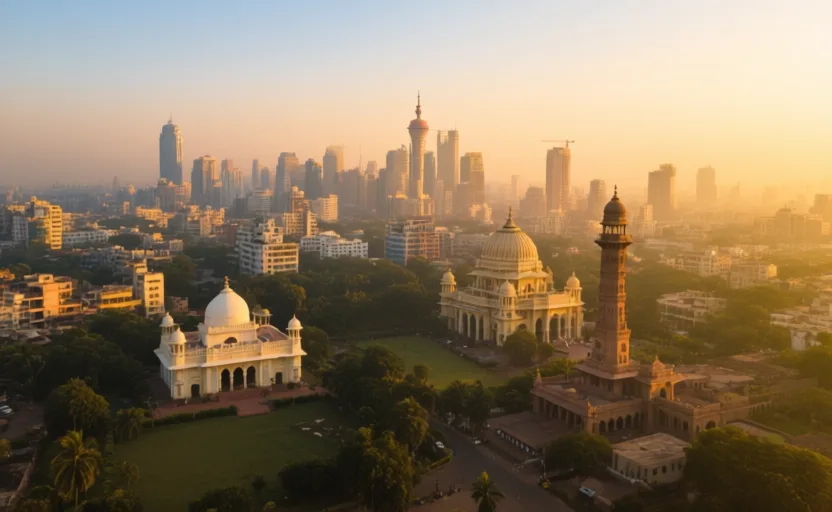 Surat · AI city illustration · Artistic impression
City · South Asia
Surat
Saved in this browser — no account needed. Sign in later and it comes with you.
Where it is
The Tapti, also called the Tapi, brings Surat close to the sea. The city lies on its bank only a short way from the Gulf of Cambay, at about 13 m above sea level, roughly midway between Ahmedabad to the north and Mumbai to the south. Rainfall of about 1,200 mm arrives between late June and September, and April and May are the hottest months. Dams have since cut the river’s flow, and the old port facilities closed. Ships now berth at Magdalla and Hazira, in the wider Surat region. Dam releases also make the river a flood risk, and the city has flooded about twenty times since 1900.
The land and water around it
The Tapti Riverriver
The river made Surat a port and, once dammed, ended its life as one. Reduced flow after the dams closed the old port facilities. Releases from the Ukai dam, 90 km away, have also caused repeated floods, notably in 1998 and 2006.
The Gulf of Cambaygulf
The gulf lies to the west of the city, and the Surat district borders it. Dumas Beach on its shore is the best-known stretch of coast, and the modern port facilities have moved to Magdalla and Hazira.
A flood-prone coastal plainplain
Low ground, a tropical savanna climate and a monsoon that drops about 1,200 mm in four months leave Surat exposed to river floods. In August 2006 Tapti floodwater swamped nearly the whole city and over 120 people died. The city has since built flood defences and resilience works.
Its history, in short
Surat rose as a port because the town beside it, Rander, fell. Rander was the main Arab trading centre of the area until Portuguese raids in the 1500s, and merchants moved to Surat. The traditional founder is a merchant named Gopi, who is linked to an artificial lake of 1516, but the name already appears in older sources. The Mughals took Surat in 1573 and made it their most prosperous port, the departure point for Hajj pilgrims. In 1612 the English opened their first Indian trading post here, and Turkish, Armenian, Dutch and French traders followed. Shivaji’s Marathas sacked the city in 1664 and 1670, and by 1759 the English held its castle. Bombay’s rise drew trade away, and a fire in 1837 destroyed 9,737 houses, so that by the mid-19th century Surat held only around 80,000 people. Railways revived it as a centre of silk, cotton and gold-and-silver work. Diamond cutting arrived in the late 1950s and made Surat the place where the large majority of the world’s diamonds are cut and polished, and its population reached about 4.47 million in 2011.
Timeline
Dates are shown on a timeline rather than as changing shapes on the map. The globe draws modern boundaries only, and tinting a modern outline to stand for a historical one would state something we cannot source.
Early modern & oceanic
c. 1500
The legend of Gopi
Tradition says a wealthy Hindu merchant named Gopi built the town and asked astrologers for a name. They proposed Suryapur, “city of the sun”, which the Gujarat king changed to Surat. Yet both names appear in sources from before 1500.
The traditional account of Gopi’s founding, against earlier references to Suryapur and Surat that show the town was already there
1573
Mughal conquest
Surat falls to the Mughals and becomes the empire’s most prosperous port, used by pilgrims bound for the Hajj. Its population swells every monsoon season when ships can safely come and go.
1612
The English factory
England opens its first Indian trading factory in Surat. Dutch, French, Armenian and Turkish traders also keep houses and warehouses along the riverfront.
1664 and 1670
Sacked by the Marathas
Shivaji’s forces sack the city in January 1664 and again in October 1670, while the Mughals fight their wider war against the Marathas.
Well attestedWikipedia1759
The English take the castle
The English from Bombay capture Surat castle from the Mughal admiral Sidi Masud. For forty years they command its castle and fleet while a nominal nawab runs the city, until the Bombay government strips the nawabs’ powers in 1800.
Well attestedWikipedia
Industrial & imperial
1837
The great fire
A fire kills more than 500 people and destroys 9,737 houses, the most destructive fire in the city’s history.
Well attestedWikipedia
Contemporary
1994
The plague scare
News of a plague outbreak in September sends about a quarter of the population fleeing, which helps spread the disease across India. Schools, public places and diamond-cutting units are closed for an indefinite period.
Well attestedWikipediaAugust 2006
The great flood
Tapti floodwater swamps nearly the whole city, over 120 people die and schools and businesses stay closed for weeks.
Well attestedWikipedia
Places that carry meaning
Gopi Talav1516
An artificial lake for water storage, attributed to the merchant-official Malik Gopi, who received the title Malik from the Gujarat sultan Muzaffar Shah II. The area around it was named Gopipura after him.
The Armenian gravestones16th–17th centuries
Carved tombstones of the Armenian traders who dealt in jewellery, cotton and silk and ran routes to Egypt, the Levant, Venice and Livorno. The stones are detailed and well preserved, and they are the main surviving trace of the community.
VarachhaLate 1950s onward
The district where most of the city’s diamond polishing workshops run, mainly owned by the Patel community. The industry grew fast on demand from the American market between the early 1970s and the mid-1980s.
Surat Diamond BoursePresent day
The trading complex, the biggest office building anywhere when measured by floor space, standing in a city whose workshops finish roughly nine in ten of the world’s diamonds.
Languages here
Places are usually multilingual. This lists what is actually spoken, not one language per border.
GujaratiIndo-Aryan family
The first language of just over half the city.
Gujarati was recorded as a first language by 54.42 per cent of residents in 2011. The name Surat itself translates as “countenance” in Gujarati, Hindi and Urdu.
HindiIndo-Aryan family
The second-largest language of the city.
About 22 per cent of residents gave Hindi as their first language in 2011.
Marathi and OdiaIndo-Aryan family
Languages of large communities from outside Gujarat.
Marathi accounted for 9.92 per cent of first languages, Urdu 3.24 per cent, Odia 3.11 per cent, Marwari 1.74 per cent and Bhojpuri 1.38 per cent, a long tail of smaller first languages.
Learn the language here
- 1Understand which languages are spoken hereSurat is multilingual. Start with which languages are used, by whom, and for what — the phrase list only covers one of them.Written by Globe Quest
- 2Learn 11 phrasesCurated everyday phrases for Surat, with audio and a written form.Written by Globe Quest
- 3Say them out loudSpeaking practice with pronunciation feedback, one phrase at a time.Globe Quest material, your own additions
- 4Come back to themSpaced review, so what you learned this week is still there next month.Written by Globe Quest
Check yourself
What share of the world’s diamonds is cut and polished in Surat?
About 90 per cent
The industry began in the late 1950s and grew quickly, so that by now Surat does most of the world’s diamond cutting and polishing.
Who sacked Surat in 1664 and 1670?
Shivaji’s Marathas
The Maratha raids came while the Mughal emperor Aurangzeb was fighting the Marathas, and the Mughal governors of Surat were left to defend themselves.
Worth arguing about
- Surat lost its harbour to dams and its trade to Bombay, then rebuilt itself on textiles and diamonds. Which of these new industries is more at risk from the river that built the city?
- In 1994 about a quarter of Surat’s population fled a plague scare, and that flight may have helped spread the disease. How should a city weigh the freedom to leave against the risk of spreading illness?
What we have not established
These are open questions, listed rather than filled in. We would rather show a gap than a plausible guess.
What caused the 1994 plague outbreak in Surat?
Accounts differ: some blame poor garbage disposal, which supported rodents and fleas, while others tie the outbreak to the floods of that year. The disease ran hardest through the slum population. A single cause has not been settled.
How large is Surat?
Its population was 4,467,797 in the 2011 census, but figures for the city, the metropolitan region and its larger urban area vary with where the boundary is drawn.
Sources
- Wikipedia · SuratWikipedia · encyclopedia · checked 2026-11-24
- Wikipedia · History of SuratWikipedia · encyclopedia · checked 2026-11-24
Reviewed by Globe Quest editorial on 2026-11-24. Drafted with AI assistance and checked against the sources above before publication.