 Globe Quest
 Human Quest · LearningSign in
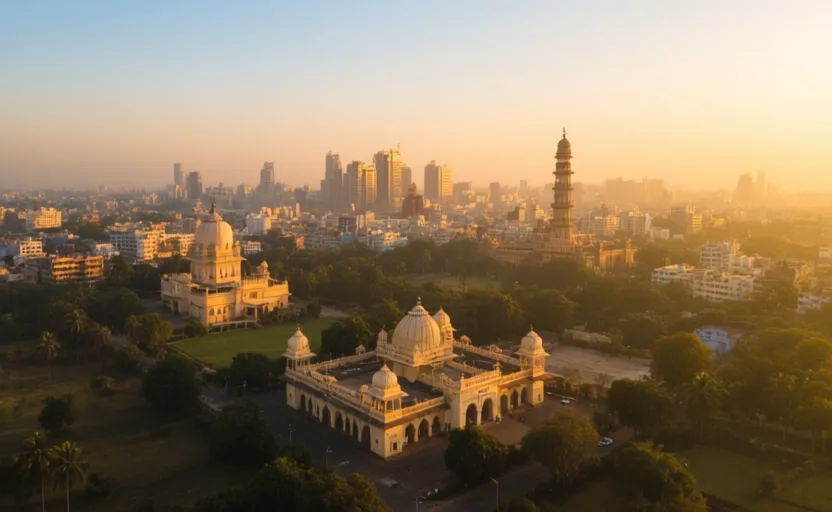 Pune · AI city illustration · Artistic impression
City · South Asia
Pune
Also known as Poona
Saved in this browser — no account needed. Sign in later and it comes with you.
Where it is
Pune lies on the western edge of the Deccan Plateau, about 560 metres above sea level and 149 kilometres south-east of Mumbai. The Sahyadri range, the Western Ghats, stands between it and the Arabian Sea, which puts the city on the dry, leeward side with about 822 millimetres of rain a year, most of it from June to September. The old city is at the meeting of the Mula and Mutha rivers, and hills rise inside the urban area, with Vetal Hill reaching 800 metres and the fort of Sinhagad on a ridge at 1,300 metres. Altitude keeps the nights cool even in the hottest months.
The land and water around it
The leeward Deccan edgeplateau
Pune sits on the dry side of the Sahyadri, which shields it from the full force of the Arabian Sea monsoon. It has a tropical wet and dry climate bordering on hot semi-arid, with the highest recorded temperature of 43.3 degrees Celsius in 1897.
The Mula and Mutha riversriver
The old city is at the confluence of the two rivers. In 1961 the Panshet Dam failed while still under construction, and the flood also damaged the Khadakwasla Dam downstream, destroying much old housing near the riverbank. Growth since then has left both rivers heavily polluted by sewage.
Hills and hill fortsmountains
Vetal Hill rises to 800 metres within the city, and Parvati and Taljai hills form a protected reserve. The fort of Sinhagad stands on a ridge at 1,300 metres.
Its history, in short
Pune was a small agricultural settlement under the Rashtrakutas and then a fortified village called Kasbe Pune under the Deccan sultanates. In 1599 the Ahmadnagar Sultanate gave the district as a fief to Maloji Bhosale, whose son Shahaji chose it as the home of his wife Jijabai and young son Shivaji, who later founded the Maratha Empire. The Lal Mahal was completed in 1640. The city as it is known began in 1728, when Baji Rao I, the Peshwa or prime minister of the Maratha Empire, moved his base here, and in 1730 completed the Shaniwar Wada. Peshwa patronage brought about 250 temples and bridges, a lake at Katraj and an underground aqueduct. The British took Pune in 1817 in the Third Anglo-Maratha War and built a cantonment to its east. Between 1875 and 1910 it was a centre of both nationalist agitation and social reform. After 1947 universities and research institutes, then automobile and engineering plants from the 1950s and 1960s and software parks from the 1990s, made it the large industrial city it is today.
Timeline
Dates are shown on a timeline rather than as changing shapes on the map. The globe draws modern boundaries only, and tinting a modern outline to stand for a historical one would state something we cannot source.
Post-classical world
8th–10th century
First written mentions
Rashtrakuta copper plates refer to a settlement, variously named Punaka or Punya, with the Pataleshwar Caves cut in the same era. Accounts date the plates to 758 and 768, to 858 and 868, or to 937.
Early modern & oceanic
1630s
The town razed
An Adil Shahi general, Murar Jagdeo, destroys the town, said to have been ploughed over with asses. Shahaji later joins the Adil Shahi service and regains the jagir, and Dadoji Konddeo rebuilds it.
1728
The Peshwas make it their seat
Baji Rao I relocates his government from Saswad to Pune and begins the Shaniwar Wada, completed in 1730. Pune becomes the administrative and also the financial capital of the Maratha confederacy.
Industrial & imperial
1817–1818
The British take Pune
The Peshwas lose the Battle of Khadki on 5 November 1817 and the city is seized. It comes under the Bombay Presidency and a large cantonment is built to the east, with Pune serving as the Governor of Bombay’s monsoon capital.
1875–1910
Reform and nationalism
Gopal Krishna Gokhale and Bal Gangadhar Tilak lead agitation, while reformers such as Jyotirao Phule, Tarabai Shinde and Pandita Ramabai press for abolition of caste prejudice, equal rights for women and better schools for the poor.
Well attestedWikipedia1942–1944
Gandhi at the Aga Khan Palace
Mahatma Gandhi is held under house arrest at the Aga Khan Palace, where both his wife Kasturba Gandhi and his aide Mahadev Desai die.
Well attestedWikipedia
Contemporary
1961
The Panshet flood
A dam under construction fails and the flood damages or destroys old housing in the Narayan, Shaniwar and Kasba peths. The damaged dams are repaired and still supply water.
Well attestedWikipedia1978
Poona becomes Pune
The English form Poona dates from 1857, during British rule. The official name changes to Pune in 1978.
Well attestedWikipedia
Places that carry meaning
Shaniwar Wada1730
The Peshwas’ palace on the high ground of the Mutha’s bank, built by Baji Rao I, and the symbol of their control of the city. An aqueduct from the lake at Katraj brought water to it.
Pataleshwar Caves8th century
A rock-cut temple complex that dates from the Rashtrakuta period, among the oldest structures in the city.
Lal Mahal and Kasba Ganapati1640
The residence where Shivaji spent his early years, finished in 1640, and the nearby temple that Jijabai is said to have commissioned. Its Ganesh idol is regarded as the guardian deity of the city.
The old peths18th century
Seventeen wards named after their founders and days of the week, most of them created under Peshwa rule, make up the old city on the east bank of the Mutha. The old city had narrow lanes with areas separated by caste and religion, unlike the planned cantonment.
Languages here
Places are usually multilingual. This lists what is actually spoken, not one language per border.
MarathiIndo-European family
The official and most spoken language.
Pune’s dialect is the basis of the written standard of Marathi, and the city is a centre of Marathi literature, with a strong theatre tradition.
HindiIndo-European family
Widely spoken as the language of migrants from across India.
Most arrivals come from Rajasthan, Gujarat, Andhra Pradesh, Uttar Pradesh and Karnataka. Sindhi refugees who arrived after the 1947 partition settled mainly in Pimpri.
Dakhni UrduIndo-European family
The variety of Urdu spoken by the Muslim community.
A Deccan form of Urdu used by Pune’s Muslims, one of several religious communities in a city that is a little under 80 per cent Hindu.
Gujarati and MarwariIndo-European family
Languages of the business community.
Spoken by the traders and merchants of the city, alongside the Marathi of the majority.
Learn the language here
- 1Understand which languages are spoken herePune is multilingual. Start with which languages are used, by whom, and for what — the phrase list only covers one of them.Written by Globe Quest
- 2Learn 12 phrasesCurated everyday phrases for Pune, with audio and a written form.Written by Globe Quest
- 3Say them out loudSpeaking practice with pronunciation feedback, one phrase at a time.Globe Quest material, your own additions
- 4Come back to themSpaced review, so what you learned this week is still there next month.Written by Globe Quest
Check yourself
What turned Pune from a small town into a city in 1728?
Baji Rao I moving the Peshwa’s base to it
Baji Rao I relocated his government from Saswad to Pune in 1728 and began the Shaniwar Wada, and the Peshwas’ patronage over the next decades produced about 250 temples and bridges.
Why is Pune comparatively dry for a city so near the Arabian Sea?
It is on the leeward side of the Sahyadri range
The Sahyadri forms a barrier between Pune and the sea, so the city, at 560 metres on the Deccan Plateau, receives about 822 millimetres of rain, mostly from June to September.
Worth arguing about
- Peshwa Pune built schools that taught the Shastras to Brahmin men only, while the city later produced the era’s most radical reformers. How does one place hold both?
- Pune went from a so-called Pensioners’ Paradise to a car-making and software centre within a few decades. What is lost, and what gained, when a city of colleges becomes a city of industry?
What we have not established
These are open questions, listed rather than filled in. We would rather show a gap than a plausible guess.
When is Pune first mentioned in writing?
Copper plates of the Rashtrakuta dynasty are the earliest references, but they are dated variously to 758 and 768, to 858 and 868, and to 937, so the earliest date cannot be fixed.
How many people live in Pune?
In 2011 the city had 3,124,458 residents, the urban agglomeration 5,057,709 and the metropolitan region about 7.2 million. The boundary determines the figure, and no later census exists.
Sources
- Wikipedia · PuneWikipedia · encyclopedia · checked 2026-11-24
- Wikipedia · History of PuneWikipedia · encyclopedia · checked 2026-11-24
Reviewed by Globe Quest editorial on 2026-11-24. Drafted with AI assistance and checked against the sources above before publication.