 Globe Quest
 Human Quest · LearningSign in
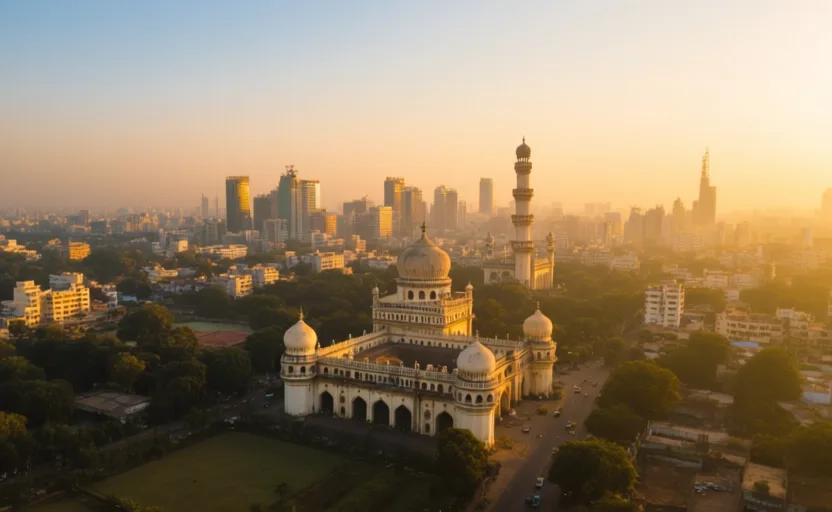 Hyderabad · AI city illustration · Artistic impression
City · South Asia
Hyderabad
Saved in this browser — no account needed. Sign in later and it comes with you.
Where it is
Hyderabad stands on the Deccan Plateau at an average of 536 metres, on rolling ground of grey and pink granite broken by small hills, the highest of which is Banjara Hills at 672 metres. The Musi River, a tributary of the Krishna, runs through it, but the city’s water has long come from artificial lakes, called sagars, created by damming the Musi. Summers are hot and dry, with highs often above 40 degrees Celsius from April to June, and the south-west monsoon brings most of the year’s rain between June and October. Its central position between the plateau and the Western Ghats has drawn institutions to it.
The land and water around it
The Musi Riverriver
A tributary of the Krishna that divides the historic Old City on its southern bank from the newer city to the north. After the Musi flooded in 1908 the city was expanded and civic buildings were added, particularly under the seventh Nizam.
The granite hillsplateau
The Golconda fort and city stand on a granite hill about 120 metres high, and the sloping granite terrain of the wider city is dotted with small hills. The fort’s walls extend about five kilometres.
The sagarslake
Hussain Sagar, built in 1562 near the centre, predates the city’s foundation, and Osman Sagar and Himayat Sagar were added later by damming the Musi. Hussain Sagar links Hyderabad to its twin, Secunderabad.
Its history, in short
The Kakatiya dynasty of Warangal built a hilltop outpost at Golconda in the thirteenth century, and after the Bahmani Sultanate broke up, a governor there founded the Qutb Shahi dynasty. By the end of the sixteenth century Golconda was too crowded and short of water, and in about 1591 Muhammad Quli Qutb Shah laid out a new city on the banks of the Musi, centred on the Charminar. Hyderabad became a market for diamonds and pearls. Aurangzeb took Golconda after a long siege in 1687, and in 1724 the Mughal viceroy Asaf Jah I declared autonomy and founded the line of the Nizams, who ruled until 1948. The city became their formal capital in 1769 and hosted a British Residency and cantonment. The Nizam’s wish to stay independent in 1947 ended when the Indian Army took control of the state in September 1948. In 1956 the states were reorganised by language and Hyderabad became capital of Andhra Pradesh, and after the Telangana movement it became capital of the new state of Telangana in 2014.
Timeline
Dates are shown on a timeline rather than as changing shapes on the map. The globe draws modern boundaries only, and tinting a modern outline to stand for a historical one would state something we cannot source.
Early modern & oceanic
1518 or 1538
The Qutb Shahi sultans of Golconda
Sultan Quli, governor of Telangana under the Bahmani Sultanate, declares independence and founds a dynasty at Golconda. Accounts date this to 1518, when the Bahmani state split into five, or to 1538.
c. 1591
A new city beside the Musi
Muhammad Quli Qutb Shah founds Hyderabad to relieve crowded and waterless Golconda and orders the Charminar built. Accounts give the year as 1589, 1590 or 1591.
1687
Mughal conquest
After a failed siege in 1686, Aurangzeb takes Golconda in 1687 and the Qutb Shahi line ends. The coins of the city carry the name Dar-ul-Jihad for a time.
1724
Asaf Jah I and the Nizams
Asaf Jah I defeats Mubariz Khan and establishes autonomy over the Deccan. He never formally declares independence from the Mughals and the Friday sermon continues in the emperor’s name until 1948. Hyderabad becomes the formal capital in 1769.
Industrial & imperial
1908
The Musi flood
A flood of the river leads to the expansion of the city and a building programme under the seventh Nizam, Mir Osman Ali Khan, called the maker of modern Hyderabad.
Well attestedWikipedia
Contemporary
17 September 1948
Operation Polo
The Indian Army takes control of Hyderabad State and the Nizam signs an Instrument of Accession. The Nizam had declared an intention to stay independent of both India and Pakistan, while the Hyderabad State Congress agitated against him.
DisputedWikipediaThe Indian Union’s account of accession against the Nizam’s claim to independence
1956
Andhra Pradesh
Reorganisation by language joins the Telugu- and Urdu-speaking districts of Telangana to Andhra State, with Hyderabad as capital. Protests called the Telangana movement followed, with major actions in 1969, 1972 and 2010.
Well attestedWikipedia2014
Capital of Telangana
Andhra Pradesh is split to form Telangana and Hyderabad becomes joint capital of the two states until 2024.
Well attestedWikipedia
Places that carry meaning
Golconda Fort13th–16th century
Built as a Kakatiya outpost and enlarged by the first three Qutb Shahi sultans over 62 years into a granite fortress. It is the oldest surviving Qutb Shahi structure in Hyderabad, and it held out against the Mughal siege in 1686.
Charminar1591
A square monument 20 metres on each side, with four arches facing four roads and a 56-metre minaret at each corner. It stands in the centre of the Old City and has become the city’s symbol.
The Old City and its bazaarsFrom the 16th century
The historic city on the Musi’s southern bank holds the Mecca Masjid, Chowmahalla and Falaknuma palaces and traditional markets such as Laad Bazaar and the Pearl Market. The oldest bridge across the river, Purana Pul, dates from 1578.
Languages here
Places are usually multilingual. This lists what is actually spoken, not one language per border.
TeluguDravidian family
An official language, spoken in the Telangana dialect.
The city’s Telugu dialect is called Telangana Mandalika. Some of the Qutb Shahi sultans were patrons of local Telugu culture.
UrduIndo-European family
An official language, spoken in the Deccani form.
Deccani Urdu belongs to the Hyderabadi Muslim community, who owe much of their language, cuisine and culture to the dynasties that ruled the city. Most Hyderabadis are bilingual in Telugu and Urdu.
EnglishGermanic family
A secondary official language, pervasive in business and education.
Widely used in administration, in publications and as a medium of instruction.
Learn the language here
- 1Understand which languages are spoken hereHyderabad is multilingual. Start with which languages are used, by whom, and for what — the phrase list only covers one of them.Written by Globe Quest
- 2Learn 12 phrasesCurated everyday phrases for Hyderabad, with audio and a written form.Written by Globe Quest
- 3Say them out loudSpeaking practice with pronunciation feedback, one phrase at a time.Globe Quest material, your own additions
- 4Come back to themSpaced review, so what you learned this week is still there next month.Written by Globe Quest
Check yourself
Why was Hyderabad founded beside the Musi in the 1590s?
To relieve crowding and water shortage at Golconda
Golconda was growing quickly and short of water, and a separate civilian and merchant city on the Musi could also be laid out apart from the fortified military centre.
Which two languages are both official languages of the city?
Telugu and Urdu
Telugu and Urdu are both official, most residents speak both, and English is a secondary official language. The Urdu is the Deccani variety.
Worth arguing about
- The city has been capital of a Qutb Shahi sultanate, a Mughal province, a princely state and then of two Indian states in turn. What does a capital keep when its state changes?
- The Nizam’s state wished to stay independent in 1948 and was taken over by the Indian Army. How should that episode be named, and who gets to decide?
What we have not established
These are open questions, listed rather than filled in. We would rather show a gap than a plausible guess.
How many people live in Hyderabad?
The 2011 census counted about 6.8 million in the municipal area after its expansion from 175 to 650 square kilometres in 2007, 7.7 million in the urban agglomeration and 9.7 million in the metropolitan region. Because the boundary was redrawn and there has been no census since, any current total is an estimate.
How did Hyderabad get its name?
One story says the sultan named it after Bhagmati, a dancer he married. Historians have dismissed it as unsupported, others say it honours Haidar, the sultan’s son, or Ali, known as Haydar, and an older name may have been Baghnagar, city of gardens.
Sources
- Wikipedia · HyderabadWikipedia · encyclopedia · checked 2026-11-24
- Wikipedia · History of HyderabadWikipedia · encyclopedia · checked 2026-11-24
Reviewed by Globe Quest editorial on 2026-11-24. Drafted with AI assistance and checked against the sources above before publication.