 Globe Quest
 Human Quest · LearningSign in
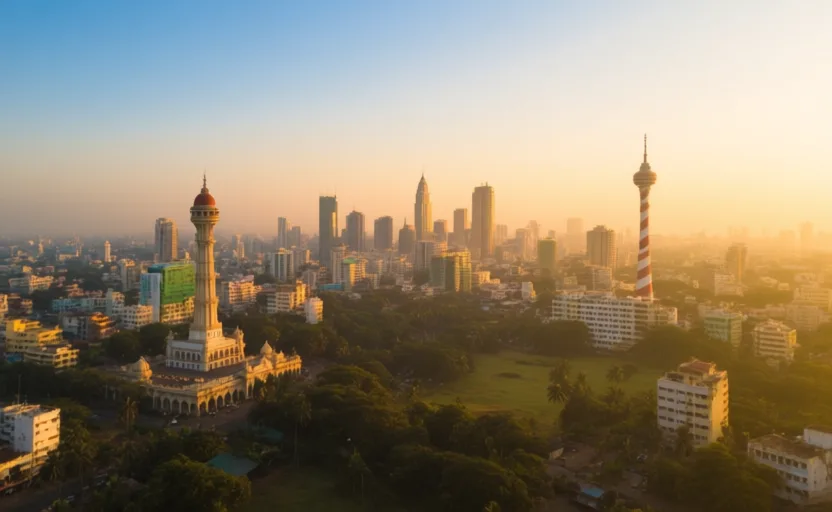 Chennai · AI city illustration · Artistic impression
City · South Asia
Chennai
Also known as Madras
Saved in this browser — no account needed. Sign in later and it comes with you.
Where it is
Chennai lies on the Coromandel Coast, on a flat strip of the Eastern Coastal Plains with an average height of under 7 metres and a highest point of 60 metres. Clay underlies most of the ground, with sand along the rivers and shore. The Cooum River runs through the centre and the Adyar to the south, and the Bay of Bengal forms the east edge. The climate is hot and humid with little seasonal swing. Most of the rain comes with the north-east monsoon from October to December, when cyclones often bring flooding to low-lying districts.
The land and water around it
The Eastern Coastal Plainsplain
The land is so flat that most of the city sits within a few metres of sea level. The shore runs for about 19 kilometres, with the Marina, 13 kilometres long, among the longest urban beaches in the world. The 2004 tsunami killed 206 people here and altered the coastline.
The Cooum and Adyarriver
Two rivers drain the city, with the Cooum through the centre and the Adyar to the south. A protected estuary on the Adyar is a habitat for birds, but both rivers and the Buckingham canal are heavily polluted by sewage and effluent.
The lost wetlandsmarsh
Water bodies shrank from an estimated 12.6 square kilometres in 1893 to 3.2 in 2017, and the number of wetlands fell from 650 in 1970 to 27 in 2015. Building on wetlands contributed to the floods of 2015, which killed 269 people, and of 2023, and to the water scarcity crisis of 2019.
Its history, in short
The area was already a place of temples and ports before Europeans arrived: Mylapore was home to the Tamil poet Thiruvalluvar, the Pallavas of Kanchi controlled the region from the third to the ninth century, and the Cholas, Pandyas and Vijayanagara rulers followed. The Portuguese reached the coast in 1522 and built São Tomé. In 1639 an East India Company agent, Francis Day, obtained a grant from the Vijayanagara emperor for a strip of coastal land holding the fishing village of Madraspatnam, and the Company built Fort St. George, the Company’s earliest large English outpost in India. The city’s corporation dates from 1688. The French captured it in 1746 and the British regained it in 1749. By the late eighteenth century Madras was capital of the Madras Presidency and the British administrative centre for the south. After independence it became capital of Madras State, which in 1968 took the name Tamil Nadu. The city was formally renamed Chennai in 1996.
Timeline
Dates are shown on a timeline rather than as changing shapes on the map. The globe draws modern boundaries only, and tinting a modern outline to stand for a historical one would state something we cannot source.
Post-classical world
1367
Madras before the British
A Vijayanagara-era inscription of this year mentions a port named Madarasanpattanam, possibly the fishing port of Royapuram. It shows that the name Madras predates British arrival.
Approximate dateWikipedia
Early modern & oceanic
1522
The Portuguese at São Tomé
The Portuguese build a port named after St Thomas, whom tradition places preaching in the area in the first century.
Well attestedWikipediaAugust 1639
The grant of land
Francis Day, an East India Company agent, secures from the Vijayanagara emperor Peda Venkata Raya a strip of coast about six miles long and one mile inland, then a fishing village. The Company builds Fort St. George a year later, though another account dates the settlement to 1644.
1688
A municipal corporation
The Corporation of Madras is established on 29 September, described as India’s earliest municipal corporation still in existence and the second-oldest anywhere.
Well attestedWikipedia1746–1749
French capture and return
The French under La Bourdonnais capture and plunder Fort St. George in 1746. The British regain it through the Treaty of Aix-la-Chapelle in 1749 and then strengthen the wall against the French and Hyder Ali of Mysore.
Well attestedWikipedia
Contemporary
1953
Madras Manade
The death of Potti Sreeramulu after a hunger strike in the city leads to the creation of Andhra State. Telugu speakers claimed Madras as their capital under the slogan Madras Manade, but it stayed with Tamil Nadu, which paved the way for reorganising states by language in 1956.
1965
Agitation against Hindi
Protests against the imposition of Hindi and for keeping English as an official language mark a shift in the city’s politics and help lead to English being retained alongside Hindi nationally.
Well attestedWikipedia17 July 1996
Madras becomes Chennai
The Tamil Nadu government officially renames the city, in line with a nationwide move to replace anglicised names. Madras remains in occasional use.
Well attestedWikipedia
Places that carry meaning
Fort St. GeorgeFrom 1640
The Company’s earliest large English outpost in India and the core of the colonial city. The Company then expanded to take in nearby villages and temple towns, so the modern city is a merger of settlements.
Mylapore and Triplicane6th–8th century onward
Older settlements around the Kapaleeshwarar Temple at Mylapore and, at Triplicane, the Parthasarathy Temple, the oldest surviving buildings in the city, in Dravidian architecture. Mylapore is also the town of Thiruvalluvar.
The MarinaModern
A beach 13 kilometres long on the Bay of Bengal, said to be the second-longest urban beach in the world.
Languages here
Places are usually multilingual. This lists what is actually spoken, not one language per border.
TamilDravidian family
The language of most of the city and the state.
About 3.64 million, or 78.3 per cent, gave Tamil as their language in 2011. Madras Bashai is a distinctive city variety. Tamil was the first language to receive classical status from the Government of India.
TeluguDravidian family
The second most spoken language, with about 432,000 speakers in 2011.
Telugu speakers are a long-standing community. In 1953 they claimed it as the capital of a Telugu state, and the demand ended once Tirupati was placed in Andhra State and the movement’s leaders dropped their claim to Madras.
UrduIndo-European family
The third most spoken language, with about 199,000 speakers.
Spoken by the city’s Muslims, who were 9.45 per cent of the population in 2011. Hindi follows with about 159,000 speakers and Malayalam with about 105,000.
EnglishGermanic family
The language of white-collar work.
Largely spoken by office workers. Agitation in 1965 against making Hindi the only link language is part of why English remains an official language of India.
Learn the language here
- 1Understand which languages are spoken hereChennai is multilingual. Start with which languages are used, by whom, and for what — the phrase list only covers one of them.Written by Globe Quest
- 2Learn 12 phrasesCurated everyday phrases for Chennai, with audio and a written form.Written by Globe Quest
- 3Say them out loudSpeaking practice with pronunciation feedback, one phrase at a time.Globe Quest material, your own additions
- 4Come back to themSpaced review, so what you learned this week is still there next month.Written by Globe Quest
Check yourself
What did the East India Company build on its 1639 grant of coastal land?
Fort St. George, the Company’s earliest large English outpost in India
The grant covered a strip of coast with a fishing village, and the Company built Fort St. George a year later. São Tomé was a Portuguese port from 1522.
What happened to Chennai’s wetlands between 1970 and 2015?
They fell from about 650 to 27
Urban growth built over lakes and wetlands, and their loss is named as a major cause of the 2015 and 2023 floods and the 2019 water crisis.
Worth arguing about
- Madras was renamed Chennai in 1996, but the old name is still used and the origins of both are debated. Does a name change settle who a city belongs to, or only who gets to tell its story?
- A city that floods every monsoon and ran short of water in 2019 has built over most of its wetlands. What would rebuilding with water, not against it, look like?
What we have not established
These are open questions, listed rather than filled in. We would rather show a gap than a plausible guess.
Where does the name Chennai come from?
One account derives it from Chennappa Nayaka, an official under Vijayanagara, with the first official use in August 1639, and another cites a land grant to a temple in Chennapatanam in 1646. Madras has older roots and may come from the fishing village of Madraspattinam, so the origin of each name remains argued.
How many people live in Chennai?
The 2011 census counted 4,646,732 in an area of 174 square kilometres and 6,748,026 after the city expanded to 426 square kilometres. A later estimate of 12.05 million is for the metropolitan area, so any total depends on which boundary is used.
Sources
- Wikipedia · ChennaiWikipedia · encyclopedia · checked 2026-11-24
- Wikipedia · History of ChennaiWikipedia · encyclopedia · checked 2026-11-24
- Wikipedia · IndiaWikipedia · encyclopedia · checked 2026-11-24
Reviewed by Globe Quest editorial on 2026-11-24. Drafted with AI assistance and checked against the sources above before publication.